LEIBNIZFEST 2015
You know what the only downside is to LeibnizFest?* Reading the last chapter of that Antognazza biography.
Man, is it sad.
Leibniz did not have a very good time at the end of his life. “Leibniz’s last years were marred by frustration and loneliness,” is the first sentence of that last chapter, and unfortunately it is a very fitting first sentence. First, he’d outlived almost everyone he’d ever communicated with (most of them died in the 1690’s; Leibniz lived until 1716) and thus had very few people to communicate with. Second, he was still trying to recover his reputation after the whole calculus debate with Newton (and actually, I shouldn’t say “after” yet because Newton and his cronies (mostly his cronies) dragged that thing out well past Leibniz’ death). Third, he wanted desperately to keep traveling, but injury, poor health, and prior obligations basically forced him to stay put for a good several years. A quote of his from the bio: “I am shut in my room working and I hardly ever leave it.” This is coming from a man who took on innumerable projects just so that he’d have the excuse to travel and converse with people of different backgrounds and skills, so it’s super sad. And then, of course, there’s the fact that he basically died alone and was given very little recognition for his accomplishments until well after his death.
It’s heartbreaking to me to hear all the crappy things that happened to him in the last five or so years of his life. Someone with such a great mind, such compassion, and such good spirit deserved something better at the end.
UGH IT JUST MAKES ME UPSET, OKAY?
To end LeibnizFest on a lighter note, have a look at this Leibniz-centric website that has pretty much everything you could ever want on the amazing polymath. I have it bookmarked. I visit it a few times a week.
It’s a healthy obsession.
Anyway. HAPPY BIRTHDAY, LEIBNIZ!
*I’m totally calling mid-June to mid-July LeibnizFest now; it’s gone beyond just celebrating on his birthday, let’s be honest.
GUESS WHAT TIME OF THE YEAR IT IS

Awwwwww yeeeeeeeeeeeeah.
Yes, I’m going to read this every June/July until I die.
No, I don’t think that’s a sign of an unhealthy obsession.
Also, I posted this awhile back, but I’m going to post it again because it’s a really good discussion of a good amount of Leibniz’ philosophical viewpoints.

Math Man!
Guess whose birthday* it is today?
Hint 1: He was a Swiss mathematician born in 1667
Hint 2: He tutored l’Hopital in mathematics
Hint 3: Most of his family members were mathematicians as well
Give up?
It’s JOHANN BERNOULLI!
So why is he awesome?
Not only did he tutor l’Hopital—which eventually led to l’Hopital publishing the first formal book on calculus**–but he also tutored Euler when Euler was young. In fact, he was the one who convinced Euler’s father that he had the makings of a great mathematician, thus steering him away from a life of a pastor.
For a majority of his life, he was in a highly competitive relationship with his equally mathematically talented brother, Jakob. When his brother died of tuberculosis, Bernoulli’s jealousy actually shifted to his son (another mathematician!) and they had a few good disputes about who came up with what papers and ideas.
One super awesome thing about Bernoulli, though, was that he was one of the few who stayed on Leibniz’ side of the whole calculus dispute with Newton. He showed his support by demonstrating several problems that could be solved using Leibniz’ methods, but not Newton’s. Go Bernoulli!
Yay.
*He was born on July 27th by old style dates; by new style, he was born on August 6th.
**The book was basically all of Bernoulli’s teachings written up formally, which ticked Bernoulli off quite a bit even though l’Hopital mentioned him in the book.
Guess what day it is!!
Yaaaaaaaaay, best day of the year!
Today is Gottfried Leibniz’ 348th birthday, yo.
As I mentioned a week or so ago, I’m re-reading this fantastic bio of him ‘cause it’s important. I know I do this a lot, but let me reiterate just one huge reason why this man is so damn awesome, since it IS his birthday, after all:
Leibniz’ formal schooling was severely lacking any rigorous mathematical training. It focused mainly on Latin, theology, and philosophy. However, due to (among other things) having access to his father’s extensive library, Leibniz developed a curiosity toward mathematics and taught himself quite a bit. However, he was still lacking a lot of knowledge once he got out of school. Here’s an excerpt from the bio regarding his visit to Paris, which was practically the center of all things intellectual in the European continent at the time:
“[In Paris] Leibniz was made painfully aware of the limitations of his mathematical preparation and of his lack of up-to-date knowledge of work in the field; and this soon led to the further realization that, in order to carry his plans forward, he would first need to forge himself new tools. … Thankfully, Leibniz was nothing if not a quick learner: by the end of his Parisian sojourn, in fact, the self-confessed mathematical apprentice had invented the infinitesimal calculus.”
So it took him approximately TEN FREAKING YEARS to go from practically a math novice to inventor of calculus.
That’s so freaking ridiculous.
Happy birthday, Leibniz, you amazing dude. <3
ACTION SLIDE!
OKAY FOOLS!
I’ve decided on my tattoo. Behold!

Why an integral sign?
- If you know anything about me at all, you know that I love Leibniz. What better way to pay tribute to him in tattoo form than to get a tattoo of his symbol for integration? So it works on the level of Leibniz tribute.
- It also works on the level of my liking stats—after all, integration is used quite a bit in many statistical applications/techniques. And since that is the case, it saves me from having to pick a specific statistical formula or expression (which I could never do; I love them all!).
- I also just really like this symbol. I thought it was very elegant even before I knew that Leibniz came up with it.
It really does have a lot more meaning to me than I can express here, but I tried, haha. I think I’m going to try and plan it so that I get it done (or mostly done) on July 1st this summer.
‘Cause yeah.
EXCITED!
Whaaaaat
LEIBNIZ CAME UP WITH THE ALTERNATING SERIES TEST?!
WHY THE HELL DID I NOT KNOW THIS ALREADY?
GOOD LORD THIS MAN IS AWESOME
YES, CAPS LOCK IS NECESSARY I MEAN THIS IS LEIBNIZ WE’RE TALKING ABOUT
*goes to hyperventilate in the corner*
The New Science
WHY HAVE I NEVER HEARD OF THIS GAME BEFORE??
From the site:
“In The New Science, you play the role of one of the great scientists from the scientific revolution in 17th century Europe. You are attempting to publish your remarkable scientific discoveries in order to gain prestige, be seen as the finest mind of your era, and consequently be appointed the first President of the Royal Society.”
And which great scientists can you play as?
LEIBNIZ!
ALSKFJASLDFJALGSLA
This looks really, really interesting. I need this game, yo.
(And a dorkfest of friends to play it with.)
The Six Degrees of Leibniz
I submit that on Wikipedia, you can get from the page of any mathematician to Leibniz’ page in 6 clicks or less (even without clicking through the “Mathematician” or “Mathematics” links that show up in like the first sentence of every mathematician’s Wiki page).
Fun Examples for Fun
Starting mathematician: George Polya
Click 1: Probability Theory
Click 2: Probability
Click 3: Christiaan Huygens
Click 4: Gottfried Leibniz
Starting mathematician: George Boole
Click 1: Differential Equation
Click 2: Derivative
Click 3: Gottfried Leibniz
Starting mathematician: John Venn
Click 1: Set Theory
Click 2: Principia Mathematica
Click 3: Philosophiæ Naturalis Principia Mathematica
Click 4: Gottfried Leibniz
Starting mathematician: Sewall Wright
Click 1: Philosophy
Click 2: Gottfried Leibniz
Starting mathematician: Henri Poincaré
Click 1: Bernhard Riemann
Click 2: Riemann Integral
Click 3: Integral
Click 4: Gottfried Leibniz
Public Service Announcement
A friendly reminder that this man existed and that he was glorious:
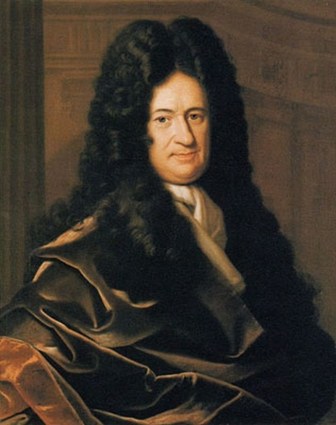
You know, in case you forgot.
YES VIRGINIA, THERE IS A SANTA CLAUS
HOLY FREAKING CRAP, MY WISH HAS BEEN GRANTED BY A WONDERFUL SOUL ON ETSY.
I’m buying this for myself for Christmas because LEIBNIZ DOLL.
I am FLIPPING OUT SLKFJALGHARLIFHASLFHASDLKFHADLFJ
[throws credit card at monitor]
Today is a Blah Factory
Today is the 297th anniversary of Leibniz’ death.
Fittingly, I have had a crap day and don’t feel much like talking.
Sorry.
OH GOODNESS
I AM SO HAPPY
YOU DON’T EVEN KNOW
Edit: AAAAAAAAA SOME OF HIS LETTERS ARE ON THERE! I AM FREAKING OUT WAODIFUALGHALAHGLDGDGHH
Edit 2: BINARY!!!!!
Haha, thanks, Google.
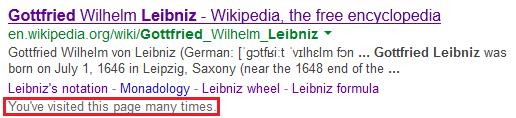
Yes. Yes I have.
No shame.
Anyway, completely changing topics…
I mention Achievement Hunter quite a bit on here. There are a few reasons for this.
- Listening to them game is like living in the house with the guys again. It’s hilarious.
- This sounds super dorky, but they kept me company over the summer. I didn’t have any friends around and they put out YouTube videos at least 5 times a week, so…that was that.
- They’re one of the funniest YouTube channels out there, in my opinion. Grown men cussing each other out playing video games is fantastic.
Since starting doing Let’s Plays of Minecraft back in 2012, they’ve done 65 half-hour (or longer) episodes, many featuring the Tower of Pimps.
Well check out the latest Minecraft update:
Pretty cool! Congrats, guys. And seriously, check them out (if excessive cursing doesn’t bother you, haha).
This One is Tumblr’s Fault, I Swear
Someone I follow posted this awesome link to Newton’s notebooks stored in the Cambridge Digital Library (link link link!).
Now that I’ve got access to both Newton’s notes and Leibniz’ notes (thanks to checking out Dr. Wolfram’s awesome post on Leibniz’ archives), you can probably guess how freaking excited I am.
So. Graphology in itself is pretty much pseudoscience, but it’s still interesting to compare the writing styles of these two geniuses, just to see if any similarities/differences stand out. That’s allowed, right? (Screw it, I’m doing it anyway.)
A lot of Newton’s notes were written in English ‘cause…duh…he was an Englishman. From what I’ve read about Leibniz, I think he could read and write in English but not nearly as fluently as in several other languages; most of his work was in Latin, the rest in French and German. So I couldn’t find a good English excerpt from both. So let’s do Latin, just for the sake of keeping the language consistent.
Here’s a Newton page:

Look at his writing, it’s so neat! I’m no handwriting analyst or anything like that, but it looks like this section of Newton’s notes was written slowly and deliberately as if he’s just sitting there going, “yeah, I got this.” There are a few things crossed out, of course, but it looks like he took the time to carefully scratch them out and then just kept going. Slow but steady. And his numbers are so clear, too, holy crap.
The above is just a screenshot of a semi-magnified page; on the actual Cambridge site you can zoom in further and make out the English notes he made in the margin. If you look at a lot of other pages in this section of notes, Newton really seems to keep things very organized, even if it looks like he’s making scratch calculations in some parts.
And then there’s Leibniz:
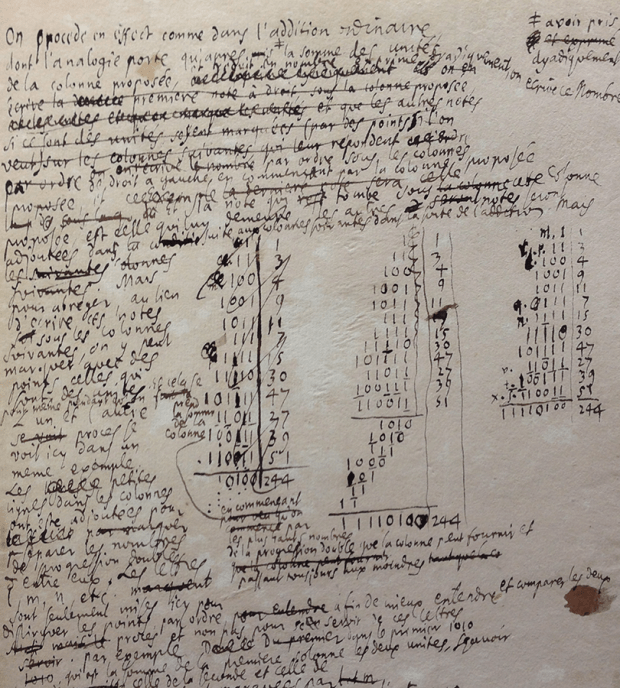
I was planning to do both samples in Latin like I just said above, but I’m snatching pictures of Leibniz’ notes from Dr. Wolfram’s post on him so there aren’t nearly as many choices as with Newton. So I figured a more appropriate comparison would be pages written by both men that contained both words and numbers. I believe Leibniz’ page is written in French, but I seriously can only make out like three words here.
I’m not sure if it’s just because of different writing tools or different ink/paper, but Leibniz looks like he pressed fairly hard (or at least as hard as you could with a quill). Also, in contrast to Newton, it looks to me like Leibniz wrote pretty rapidly. Newton’s corrections were either neat single cross-outs or carefully scribbled out so the mistake couldn’t be read. All of Leibniz’ corrections look like, “no time for error must keep writing!” *scratchscratchscratch* “ONWARD!” Even his numbers look rushed (look, it’s binary!). It almost looks like he used this page for just those calculations but then wrote around them, continuing from a previous page.
On some of the other pages Leibniz really manages to get a lot on a single page. We’re talking ITTY BITTY scrawl, a consequence of his becoming very near-sided in his 20s and it only getting worse as he got older. I’m actually not sure how good (or bad) Newton’s vision was. Of course he did stick a darning needle back behind his eye and wiggled it around (optics experiment), so…
Anyway. Just an interesting thing to see the differences/similarities in their styles.
Holy Crapples
Oh my god.
There’s an article on Leibniz on Uncyclopedia.
The whole thing is a Leibniz/Newton slashfest.
- “He was born with extremely long and poofy hair, which he wore to bed every night and named ‘Poof.'”
- “The mathematician Isaac Newton fell in love with Leibniz when he discovered this divine hair, nicknaming him ‘Gotthair.'”
- “He enjoyed sex, tapdancing, walking his headdress, keeping frogs in his pocket, drinking, and keeping frogs in his headdress.”
- “Newton fell desperately in love with Leibniz, and ferociously stalked him. Leibniz, however, was not interested in Newton’s inferior and less poofy hair.”
- “Leibniz’s troubles of giving us this divine truth was due to the threat of Netwon’s sex drive. Leibniz was never able to sit down long enough to write more than a couple of pages before Newton found him again.”
- “Leibniz and Poof relentlessly attempted to avoid Newton’s calculus seduction, which began the series of violent battles known as the Calculus Wars.”
- “It has been theorized that Leibniz’s unique ability to rise from the dead is attributable to Poof’s power level being over 9,000!”
I AM LAUGHING SO HARD.
Last Leibniz-Centric blog for a while, I promise (maybe)
Gottfried Wilhelm Leibniz.
This man.
THIS MAN.
Let me tell you about this sexy, badass, wig-adorned genius, shall I?
I just finished Antognazzi’s amazingly thorough biography of him. As I mentioned, I had gotten to when he was 40 years old in the bio by the time I raved about him a few days ago, and so I still had about 30 more years to cover in the latter half of the book.
And let me tell you something: as fascinating as the first 40 years of his life appeared to be, the last 30 were even more amazing.
Here’s the run-down of awesomeness, presented in bullet form so that I can keep track of stuff.
- Leibniz was a very social man. He loved being with people, talking to them about everything and exchanging ideas and thoughts. According to the people in charge of archiving Leibniz’ work/letters/papers, he corresponded with no fewer than 1,100 individuals. That’s insane. And this wasn’t like “Facebook friends approve them and then never speak to them again” correspondence. This was “all his free time was consumed by writing letters to these other people” correspondence. Even when he was older and had bad gout, an injured leg, and was extremely near-sighted, he was still hell bent on getting out of Hanover to visit people. Probably the saddest aspect of this incredibly social demeanor, though, was the fact that he outlived the vast majority of people with whom he corresponded, including many of his closest friends. How sad must it have been for him to slowly lose these people over the course of like a decade (a LOT of them died in the 1690s; Leibniz lived until 1716).
- He. Did. Everything. Far from the “I’ll lock myself in this room and just think for all eternity” picture that I think we tend to have of philosophers, Leibniz was always just out doing stuff. Hell, he personally supervised some of his proposed improvements on the Harz mines (he had some ideas to keep them from flooding) and was constantly trying to start up scientific societies and journals across Germany. Though he appeared to consistently run into bad luck with these schemes throughout his life (money was always tight for him and it seemed like every time he got a project going there’d be one thing that’d go wrong and cause everything to fall apart), he never let go of many of his main projects aimed at improving the world.
- For all his running around in mainland Europe, he was not one to shirk (at least entirely) the duties set forth to him by his various employers. Example: his main employer in his later years, Georg Ludwig, put him in charge of writing a complete history of the House of Guelph (a dynasty of German and English monarchs). This was supposed to take like 10 years max but, Leibniz being Leibniz, he kept the task in the back of his mind as he traveled about and slowly began to amass a huge amount of information he deemed relevant to the history. Ludwig was always asking him, “Hey man, how’s that history comin’?” and Leibniz always managed to say, truthfully, that he was still researching, all the while sneakily making his way around the continent to do the other Leibniz things that he really wanted to focus on. However, as time went on and Leibniz continued to travel much to the dismay of his employer, tension rose between the two and Ludwig became more and more upset with him. I particularly enjoyed this little quote of frustration: “at the very least he [Leibniz] should tell me where he is going when he takes off. I never know where to find him.” By the time Ludwig was finally like, “Gottfried, dude, just sit your butt down and write this thing or I’m suspending your salary!” the amount of material Leibniz had gathered was so extensive that the history actually was left unfinished by the time he died. And that’s even with him spending the last 5 years or so of his life sequestered in his study (he was pretty much forbidden to travel by that point), frantically trying to get it done so that he could pursue more important tasks.
- I mentioned this before but it bears mentioning again, because it’s one of the main reasons I like Leibniz so much: it seems like he was a good guy. The idea a lot of people seem to have about European White Guys, especially of that era, is probably something along the lines of, “each one thought they themselves were correct in their thoughts, ideas, and philosophies, and all other cultures/genders/backgrounds/European White Guys were unquestionably wrong!” Leibniz communicated with men, women, uneducated people, very learned people, people from many different countries…and from what it sounds like, he was just very open to the possibility of views different than his own. He seemed to take it all in and use it—regardless of who/where it came from—to further refine what he himself believed or knew. He was also a major Sinophile, in part because of his interest in creating a “universal alphabet” and the parallels he saw between that and Chinese symbols/writing.
- Even when people disagreed with him he seemed to retain a polite congeniality in correspondence with the disagreeing party(ies). The one exception to this appears to be the final years (at least for him) of the calculus dispute. But by then he was really just like, “gettin’ real tired of your shit, Keill,” which honestly was quite a valid reaction by that point in time. (Side note: I really like how this biography talks about the calculus dispute but doesn’t make it the focus of Leibniz’ last few years of life. It really emphasizes that even though he was at war with freaking Isaac Newton and his cronies, he was still trying to bring his other more important projects to fruition).
Just…nnnf. I love this guy.
Man, I was going to restart my fiction list today with 20,000 Leagues Under the Sea, but I don’t think I can read anything else for a few days. I’m like in mourning now that I’ve finished this book. I seriously recommend reading it, even if you’re not a hardcore Leibniz fangirl/fanguy/whatev.
Fifty Shades of Eigengrau
Why does my butt hurt? I walked the 20-mile round trip to Pullman, I didn’t butt-glide it.
Anyway.
So out of curiosity (and because I’ve got an INFLUX OF FREE TIME that I’m failing to use constructively), I went back and made a list of every Leibniz reference I’ve made on here since February 19, 2008 (the day we covered him in Modern Philosophy).
Because that’s the type of thing I do.
Results:
- 26 blogs dedicated solely to him.
- 20 pages’ worth of Leibniz references, not counting the material from the 26 Leibniz-only blogs.
Holy crap, I am obsessed.
Am I sorry?
NOPE.
I also REALLY miss calculus class. Time to MIT it up!
Happy Birthday, Leibniz, You Magnificent Human Being
OH YOU KNEW IT WAS COMING.
LEIBNIZ DAY!
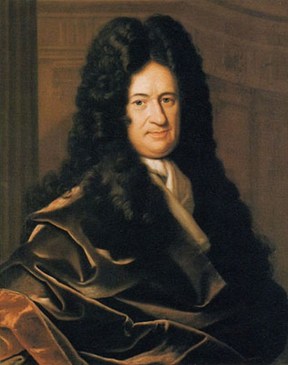
367 years ago today, the coolest polymath to ever exist was born.
I was hoping to be through Antognazza’s biography of him by today so I could extoll every inch of his beautiful mind that is covered in the 664-page bio, but alas, calc III happened (not that I’m complaining) and so my reading time was severely hindered. So I’m about halfway through as of writing this blog (I think he’s in his 40s at this point in the bio).
And with each page I’m like, “holy monads, Batman, it is not possible to like this man any more than I already do.”
And then I read the next page and I like him even more.
It’s hard for me to express exactly why I like Leibniz so much. As I mentioned in a past blog, as soon as I started reading his work and reading about him in general I felt this weird connection with him. Like we were supposed to know each other but the universe was like “NOPE!” and threw us into the mix a couple centuries apart.
(Don’t judge me, I’m really trying to not sound creepy. Am I failing miserably?)
And as I’ve mentioned in other blogs, it really seems like he was just a good guy. He wasn’t a buttface to those who disagreed with his philosophy or ideas about the natural world. He was accused like five separate times of stealing others’ ideas (which he never did) but never totally flipped out and started smothering people with his wig. According to the reports of his contemporaries, he was very kind, congenial, and graceful in social settings. The ladies seemed to dig him (SMART LADIES!). AND he was about as naturally intellectually curious as a person could be.
Seriously. A year after his father’s death when Leibniz was six, he inherited his library and immediately worked to teach himself Greek and Latin so that he could read the works of the ancient philosophers (his father taught moral philosophy at the University of Leipzig). He received his law degree when he was like 19 and for his doctoral dissertation he wrote some work on permutations/combinations that was fairly groundbreaking. And this was before he even started to seriously get into the field of mathematics.
Yup, the guy who invented calculus didn’t really start into math until his twenties. He was interested in law and philosophy originally, but as he continued to refine his ideas he began to move into math. As he began his travels around Europe after finishing his education, it became clear to him that his mathematical knowledge was lacking. So he was like, “oh crap, better catch up!” and pretty much taught himself everything without anyone’s help
Actually, when I was reading about his early life in the bio, it was this fact that he was so self-taught that was really the cause behind most of the accusations of plagiarism he faced. He didn’t start out in math, as I said, so he had to catch himself up. Along the way, he started making advancements and discoveries that, to him, were new and unique, and thus he eagerly published them. But unbeknownst to him, several of these major discoveries were things that had actually been discovered and published not too long before. So some people (*cough*Hooke*cough*) were like “hey, you totally got that from [insert mathematician here]! THIEF!” even though he had come up with it on his own.
Really. That happened to him like three times even before the whole calculus thing.
And did you know he was the one who came up with what is today known as Cramer’s Rule? Truth! But like a lot of the stuff he developed, it was so advanced for his time that it just kind of sat in his notes and wasn’t used for a long time.
(Like his binary!)
But I think the one thing that I really, really like about him is the fact that he was always looking for connections between everything. He was convinced that even the most isolated bits of the universe and of human knowledge were connected to everything else and that a system could be developed with which we could express these connections and better understand them. In everything he did, he always seemed to be driving towards defining this system and better describing the connectivity of the universe.
And that’s just cool.
NNNNNNNNNNNNF I JUST LOVE HIM, OKAY?
(I live in a fantasy world where Leibniz and I are married and he does calculus and I do statistics and we do each other and life is perfect.)
Um…anyway.
Expect another Leibniz-heavy blog when I finish the whole bio, ‘cause it’s going to happen whether you like it or not.
Until next year!
Happy birthday, Gottfried! <3
OH CRAP SORRY PASCAL
So I hadn’t checked my little mathematician birthdays database in awhile and decided to check it yesterday. It turns out I missed Pascal’s birthday by a day. He was going to get my blog yesterday but I was distracted by freaking out about my final. I’m still freaking out about my final, but I have nothing else to blog about related to it. So Pascal shall get my blog today instead!
Though he only lived the 39 years between 1623 and 1662, Blaise Pascal was an incredibly accomplished mathematician and inventor. He was educated by his father and was still in his teens when he began to explore advanced topics on his own.
He was interested in math (particularly geometry) early on; when he was 16 he wrote an essay on conic sections that was so advanced that Descartes read it and thought that Pascal’s father had actually written it for him.
Little Pascal was also very interested in the idea of a mechanical calculator, and he was strongly motivated to produce the first working prototype of what was called the “Pascaline” in 1642 to help ease his father’s work as tax commissioner for the king of France. The calculator could do addition and subtraction* and was a great help to his father, but because of its cost it failed to be a commercial success.
Probably Pascal’s most famous contribution to mathematics is Pascal’s Triangle and the closely-related Pascal’s rule which states how the triangle is to be constructed. The triangle displays the binomial coefficients resulting from the binomial theorem along with other really cool properties (might have to do a blog just on his triangle here in a bit…). The development of this triangle led to conversations with Fermat, and the two collaborated together to develop probability theory.
In addition to his contributions to math, Pascal also gave the world the hydraulic press, the syringe, and did a whole ton of experiments with vacuums and hydrodynamics (he’s got the SI unit of pressure named after him as well, though that obviously happened much later). Some of his most famous demonstrations of the effect of elevation on atmospheric pressure involved carrying barometers to the tops of churches to see what happened to the mercury levels.
Cool dude, huh? See? 17th-century Europe!!
BLOG COMPLETE!
*The Pascaline was what Leibniz was trying to improve on with his Step Reckoner by including also the functions of multiplication and division.**
**Yes, I have to mention him in every post.
Claudia’s Alternate History Party
GUYSGUYSGUYSGUYSGUYS I’m hyper.
You know what I would love to do (even though it would screw history and the rest of existence up because that’s how these things work)? I would love to take a graphing calculator and a calculus textbook, go back in time, and show them to Leibniz.
“Look!” I’d say. “See this little itty bitty machine? Look at all this nonsense it can do! Not only can I add, subtract, multiply, and divide in a fraction of a second, I can also find square roots, sines, cosines, and tangents, and GRAPH FUNCTIONS! This is your Step Reckoner on steroids. YOU helped pioneer this! EVERYBODY uses these now.
“And look at this textbook. This is what we use to teach calculus to people today. Let me show you some of these symbols. See what we’re using? dy/dx! And the elongated S! We’re still using YOUR symbols because they remain the clearest, easiest, most adaptable ones for this branch of math. AND THIS COMING FROM THE FAR-OFF YEAR OF 2013!!”
Ignoring the whole “somebody just time-traveled!” aspect, I think the calculator would really be the thing that would blow his mind. I mean, the Step Reckoner was massive and it just did the four basic operations. Plus, you know, the fact that the calculator now has this crazy-ass digital display thing. I’d totally help him take it apart and do the best I could explaining what the components were.
Of course I’d probably end up having to lean in reeeeeeeally close to him to do that.
Y’know.
OH DEAR LORD
ASDFLKADFAGLADKFADSDFSGG I NEED TO GO TO HANOVER LIKE NOW
Like, I knew a lot of Leibniz’ work was archived, but I didn’t know there was so much.
(If you could’ve seen me reading this article, I was like a 12-year-old Belieber flipping out right in front of Justin on stage).
Look at this beautiful man’s beautiful handwriting. LOOK AT IT.
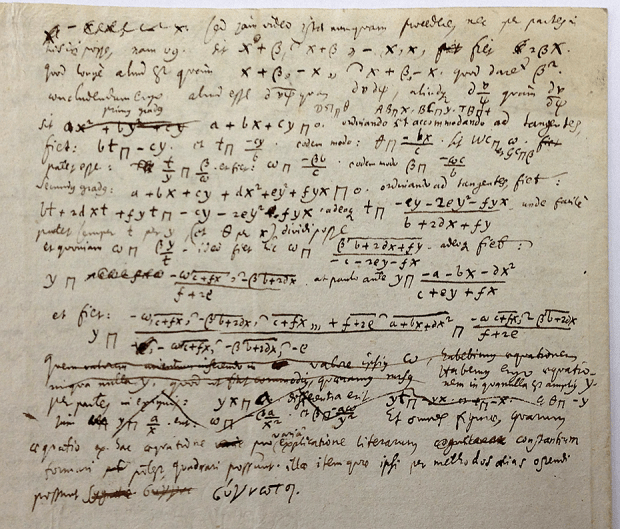
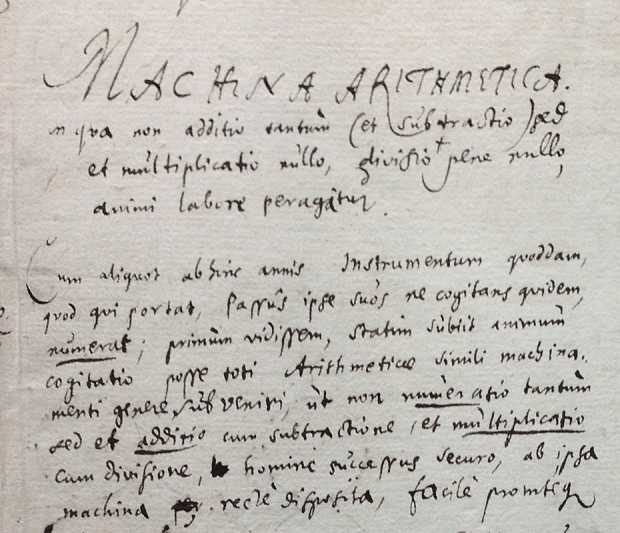
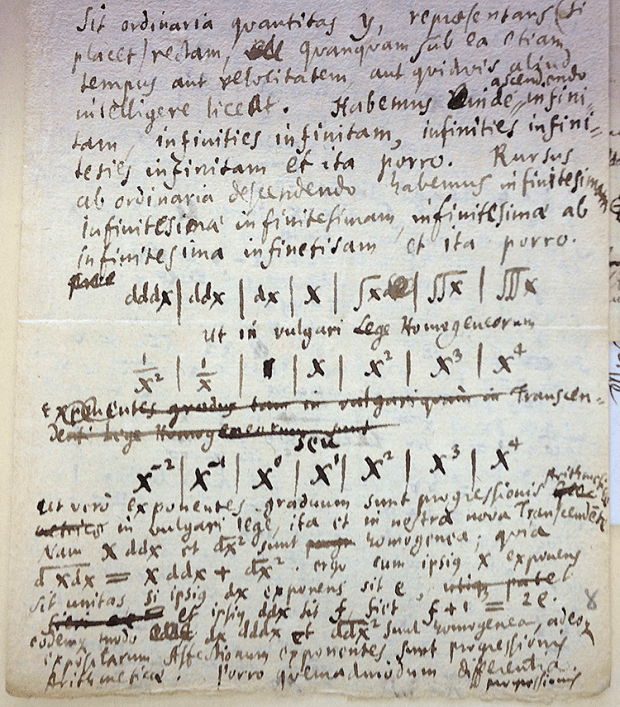
INTEGRAL SYMBOLS IN THEIR NATURAL HABITAT *flailing*
I just…I need to go there.
*all pictures from Stephen Wolfram’s blog, linked above*
LEIBNIZ.
Have I mentioned lately how much I love this man?
(Yes you have, Claudia. Shut up.)
(NEVER!)
The more I read about him the more I like him. And I’ve read a lot about him, so I like him a lot.
I mean, not only was he a freaking genius with the wig of a god, but he had to deal twice—twice—with being publically accused of stealing the idea of calculus from Newton. First from Fatio, who Newton actually quelled when Leibniz wrote him and said, “hey man, this dude’s saying false things about me!”
And did Leibniz set out to ruin Fatio the way Fatio was wanting to ruin him?
Nope!
He was like, “I won’t stoop to that level. I’ve got more important things to do with my time.”
And then there was Keill. And Keill was out for blood, man. He publically and without reservation bellowed claims of plagiarism to all who would listen.
And once the accusations actually reached Leibniz I’m sure he was like, “ugh, not this again.” But even after all that insanity, Leibniz did very little to Keill. He still tried to maintain his “I’m above all this nonsense” even after Newton’s Commercium Epistolecum was published, totally slandering his name.
He just seems like he was a good guy. That makes me happy.
Now back to obsessively stalking dead people!
Flu shots are BOGUS, I have the immune system of Zeus!
(A “Claudia is hyper” blog follows. You’ve been warned.)
Can you blister your eardrums with hot, hot tunes?
‘CAUSE I THINK I JUST DID!
(That chord at 2:32 makes me super happy. Also, we’re playing this in Concert Band)
I will not be able to hear by the time I’m 30.
[Insert me not giving a crap and cranking the volume higher]
Also, I got all my Amazon stuff at once.

GRE material, Leibniz-related shenanigans, and Metalocalypse.
Yup, sounds about right.
Edit: oh my god, these season 4 extras are great. “It’s a nice night for flying around in a cuuuuuube!”

 Eigenblogger