The best things in life are pee. NO WAIT
Lists like this are dumb. Hell, I’m guilty of like 80% of these. Let’s rant.
1. Dressing for the weather.
When it’s -14 outside, I wear what’s practically a windbreaker and those tiny little thin gloves. Everyone else I see, including the dudes (SHOCKING!) are wearing appropriate clothing. So yeah.
2. Taking up the appropriate amount of space.
At least the author didn’t use the word “manspreading.” I like how manspreading gets all this hype about it, but nothing is said about the women who go on public transit with 3+ shopping/grocery bags and then just dump said bags into the seat next to them. How is that any better than a dude splaying his legs? I do the leg splay thing too, anyway, if I’m on the bus after a long walk. Only if it’s not crowded, though.
3.Taking care of themselves when they’re sick.
Nobody is good at taking care of themselves when they’re sick. Nobody. That’s why it sucks so hard. Story time: back in 2014 I got sick with what I’m assuming was some sort of Black Plague variant, ‘cause it completely knocked me for a loop (for those of you who don’t know: I very, very rarely get sick, but when I do, I feel like complete death). This was before I knew Nate, so I was basically on my own in my little basement apartment, trying not to die. I NEEDED medicine ‘cause my fever was approaching 104 and I was having trouble breathing because of the blood that was filling my lungs (exaggerating…or AM I?!), but the closest anything that sold anything of the sort was the Safeway a mile away. Let me tell you, man, I could BARELY make it to that Safeway. I thought my insides were going to catch fire, they hurt so bad. I almost had to ask some random person in Safeway if they would please drive me home, ‘cause I didn’t think I would make it the mile back. I did, I took meds, and was eventually fine, but seriously. Taking care of yourself when you’re sick is awful and no one is good at it.
4. Packing for trips.
Every guy I’ve ever known has been better than me at packing for trips. I take like 7 hours to get what I need ready and organized and packed. My guy friends grab their crap, chuck it into suitcases/backpacks, and are ready to go in like half an hour. And they never seem to forget anything, either.
5. Speaking at a volume that suits their current space.
You mean kids, not adult guys, right? Kids never speak at the appropriate volume. Adult guys do. F-.
6. Doing laundry in a way that doesn’t ruin at least one clothing item.
HAHA I GET IT IT’S A “WOMAN’S CHORE” SO GUYS SUCK AT IT AM I RIGHT?? Even if this were true for a dude (or a lady), I would suspect the growing pile of ruined clothes would prompt him (or her) to figure out how to freaking do laundry correctly.
7. Deciding when it’s time to get a haircut.
*old man voice* “I haven’t gotten a haircut since Truman was president and I’ll be dead and buried before these young whipper-snappers force me into a barber’s chair!”
8. Drying off after a shower.
THOG BIG MAMMOTH MAN! THOG CANNOT REACH BACK WITH TOWEL! THOG DO MANLY NAKED SPRINT THROUGH TOWN TO DRY OFF INSTEAD!
9. Communicating their feelings effectively.
NOPE NOPE NOPE NOPE NOPE NOPE NOPE
10. Sleeping in a position that doesn’t cause snoring.
Who can freaking control how they sleep once they’re asleep? I certainly can’t. I mean, I can fall asleep curled up on my side, say, but when I wake up I’m sprawled out on my back taking up the whole bed.
11. Waiting for their food to cool before they eat it.
THOG’S MOUTH ON FIRE, BUT THOG SO BAD AT COMMUNICATING HIS FEELINGS, HE CANNOT EXPRESS HIS DISTRESS AND PAIN!
12. Leaving the toilet seat up.
Really? Really?
13. Wearing matching socks.
Is this a serious issue for…anyone? I don’t think I’ve ever seen anyone wearing non-matching socks, unless it was deliberate. And even if a person does wear mismatched socks, who freaking cares?
14. Wearing properly fitting pants.
OH GOD, NOT IMPROPERLY FITTING PANTS!! Have you seen the ill-fitting pants that women wear? Have you? Have you seen MY pants? Not a single freaking one of them fits me “properly.” I think dudes are better at finding decent-fitting pants than the ladies are, honestly.
15. Knowing what looks good on their body type.
Wasn’t this covered in #14?
16. Being patient with someone who’s getting ready.
My dad is not patient with others getting ready. But does that generalize to all dudes? Nope! Not unless you do the same with one of my female friends, who can’t stand waiting for others.
17. Mansplaining.
I hate this word and I hate your face.
18. Zoning out when anything sports related is happening in the vicinity.
Goddamn home-wrecking sportsball, man. Does the zoning out include them zoning out on the sports as well? Like, if they suddenly flip to a football game on TV, do they just go into a fugue? That would actually be kind of hilarious. “THE PACKERS GAME IS ON THE RADIO; TURN IT OFF OR ELSE GARY’S GONNA DRIVE US INTO THE GRAND CANYON!”
19. Closing the shower curtain after a shower.
What? This is a thing that needs to be done? Shoot, I don’t do this either.
20. Empathizing about periods/childbirth.
I think they do the best they can, considering most guys never experience these things. It’s hard to empathize with something you can’t experience. When my mom is gagging from the smell of a skunk, for example, I can’t really empathize with that. I have no idea what that’s like, and I never will. So yeah.
21. Knowing when to stop talking.
Apparently the author of this article has the same problem!
Book Review: The Chosen (Potok)
Let’s review The Chosen today, shall we?
Have I read this before: I have, but I can’t remember when, exactly. High school, maybe?
Review: This is such a good book. Such an impactful book. I remembered a lot of this book from the first time I’d read it, and that’s saying something, especially considering I read it so long ago that I can’t actually remember when that was. I remember that the ending made me cry last time; it didn’t this time, but it was a very satisfying, complete ending, if that makes any sense. I don’t want to give away too much about this book, but if you’re looking for something thought-provoking that is super well-written and will stick in your brain for a while, read The Chosen.
Favorite part: This quote from Reuven’s father:
“Human beings do not live forever, Reuven. We live less than the time it takes to blink an eye, if we measure our lives against eternity. So it may be asked what value is there to a human life. There is so much pain in the world. What does it mean to have to suffer so much if our lives are nothing more than the blink of an eye? … I learned a long time ago, Reuven, that a blink of an eye in itself is nothing. But the eye that blinks, that is something. A span of life is nothing. But the man who lives that span, he is something. He can fill that tiny span with meaning, so its quality is immeasurable though its quantity may be insignificant.”
Rating: 7.5/10
Ten
So 2016 is just all about the milestones. Today, for example, marks exactly 10 years since I graduated high school. I’m not going to do a “here’s all the stuff that’s happened in the past decade” ‘cause I already did that for my decade blog anniversary (see this post), but it’s still a big deal in my opinion.
Ten years is a long time. A lot has changed, and most of it in ways I would have never expected. I certainly could have never predicted that at 28 I’d be living in Calgary, working on my second graduate degree, and engaged to be married.
I also wonder, every once and awhile, how all of these dorks are doing. I never talk to anyone from high school anymore.
Is your life something you would have never expected 10 years ago?
Week 23: The Wilcoxon Matched-Pairs Signed-Ranks Test
Yo! Today we’re going to talk about another nonparametric test: the Wilcoxon matched-pairs signed-ranks test!
When Would You Use It?
The Wilcoxon matched-pairs signed-ranks test is a nonparametric test used to determine if two dependent samples represent two different populations.
What Type of Data?
The Wilcoxon matched-pairs signed-ranks test requires ordinal data.
Test Assumptions
- The sample of subjects has been randomly selected from the population it represents.
- The original scores obtained for the subjects in the study are interval or ratio data.
- The distribution of the difference of the scores in the populations represented by the samples is symmetric about the median population difference score.
Test Process
Step 1: Formulate the null and alternative hypotheses. The null hypothesis states that in the two populations represented by the two samples, the median difference score between the two populations is zero. The alternative hypothesis claims otherwise (that the population median difference is greater than, less than, or simply not equal to zero).
Step 2: Compute the test statistic. The test statistic here is called the Wilcoxon T test statistic. Since the calculation is best demonstrated with data, please see the example shown below to see how this is done.
Step 3: Obtain the critical value. Unlike most of the tests we’ve done so far, you don’t get a precise p-value when computing the results here. Rather, you calculate your T test statistic value and then compare it to a specific value. This is done using a table (such as the one here). Find the number at the intersection of your sample size and the specified α-level. Compare this value with your T value.
Step 4: Determine the conclusion. If the calculated T value is larger than the table value, fail to reject the null hypothesis (that is, retain the claim that the samples do not represent different populations). If the calculated T value is equal to or smaller than the table value, reject the null hypothesis in favor of the alternative.
Example
The example for today’s test comes from one of the STAT 213 lab sections I taught last semester. I wanted to see if the students’ ranks in relation to their lab peers changed between midterm 1 and midterm 2. Set α = 0.05. The data is summarized in the following table, and an explanation of the columns can be found below.
H0: θD = 0
Ha: θD ≠ 0

Column 1 is the student ID.
Column 2 is the student’s ranks on midterm 1, with “1” corresponding to the student with the highest grade and “23” corresponding to the student with the lowest grade.
Column 3 is the student’s ranks on midterm 2, with “1” corresponding to the student with the highest grade and “23” corresponding to the student with the lowest grade.
Column 4 is the differences between the rank on midterm 1 and the rank on midterm 2.
Column 5 is the absolute values of Column 4.
Column 6 is the ranks of the values in Column 5. If a Column 5 value is zero, it is not ranked. If there are multiple identical values in Column 5, the average of their ranks is assigned to each of those values for Column 6.
Column 7 is the signed ranks of the values in Column 5. It is the same as Column 6, except if a value was negative in Column 4, its rank becomes negative in Column 7.
To obtain the Wilcoxon T test statistic, find the sum of the positive signed ranks and the sum of the negative signed ranks (all in Column 7). The absolute value of the smaller of these sums is the Wilcoxon T. Here,
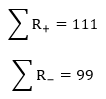
So T = 99. The table value for a two-tailed test with n = 23 and α = 0.05 is 73. Since our calculated T is larger than the critical value, we fail to reject the null hypothesis and claim that the median difference in rank in the population is not different between midterm 1 and midterm 2.
Example in R
No R example this week, as this is probably easier to do by hand.
Text2Personality
So I found an interesting thingy. From the website: “This service applies linguistic analytics and personality theory to infer attributes from a person’s unstructured text.” Basically, you can use someone’s Twitter account (with or without replies) or a body of text and see what’s what with their personality.
Let’s give it a shot!
My Twitter* sez:
“You are a bit critical, skeptical and can be perceived as indirect.
You are self-focused: you are more concerned with taking care of yourself than taking time for others. You are reserved: you are a private person and don’t let many people in. And you are self-conscious: you are sensitive about what others might be thinking about you.
Your choices are driven by a desire for prestige.
You consider independence to guide a large part of what you do: you like to set your own goals to decide how to best achieve them. You are relatively unconcerned with tradition: you care more about making your own path than following what others have done.”
Eh, I suppose. Traits:
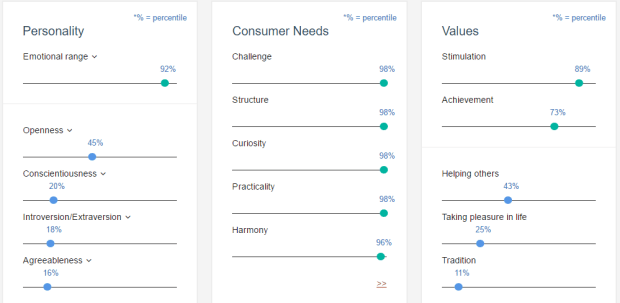
And here’s the results from entering the text of that Vancouver thing I wrote. It’s probably the longest “personal” thing I’ve written in a long time:
“You are inner-directed, shrewd and strict.
You are independent: you have a strong desire to have time to yourself. You are empathetic: you feel what others feel and are compassionate towards them. And you are calm-seeking: you prefer activities that are quiet, calm, and safe.
You are motivated to seek out experiences that provide a strong feeling of well-being.
You are relatively unconcerned with both tradition and achieving success. You care more about making your own path than following what others have done. And you make decisions with little regard for how they show off your talents.”
Traits:

Twitter’s more accurate, I think, but that’s probably because my nonsense tweets have zero filter and are basically me just rambling about garbage.
*Yes, I still hate the fact I have a Twitter and, on occasion, tweet. Feel free to hate me.
Yesssssssss
It’s going to be really hard not to fill my Top 50 playlist with these amazing remixes I keep finding this year.
Not saying that this is 5-star material, but if it’s not, it’s really damn close.
I won another another thing
Hello, faithful readers!
So I just checked my mailbox at school and I found in it a letter from the dean of the Faculty of Science. Turns out, I won the Fred A. McKinnon Award for being “the best Graduate Student TA in the Department of Mathematics and Statistics.”
I get to go to the Faculty of Science awards of excellence reception on the 15th, which is pretty freaking cool.
Now if I can only get a teaching job…
RiverRun
Today was perfect weather for being outside—not too hot, not too cold, and overcast—so I decided to go for a run down by the river for the first time.
It was pretty awesome.
The 5k mark from where our street meets the river path is pretty distinctive, so running to that point and back gives for a nice 10k. And it’s a lot nicer running along a path made for walkers/runners than having to run along a sidewalk and get interrupted by stop signs, stop lights, and cars every block or two, like I had to do in Vancouver.
Yay running!
I’m a champ.
I haven’t had much of an appetite for the past week or so, but I just inhaled like an entire box of cereal tonight because doing so felt like the best thing in the world.
Now I feel like garbage ‘cause I ate an entire box of cereal.
Dafuq, body. Dafuq.
Week 22: The t Test for Two Dependent Samples
Today we’re going to talk about our first test involving dependent samples: the t test for two dependent samples!
When Would You Use It?
The t test for two dependent samples is a parametric test used to determine if two dependent samples represent two populations with different mean values.
What Type of Data?
The t test for two dependent samples requires interval or ratio data.
Test Assumptions
- If each sample contains the same subjects (e.g., a setup that involves testing subjects at time A and then again at time B), order effects must be controlled for.
- If a matched subjects design is employed, within each pair of matched subjects, the two subjects must be randomly assigned to one of the two experimental conditions.
Test Process
Step 1: Formulate the null and alternative hypotheses. The null hypothesis claims that the two sample means are equal. The alternative hypothesis claims otherwise (one population mean is greater than the other, less than the other, or that the means are simply not equal).
Step 2: Compute the t-score. The t-score is computed as follows:

Step 3: Obtain the p-value associated with the calculated t-score. The p-value indicates the probability of a difference in the two sample means that is equal to or more extreme than the observed difference between the sample means, under the assumption that the null hypothesis is true.
Step 4: Determine the conclusion. If the p-value is larger than the prespecified α-level, fail to reject the null hypothesis (that is, retain the claim that the population means are equal). If the p-value is smaller than the prespecified α-level, reject the null hypothesis in favor of the alternative.
Example
For the data for this example, I decided to compare the age at which the internet thought I would die in 2011 to the age at which the internet thinks I would die in 2016. That is, I took 8 different online “death tests” in 2011, then re-took them this evening. The data are in the following table:

I wanted to see if there was a significant difference in the average “age of death” between 2011 and 2016, based on what information I gave these tests. Here, n = 8. Set α = 0.05.
H0: µ2011 = µ2016 (or µ2011 – µ2016 = 0)
Ha: µ2011 ≠ µ2016 (or µ2011 – µ2016 ≠ 0)
Computations:
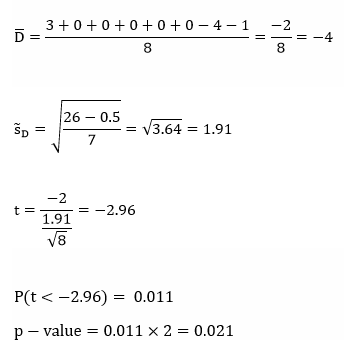
Since our p-value is smaller than our alpha-level, we reject H0 and claim that the population means are significantly different (with evidence in favor of the mean being higher in 2011).
Example in R
dat=read.table('clipboard',header=T) #"dat" is the name of the imported raw data

diffs = y2011 - y2016

n=length(diffs)

D = sum(diffs)

sdev = sd(diffs)

t = D/(sdev/sqrt(n))        #t score

pval = pt(t, n-1)*2         #p-value

                               #pt calculates the left-hand area

                               #multiply by two because it is a two-sided test
(Here’s a list of the tests, by the way.)
Smart?
Aw hell, guys, I got a smart phone!
Well, Nate got it for me ‘cause he’s TOO NICE, but now I’m not stuck with my old slide phone thingy. The new phone is not an iPhone, but a Samsung Galaxy S6. There are no iPhones with the plan that works best up here for me (unlimited US texting so I can talk to my mom, plus unlimited data). But this phone is pretty awesome! I tried taking a picture of it so that you could see the pretty dark blue color of it, but I couldn’t get it to show up very well. So here’s a picture (from here) of a phone where you can see the color.

Now I have CONSTANT INTERNET ACCESS.
I may die.
Edit: Customized it so that it’s super ostentatious.


Book Review: A Handmaid’s Tale (Atwood)
Are you ready for some MARGARET ATWOOD!?!?!?
(You should be.)
Specifically, let’s review A Handmaid’s Tale.
Have I read this before: Indeed. I think I read this in the summer between high school and college. I’m too lazy to check my blog archive. HOW’S THAT FOR OVERACHIEVING?
Review: This book? It’s great…until the ending. I don’t know if it’s just me or if this is something that other people have thought about this book, but I was totally gung-ho and loving everything up until—quite literally—the last two pages. And that was the case both the first time I read it and this last time. I was thinking, during this last read, that my dislike for the ending might just have been because I was 18 and stupid and didn’t appreciate the way the story was finished. BUT NOPE! I got to those last two pages, everything ended, and I was like, “oh. Right. This.” Seriously. The whole book, save those last two pages, is fantastic. But maybe that’s just how I see it. Maybe you’d like the whole thing. Give it a read and see.
Favorite part: Anything but the ending.
Rating: 5/10 (because of the ending)
ZztZzt
So my knowledge about where various cities are in Alberta is horrible.
Example: I’m looking on Indeed for stats-related jobs and I see an ad for an instructor at Grande Prairie Regional College. Oh, sweet, I think. I wonder where that is. It sounds like it wouldn’t be all that far up north—

Hell.
Granted, I’m no Captain Geography when it comes to any other province/state/country/continent, but I’ve never really had a reason to study Alberta and the distribution of its population. Plus, it’s a big chunk of earth, so there’s a lot of it to know.
DON’T JUDGE ME!
Past from the Blast
So here’s a video I’d completely forgotten I’d uploaded to YouTube (I found it after logging onto my old AntarcticaFreak account).
This is my mom filming me doing stuff with stencils (??). Also, animals. The kitty is Baby Slick, and the dog is Mindy. This was our house in Troy.
Good times.
The Amateur Hour with Claudia
HAHAHA BLOGGING GUIDELINES ARE FOR AMATEURS
1. Focus Your Content
*throws on fedora and stares hipsterly into the sunset* My focus…is everything.
2. Consistency Is Key
I can say with 100% accuracy that I am consistently horrible at posting these things on a daily basis. Or even on a monthly basis.
Fire me.
3. Traffic Has To Come From Somewhere
I have like three people who consistently read this garbage, and that’s all I need. I mean, I get that some people blog for status/fame/monies, but I don’t. Obviously.
Though I wouldn’t be upset if I got any of those things.
4. Don’t Lie In Your Titles
30% of my titles are puns, 50% of my titles are somewhat coherent non-puns, 10% of my titles are something like “alsdflajdfakdf”, and 10% of my titles accurately reflect the content in the following post. I see no lies here. I win!
5. 6 Figure Incomes, 4 Hour Work Days, and Vacations Don’t Come Easy
Are there any bloggers that have these things solely from blogging?
6. Quality Outweighs Quantity
*Insane laughter*
7. You’re On Your Own
And that’s why these things get mass-posted every three months.
8. Do It For Anything But The Money
I wouldn’t want to get paid for blogging, honestly. Blogging is like my stress relief, ‘cause I have the freedom to post whatever the hell I want. Nobody’s paying me anything for what I say. If they did, I’d probably be way too stressed about posting and would probably never upload things.
Week 21: The z Test for Two Independent Proportions
Hello, all! Today we’re going to talk about a two sample test involving proportions. Specifically, we’re going to talk about the z test for two independent proportions!
When Would You Use It?
The z test for two independent proportions is a nonparametric test used to determine if, in a 2 x 2 contingency table, the underlying populations represented by the samples have equal proportions of observations in one of the two categories of the dependent variable.
What Type of Data?
The z test for two independent proportions requires categorical or nominal data.
Test Assumptions
- The data represent a random sample of independent observations.
Test Process
Step 1: Formulate the null and alternative hypotheses. The data appropriate for this type of test is usually summarized in a 2 x 2 table (see the example below to get a better understanding of this). The null hypothesis claims that for the category of interest of the dependent variable, the proportion of observations from the first category of the independent variable that belong to the category of interest is equal to the proportion of observations from the second category of the independent variable that belong to the category of interest.
Step 2: Compute the test statistic. The test statistic here is a z-score and is computed as follows:

Step 3: Obtain the p-value associated with the calculated z-score. The p-value indicates the probability of observing a difference in proportions as extreme or more extreme than the observed sample difference, under the assumption that the null hypothesis is true.
Step 4: Determine the conclusion. If the p-value is larger than the prespecified α-level, fail to reject the null hypothesis (that is, retain the claim that the proportions are equal in both groups of the independent variable). If the p-value is smaller than the prespecified α-level, reject the null hypothesis in favor of the alternative.
Example
For today’s example, I wanted to see if there was a significant difference in the proportion of gold medals for European countries versus the rest of the world in the 2012 London Summer Olympics. I sampled a total of 55 countries (all countries that won at least one gold medal), then tallied the number of gold medals, the number of non-gold medals, and whether or not the country was in Europe. This data is summarized in the following table:
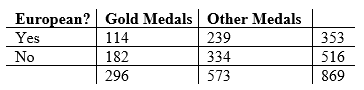
Let’s test the claim that the proportion of gold medals for European and non-European countries is different. Set α = 0.05.
H0: π1 = π2
Ha: π1 ≠ π2
Here, n1 = 353, n2 = 516, p1 = 0.323, and p2 = 0.353. The values of p and z and the resulting p-value are calculated as:
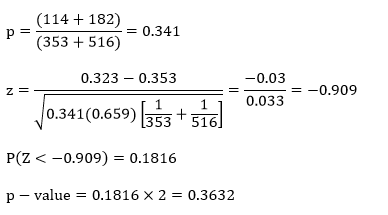
Since our p-value is larger than our alpha-level (0.3632 > 0.05), we fail to reject H0 and claim that the proportions are equal in the population.
Example in R
This example assumes that your data are in columns, with one column containing the number of gold medals per country, one column containing the number of total medals per country, and one coded column telling you whether a country belongs to Europe or not.
dat=read.table('clipboard', header=T) #'dat' is the name of the imported raw data
euro = subset(dat,europe == "y")
non = subset(dat,europe == "n")
a = sum(euro$gold)
b = sum(euro$total) - a
c = sum(non$gold)
d = sum(non$total) - c
n1 = sum(a + b)
n2 = sum(c + d)
goldsum = sum(dat$gold)
othersum = sum(total)
p1= a/n1
p2 = c/n2
p = (a + c)/(n1 + n2)
z = (p1 - p2)/(sqrt((p*(1-p))*((1/n1)+(1/n2))))
pval = (pnorm(z))*2          #p-value
                               #pnorm calculates the left-hand area
                               #multiply by two because it is a two-sided test
Book Review: Animal Farm (Orwell)
It’s Orwell time!
Have I read this before: Yes, but a loooong time ago. Like 8th grade or something. I didn’t really remember it very well.
Review: Really, now that I think about it, re-reading this was basically like reading it for the first time, ‘cause I didn’t remember a damn thing from the first time I read it, apart from the characters all being animals and one of them being named Napoleon. But yeah, it’s a good book. Everything escelated very quickly once the animals got control of the farm, but I guess I’d rather have that in a rather short book than have it drawn out too long in a longer book.
Favorite part: I like the repetition throughout the story. By that, I mean not only the repetition of some of the animals’ phrases/songs, but also the repetition of how the pigs justified their actions, how the “all animals are equal” and the Seven Commandments are slowly altered. Very cool.
Rating: 6/10
Well, at least I’m consistent.
Hey, doods.
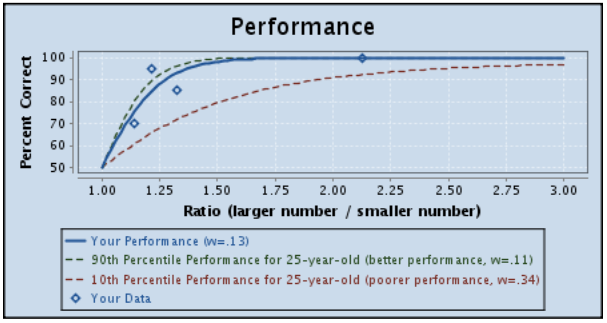
Back in 2012, I took an Approximate Number System aptitude test that I found online.
Then, in 2014, I took it again to see if my score had changed (since I’d done so much more math between 2012 and 2014 than I had prior to 2012). My score didn’t change at all.
So it’s 2016 now…wanna guess what I did?
I took it again!
And my score is still the same!
2012


2014

2016
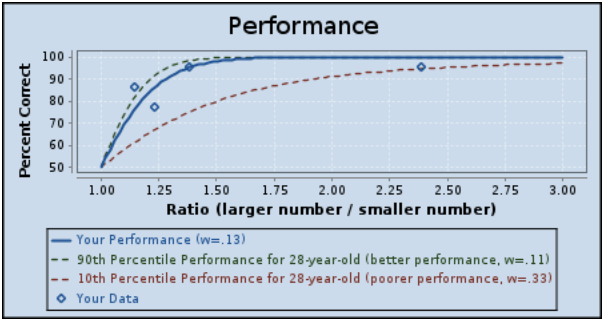

Yeah. I guess the amount of math/numbers I deal with doesn’t affect how good I am at this test. Pretty cool result, though, nonetheless.
Back to Calgary
I left Moscow this morning to head back to Calgary. Didn’t feel like I got enough time here, but I feel guilty just ditching Nate for X number of days to go frolic* in the ‘Scow. But I also feel guilty about leaving my mom all alone down there.
And now I’m feeling guilty because approximately 95% of my blog posts are garbage, including this one.
YAY GUILT!
Have some more Jaboody.
*I totally frolicked. You saw me.
Encyclopedia Blogtannia
HELLO, FOOLIOS!
So.
I might have mentioned at some point over the last ten years that I’d really like to have a physical copy of my blogs. This is due to a few reasons. First, I’m super paranoid and would hate to lose all my blogs due to some sort of technical implosion (read: solar storm). Second, I’d like to see what it would look like to have all my blogs printed out and bound. I mean, I kind of did that at my five year anniversary, but there was little to no consistent formatting and I just had everything shoved into a three-ring binder. A big three-ring binder. Not very aesthetically pleasing. Finally, I just think it would be cool to have my blog on a shelf. Each year could be like an installment or something.
But anyways. The main challenge is figuring out how to go about this publishing process. I’d definitely have to have them published by blog year, as all of them together would be waaaaaay too many pages. Also, I have pictures and I want them to be in color, so that’s going to make it pricey no matter what I do. Here’s the frontrunner option I’m thinking about:
Lulu.com appears to offer several good choices as far as the size and layout of what could be printed. If I’m looking at all the options correctly, a hard cover, US letter-sized, 400 page colored book can be made for about $85. So approximately $850 for a decade of blogs. That’s a lot of money, but not super unreasonable, I don’t think.
There are probably other options out there, too, but this is the best I can find (that does as many pages as I would need for these freaking blogs). If anyone has any suggestions, feel free to tell me!
“I’m goin’ 38, Dan…”
I’m kind of in love with Macklemore’s Downtown. Especially the music video:
It was filmed in Spokane, you know.
Edit: Hahaha, this is pretty great, too:
Edit 2: Imogen Heap! Wonderful:
(Sorry for the music video dump.)
MOAR RUNNING
So today I ran 10 miles.
BECAUSE WHAT IS MODERATION, ANYWAY?
I still hurt while I was walking to the rec center, but once I actually started running, I felt a lot better. So I just kept running.
Plus, there was baseball on one of the TVs and the Mariners were actually winning.
Plus, U of I rec center.
Yeah.
[Edit: OH MY GOD I am in a lot of pain, haha. I can’t bend my legs; my quads are super sore. WORTH IT, THOUGH]
RUNNING
Smart person: Hmm, I haven’t gone on a run since 2012, but let’s see what happens when I try to run on a treadmill.
Me: Hmm, I haven’t gone on a run since 2012, but let’s see what happens when I try to run on a treadmill.
Smart person: (after running a mile) Cool, this is fun and doesn’t hurt. I should take it easy, though, ‘cause I haven’t run in four years.
Me: (after running a mile) Cool, this is fun and doesn’t hurt. Let’s keep going!
Smart person: (later) I’m glad I stopped after 3 miles. It felt good and I’m not in pain!
Me: (later) LET’S KEEP RUNNING THIS IS AWESOME
Smart person: (the next morning) Still not in pain! Maybe I can run for a slightly longer distance today.
Me: (the next morning) FOR THE LOVE OF GOD AMPUTATE MY LEGS PAIN PAIN PAIN PAIN PAIN
Yeah. I haven’t gone on a run since 2012 and yesterday I decided to do a dumb and run 8 miles without a break. The good news: I’m able to run 8 miles without a break and it felt fantastic. The bad news: my quadriceps feel like they’re going to shrivel up and die.

 Eigenblogger