I love orchestras! I love metal!
Hahahaha, holy crap:
New job review!
So either last night was a really easy night, or this job will consist of me sitting on a couch for 11 hours, reading.
I’m cool with that.
New job!
Wow…well, getting a job this summer was a LOT easier than it was last semester. Second place I went to and I got it.
Now I will work at Seubert’s the in-home care place right next to Subway. I start tonight, actually, and I’m working from 8 PM to 7 AM for a lady. I shall review for you tomorrow!
Damn you, Linear Algebra
SO CLOSE. I was SO CLOSE to getting another 4.0 this semester.
But no.
Because I’m stupid.
At least 3.98 is still above the summa cum laude cutoff.
What the last three years have taught me
The last three years of college have taught me that:
- the rubber from the Kibbie Dome field will stay embedded in your socks for eternity.
- they don’t call it “Wish You Were Dead Week” for nothing.
- the Dollar Store is a good place at which to lose money and gain worthless yet awesome crap with which to decorate the house/lawn/car.
- if you work your ass off, you can get a Bachelors in 2 ½ years.
- it doesn’t take much to ruin the movie 300 for your friends.
- marching band pretty much rocks.
- our upstairs neighbors are stupid.
- drag shows are awesome and lead to interesting stories.
- 1-800-BUTTSEX is a real number.
- Wallace sucks.
- the U of I in general sucks.
- no matter how many times you wash the floor, if you live in a room in Wallace, the sand from the sidewalks in winter will NEVER go away.
- the table in the Commons will keep you entertained. Forever.
- Kermit’s loins are soft and pants-shaped.
- Ren’s boobs are god.
- relationships are always better if they begin by making out in a random place.
- stereotypical philosophy teachers = sexy.
- I still can’t do algebra.
- the Enlightenment was the best time period ever.
- carving genetalia out of erasers actually does reduce the stress of a 25-credit semester.
- you shouldn’t take 25-credit semesters.
- GPA miracles DO happen.
- Dr. O’Rourke is badass.
- the Quote Book is law.
- weird things happen in multidimensional spaces (thanks, Dr. Lee).
- parties at Maggie’s are fun and often result in me wearing bras that don’t fit.
- Leibniz is the greatest person that has ever lived.
- Newton is a thief and a liar.
- we will never know if love is universal or not (long story).
- Rock Band is quite possibly the best thing ever.
- sometimes things just work out.
- Pink Pearls are valuable tools in keeping one’s sanity.
- leftover Flex Dollars will earn you friends as well as a huge bag of candy at the end of the semester.
- noodles with shredded cheese on them are the food of the gods.
- spaghetti is pretty awesome, too.
- college drama is even more ridiculous than high school drama.
- late night discussions with Sean over MSN Messenger are worth staying up until 4 AM, even when you have class at 8:30 the next morning.
- in heaven there is no beer. Thus explaining why we drink it here.
- Karmic debt can be repaid in worrying about how the universe will make you repay your karmic debt.
- I still suck at Flash.
- fall semesters are substantially worse for your morale than spring semesters.
- everybody needs an Orgy Couch.
- zeppelins are hilarious.
- midnight runs to Shari’s are made of win.
- Sean is not allowed to wear socks (another long story).
- clown music, funny as it may be, is not suitable for concert band.
- drawing naughty pictures is always an appropriate and productive activity, regardless of what you’re supposed to be doing at the time.
- the Clock Crew is my second family.
- finals = panic attacks.
- the progression from “box of random magnetic words” to “series of naughty phrases on the fridge” is a law of nature.
- Aaron is a robot killer.
- if you spend enough time there, the Ag Sci computer lab is like your home.
- there are few things funnier than Ballroom Blitz sung in a Scottish accent.
- Benny Lava requires a bun in order to be bitten.
- the Registrar is not to be trusted.
- apparently my dad is a good enough professor to warrant his own Facebook fan group.
- 1 + 1 = 1…in BOOOOOOOOLEAN ALGEBRA!!!!
- you should never underestimate the Papin brothers.
- mice families are hard to kill once they start to make babies in your microwave (again, a long story).
- milking he-brides is an appropriate concert band activity.
- so is doing the Macarana.
- working at the U of I is quite possibly the worst thing you can do to yourself.
- you are still forced to make collages in 300-level classes.
- you can make a “your mom” joke out of anything (e.g. “This milk is expired.” “So’s YOUR MOM!”).
- Soylent Glitter is people!
- math 143 can suck it.
- you can survive solely on instant mashed potatoes and M&Ms for at least 10 months.
- Symbolic Logic is scary as shit, but is totally worth it.
- islands sold on eBay make great conversation topics.
- Millard Fillmore = best president ever.
- I ON DA COLE TRAIN!!!!
Sad day
Just so you all know, Aaron and I decided to call it quits today.
No, this isn’t a bad thing. We sat on his bed tonight and decided that, since I’m leaving in a few months, we should stop things now so that we don’t have crazy emotions going when we part in August. I’ll miss a LOT, but I wouldn’t have traded it for anything.
It’s all good.
It’s sad, of course, but good.
The cylinder may have graduated, but the thermometer has many degrees
YAY GRADUATION! Again…
So today I woke up at 7:00 AM to go and graduate. And yes, they definitely make a bigger deal of it in the spring than in the fall.
They also forgot to put “summa cum laude” on my reader card (I had to write it on there) and they got my major wrong in the commencement book (they had last semester’s degree).
Let’s see, what else happened…
There was a major technical difficulty and the two front screens shorted out after about 15 minutes…Walt Minnick’s speech was the most depressing thing I’ve ever heard…people with air horns are stupid…
Also, even though there were six (I think) philosophy majors graduating, I was the only one who actually walked. This wasn’t awkward at all except for the college receptions after the main ceremony. CLASS was in the Memorial Gym, and when I went inside there were all these different signs for the different majors, under which the graduates were supposed to gather.
I was the only one under the “philosophy” sign. But it’s okay, ‘cause my mom got a picture of me giving a big thumbs up underneath the sign. And the department head came up to me—apparently I went to school with his son—and congratulated me on finishing in three years.
It was fun.
Long, but fun.
Oh, but what was really cool was that the last song I heard the band play as we were leaving the Kibbie Dome was “School’s Out for Summer.”
That’s the first song we played in band camp my first semester here.
I love you, mom!
Happy birthday!!
Also, can you make me good at math? ‘Cause I’ve got my Linear Algebra final in less than three hours.
I’m not studying for Linear Algebra like I should be
But instead, I have a survey!
Are you a loyal friend?
I’d like to think so.
Who is your favorite fashion designer?
Alex Colman (think those bright pink bell bottoms I have. Those were from his company).
Why do you love the person you love?
Because he’s sweet.
If you were to become a superhero, what would you call yourself?
Spectrum!
What’s something you’re really good at?
Writing?
School?
Do you write fan fiction?
Yes indeed.
What’s your favorite thing to debate?
Free will versus determinism.
Is there something about you that you keep secret from your friends?
There’s something about me I keep secret from everyone but my parents and grandparents.
What’s your favorite TV show?
METALOCALYPSE, BITCHES!
Your top five songs:
As of right now…
Sleepyhead – Passion Pit
Lights & Music – Cut Copy
Atlas – Battles
Body Crash – Buy Now!
Supermassive Black Hole – Muse
What’s your living situation?
Awesome.
Any obsessions?
Hahaha…statistics, Leibniz, philosophy in general, blogging.
Are you in a band?
In Rock Band I am, haha. Summer just started, so I’m technically not in any band right now.
What are the genres of the last five songs you’ve downloaded?
Electronic, metal, rock, folk, and dance.
What’s the hardest class you’ve ever taken?
Either Symbolic Logic or Linear Algebra. Symbolic Logic because it was stuff I’d never dealt with before, Linear Algebra because, well, it’s algebra.
Name a song that reminds you of an ex.
You’re a God – Vertical Horizon
Are you a risk-taker?
In my own way. Taking 22-25 credits a semester is quite a risk, I’d say.
What was the last song you downloaded?
Body Crash by Buy Now! Badass electronic.
Do you own any music sung in a different language?
German, Japanese, French, Swedish, Spanish…I think there’s one in Dutch…
Which friend of yours lives closest to you?
Well, technically Sean does, ‘cause one wall separates us, but if we’re talking outside of the house, probably Matt. Or someone in the dorms.
Besides you, who was the last person in your room?
Aaron.
What were you doing last Friday night?
Having fun with my roomies.
What’s one thing that can always make you laugh?
Aaron and Sean playing in co-op. They’re hilarious when they game together.
Do you dye your hair?
Twice. Once to put in temporary red dye. Once again ALMOST A YEAR LATER TO GET THE DAMN TEMPORARY RED DYE OUT!
L’oreal lies.
Have you ever gone to a party where you were the only sober one?
Do you know who I live with?
Tell me about the shirt you’re wearing?
It ate my soul.
What do you currently hear?
My laptop fan revving up to take off into the stratosphere.
Little bugger’s NOISY.
What’s your favorite Disney movie moment?
Frollo’s “Hellfire” song in Hunchback. Badass.
Stats + Primes
So I finished my stats final today. The 3 questions asked resulted in 27 pages of answers, and I think I did pretty well. Here are some things on which we were tested:
- starplots
- biplots
- principle components analysis (PCA)
- exploratory factor analysis (EFA)
- computing the variance of a set of principle component scores (stupid eigenvalues)
- explaining why fitting an EFA model to original data is the same as fitting it to the standardized data
- finding the Fisher direction and standardizing it to unit length, then finding the related Fisher ratio
- finding the value of the Fisher ratio along the first PCA direction
- finding within group variance/covariance matrices
- computing posterior probabilities using the Bayes formula and the normality pdf’s.
Freaking awesome!
I think my favorite’s the non-primes.
We interrupt this program to bring you OMEGLE
Online anonymous chatting…there is no more dangerous thing.
You’re now chatting with a random stranger. Say hi!
Stranger: hi :)
Stranger: got a pussy?
You: I have a dog
You: Its name is BINGO
You: B
You: I
You: N-G-O
You: B
You: I
You: N-G-O
You: What’s your name-o?
You: Can I call you PussyMan?
You: …PussyMan?
You: Puss n’ Boots?
You: Lord Buttcheek of the North?
Stranger: You can call me The Grim reaper Of Omegle
You: YAY
You: Why is the Grim Reaper of Omegle looking for pussy?
You: I think I’m going to stick with calling you Lord Buttcheek of the North
You: Or LBN
You: Or Petey
You: You like that name?
You: And Petey is your name-o!
You: Backwards it’s yeteP
You: !o-eman sdrawkcab ruoy si yeteP dnA
You: Just dance…it’s gonna be okay
You: Da-da-DO-DO, just dance
You: And GaGa was her name-o!
You: Jesus, dude, talk or disconnect, I can ramble all night
You: Or rock n’ roll all night, I can do that too
You: (and party ev-er-y day)
You: Fart
You: Fart
You: Fartfartfartfartfartfartfartfartfartfartfartfartfartfartfartfartfartfartfartfartfartfartfart
You: Did you die?
You: ARE YOU BREATHING?!
You: OH GOD, HE’S NOT RESPONSIVE, GET ME A CRASH CART, STAT!
You: 200 JOULES!
You: CLEAR!
You: *BZZZT!*
You: NO RESPONSE!
You: 400 JOULES!
You: CLEAR!
You: *BZZZZZT!*
You: NO RESPONSE!
You: 80,000 JOULES!
You: *BZZZZZZZZZZZZZZZZZZZZZZZZZZZZZZZZZZZZT!*
You: OH FUCK, I FORGOT TO SHOUT “CLEAR” AND NOW THE ENTIRE ER STAFF IS DEAD!
You: GODDAMMIT
You: Wake up, sunshine, Omegle’s calling…
You: WHY AREN’T YOU TALKING, DO YOU HAVE SOME SORT OF MAGIC WORD I HAVE TO TYPE IN ORDER TO GET YOU TO RESPOND?
You: CAPS LOCK
You: Of the 3,013 users online, I had to get you
You: Okay, fine, I have a pussy, will you talk now?
You: MY LADY PARTS ARE BECKONING!
You: Labia are quite loud
You: I’M STILL HERE!!
You: A
You: B
You: C
You: D
You: E
You: F
You: G
You: H
You: I
You: J
You: K
You: L
You: M
You: N
You: O
You: P
You: Q
You: R
You: S
You: T
You: U
You: V
You: W
You: X
You: Y
You: Z
You: BITCH!
You have disconnected.
Forget everything you ever knew about…wait, what was this essay about?
Oh yeah. Searle. I heart Searle.
Note: do not read if you don’t care for philosophy and/or speculations regarding the way the mind understands, or if you just don’t want to read my crappy essays.
“A Whole-Systems Response to the Chinese Room”
Of the several different responses to dualism—the idea that the mind and the body are separate substances entirely—one that has gotten a large number of responses is functionalism, or the idea that mental states are functional states of the brain and that the mind’s relationship to the body is analogous to software’s relationship to a computer. One form of this response—the idea of strong AI—claims that a properly programmed computer is a mind rather than just a model for the mind (Searle, 67) and that the processes and outputs of such a programmed computer demonstrate an understanding similar to the type of understanding we exhibit. One notable argument against strong AI is put forth by John Searle in his essay, “Minds, Brains, and Programs.” Using the example of a man locked in what he calls the “Chinese Room,” Searle claims to show that a mind as demonstrated by computers is not analogous to humans’ mind.
In Section I of this essay I explain Searle’s Chinese room and follow it with the important relationships his example has both with understanding and with strong AI in order to explain what he attempts to show with his demonstration. I then compare in Section II what I take to be the logic used in the Chinese Room with a more real-life example to demonstrate that Searle’s argument fails to show that strong AI is false due to the fact that it does not take into account the fact that understanding requires context. Following this, I better explain my argument by comparing and contrasting it to the systems reply, another argument against Searle’s Chinese Room.
Section I
Searle sets up his Chinese Room example by asking the reader to imagine him locked in a room full of books containing Chinese writing. He notes that in this scenario, he has no knowledge of Chinese—he cannot read it, he cannot understand it when it is spoken, he cannot tell Chinese characters from random squiggles—he doesn’t even have knowledge of China (Searle, 68). Knowing this, he then asks us to imagine that, while in this room, he is constantly given input, or Chinese writing, from outside. His instructions in English are to compare these input characters to another set of symbols in the books, and then compare the information from the books with a third set of characters he is given. He responds to this third set of characters based on the comparisons he makes in the books, and outputs these responses back to the outside world (Searle, 69).
For those who are native Chinese speakers outside of the room, Searle’s output responses are indistinguishable from those generated by native Chinese speakers. This, Searle claims, is him behaving like a computer—his output is based on the input that enters the room and the “program,” or the set of English instructions he is given, helps to formulate output that is something indistinguishable from responses given by native Chinese speakers (Searle, 69).
The goal of Searle’s Chinese Room is to argue against the idea that strong AI is true—that is, to argue against the idea that a properly programmed computer is actually a mind, rather than just a model for a mind. In order to understand how Searle comes to this conclusion, it is important to see how Searle defines both understanding and strong AI. Searle describes the concept of understanding by viewing it in relation to representation of things or concepts. He notes that when a human reads a story, he or she can correctly answer questions that are derived from the story but whose contents involve information that was not explicitly provided. He uses the example of a story about a man ordering a hamburger from a restaurant and then storming out without paying because the hamburger arrived at his table horribly burnt. The human can answer the question, “did the man eat the hamburger?” correctly, even though that information was never explicitly stated, due to his or her understanding of the story (Searle, 68).
As for the concept of strong AI, Searle describes it as the idea that a properly programmed computer can actually be a mind, instead of just a representation of one. Rather than just demonstrating how the mind works, strong AI proponents claim, properly programmed computers can literally understand—e.g., read a story about a man who angrily left a restaurant because of a burnt hamburger and correctly determine whether or not he ate it—and possess cognitive states, and thus exist as minds rather than mere models.
For Searle, both of these definitions play into his denial of strong AI. An important component of the Chinese Room example is the fact that the Searle isolated in the room fails to understand (his definition of understanding) Chinese. Even though he can take the input, manipulate it, and produce an output that is, to any native Chinese speaker, indistinguishable from responses produced by any other native Chinese speaker, Searle fails himself to understand what the symbols mean. This lack of understanding, coupled with the fact that he is functioning as a properly programmed computer in the example, demonstrates for Searle that a computer with strong AI is not equivalent to a human mind.
He basically uses his situation and compares it with what occurs in computers. If Searle in the example is doing everything a computer that appears to understand Chinese does—taking in input, processing it and manipulating symbols, and providing an output—but he fails to understand Chinese, how can it be said that the computer could understand Chinese, either? A computer properly programmed to output Chinese can appear to understand but really doesn’t understand it at all. Because of this lack of understanding, according to Searle, it seems inappropriate to him for us to claim strong AI—to claim that properly programmed computers essentially are minds.
Searle puts a lot of weight on the importance of understanding. He wants to demonstrate that a computer can look like it understands Chinese—but only so far as a door with a motion sensor can understand when to open or a can opener understands how to open a can. He wishes to draw a connection between attaching the idea of understanding to inanimate objects and the fact that people, as he puts it, “can follow formal principles without understanding” (Searle, 71). In other words, a person can act much like a door with a motion sensor—if the motion sensor detects movement, it sends an electrical signal, which triggers the door to open—by simply following the logical steps (much like a Turing Machine). However, if the situation is reversed, Searle claims that you cannot have a door with a motion sensor act like a person—it cannot gain a sense of understanding that a person can.
Section II
Drawing from this idea, he wishes to claim that minds are capable of some sort of deeper understanding than symbol-manipulating computers. In other words, he wants to show with his Chinese Room example the dissimilarity between the understanding demonstrated in the example and the understanding we all experience when we, for example, read a sentence “the dog is brown.” If the example is examined closer, though, I do not feel that it demonstrates exactly what Searle wants it to demonstrate—that is, I do not think that it is an argument against strong AI.
It is true that when Searle isolates Example Searle (ES) in the room and has him take in Chinese characters and produce uninterpreted outputs, ES fails to understand Chinese. However, I do not feel that his example is an accurate representation of how understanding arises. ES is all alone in the room. Aside from the set of English instructions telling him which input characters go with which characters in the books and which characters in the books go with which third character, ES has nothing else to go on—no background, no scenarios in which to see the use of the Chinese characters, no relation of these unfamiliar characters to a language he does know or even to components in his world (e.g, “this squiggle here represents the English word “mouse” or the object “chair”). In other words, ES is isolated from all other context in which these characters could be applicable, and it seems unfair of us to assume that ES, in this situation, could possess any level of understanding (that is, understanding in the same sense we gain when we read the sentence “the dog is brown”) with regard to the Chinese language.
Looking at the Chinese Room example from this angle, I think that it is analogous to a situation in which we could take, for example, the syntax-understanding part of the brain, isolate it from all other parts, and ask it to understand the phrase “the dog is brown.” Assuming that this isolation were possible, it would seem odd to assume that this part of the brain could understand the sentence as we do. It does not understand “dog” in the sense that it represents a four-legged, furry mammal, and it does not understand “brown” in the sense that it represents a color that can be formed by mixing two complementary colors. It understands that “noun is adjective,” and that “dog” represents a noun and “brown” represents an adjective in this case, but that is probably the extent to which anyone would credit understanding to the syntax-understanding part of our brain. This part of our brain is like Example Searle, and the words “dog” and “brown,” apart from the roles they play in syntax, may as well be random Chinese characters.
However, if we examine our understanding of the sentence “the dog is brown,” it becomes apparent that our understanding of this sentence goes far beyond its syntax—we know what “dog” is due to various other experiences, mental routes, and inputs, and we know what “brown” is due to various components of the brain—the vision center, memory (since we’ve probably seen brown before), etc. This is due to the fact our mind—and our understanding in the way that we experience it—does not arise from isolated components of the brain. Rather, it arises from the culmination of the different parts of the brain as well as the inputs into the system of the brain. I need a syntactical understanding of the sentence to understand how brown relates to dog, but I need experiential understanding of what a dog is to know how brown can be applied, etc. Isolating any part of the brain and asking it to understand something will not produce the same type of understanding we are used to because we use many different components—the whole system of the mind—when arriving at an understanding of something.
The problem I see with Searle’s argument is that by isolating ES, he is in effect assuming that one component of the mind is responsible for understanding. In other words, he eliminates the idea of the system of the mind arriving at understanding and instead focuses on one aspect of it, claiming that what ES is doing is merely symbol manipulation, moving uninterpreted Chinese characters around and producing a recognizable output for those who understand Chinese while still failing to actually understand what the symbols mean. If we take understanding to arise out of this more compartmentalized view of the mind—that is, if we isolate processes that produce different forms of understanding and ask them to form an understanding of something—it is true that the compartmentalized parts of the mind, such as the syntax-understanding part of the brain discussed above, are merely manipulating symbols (‘dog’=noun, ‘brown’=adjective, and so on). However, what I think Searle fails to look at is that understanding as we see it arises out of the entire system and all inputs into it.
While my objection may initially seem like a form of the systems reply as discussed and replied to by Searle, it is distinctly different. The systems reply argued against by Searle claims that while the individual (ES) does not understand Chinese, the entire system does. Searle argues against this by claiming that even if ES internalized the entire system, ES still would not understand, and therefore the entire system would not understand (Searle, 72-73). What I am arguing for is different—understanding instead lies in the different communications and connections in the system as well as outside influences that are interpreted through the components (like, for example, light interpreted through the vision center of the brain). There is no way that all inputs into the system can be internalized into, for example, the syntax-understanding part of the brain, due to the fact that the inputs exist outside of the system and since the system relies so heavily on connections between components.
Computer programming as it stands today may only be able to represent an example such as one demonstrated in Searle’s Chinese Room—that is, it may only be able to produce computers and programs for those computers that can only run one form of input à symbol manipulation à output chain. Regardless of this, however, I think that Searle’s Chinese Room example fails to argue against strong AI due to the way the example represents understanding.
Rather than seeing understanding from the viewpoint that it arises from a multitude of different functions, the isolation of ES in the Chinese Room seems to suggest viewing understanding as based on components (in his example, ES in the room). For Searle, the fact that ES does not understand Chinese despite the fact that his output looks like he does is indicative of a failing of strong AI. However, I think Searle’s example is only indicative of trying to get at understanding by looking at the mind piecemeal rather than as a whole—analogous to trying to derive an understanding of the sentence “the dog is brown” based off of the sole interpretation of the sentence by the syntax-understanding part of the brain rather trying to get at it from the whole system of the mind.
References
Searle, J. R. (1980). Minds, brains, and programs. The Behavioral and Brain Sciences 3, 417-424.
Forget Everything You Ever Knew about Knowing!
Actually, don’t. It’s probably all still relevant anyway.
I had to write the rough draft of my Epistemology final during that week I was so sick, so the revision process was not so much a revision as it was a “let’s start from scratch” kind of thing. I’ve been working on it all day and I took like 400 shots of some energy spray thing last night just for fun (MENERGY!). Couldn’t sing in Rock Band ‘cause my voice was all shaky, but then I got a 100% on expert singing Livin’ on a Prayer and another on More Than a Feeling, so I guess shaky = good (or shaky = Bon Jovi, one of the two).
What was I doing?
Oh yeah.
So…since classes are done with and that essay is done with and I am in denial about the hell this week will be, I decided to take the night off and just dink around. During said dinking around, I decided to figure out how many pages of essays I’ve written since I started college.
Numbers are as follows:
FALL 2006
143
SPRING 2007
183
SUMMER 2007
48
FALL 2007
82
SPRING 2008
62
SUMMER 2008
52
FALL 2008
142
SPRING 2009
381
TOTAL:
1093
Let’s see…college started on August 21, 2006, which means that, counting today, I’ve been here too long 992 days. This equates to about 1.1 pages of written material a day.
It also means that about 35% of the total number of pages I’ve written in college have been written over the past 16 weeks. Scary stuff. Also, notice Spring 2008. Not too bad for a 25-credit semester, eh? Thank you, stats classes.
Blog 1105: ARE YOU SICK OF MY MUSICAL TASTES YET?
So in honor of reaching 1,500 songs, I’ve decided to give you my list of songs that I’ve given 5 stars. Only 3.3% of my songs have five stars (that’s 50 songs, FYI). Cherish these, they are my favorites. Listed are the title and artist, then genre in parentheses (just in case you have a particular genre you like). Additional comments in [brackets].
- The Riddle – Gigi D’agostino (dance)
- Lights and Music – Cut Copy (electronic)
- Sleepyhead – Passion Pit (electronic)
- Saturdays – Cut Copy (electronic)
- Get Over It – OK Go (alternative)
- Call On Me – Eric Prydz (dance)
- First Date Mullet – Pony Pony Run Run (rock) [this song is impossible to find]
- Breathe (LMC Extended Club Mix) – Erasure (electronic)
- We’ve Got Everything – Modest Mouse (alternative)
- Kill You – Dethklok (metal)
- The Jagermeister Love Song – Psychostick (metal)
- Cara Mia – Mans Zelmerlow (dance)
- Peace Of Mind – Boston (rock)
- Chelsea Dagger – The Fratellis (indie)
- I Am The Drug – Ed Harcourt (alternative)
- Valdres March – Johannes Hansen (classical)
- Farewell – Apocalyptica (metal)
- Nothing Else Matters – Apocalyptica (metal)
- Shake It – Metro Station (alternative)
- Atlas – Battles (math rock) [best genre ever!]
- Untouched – The Veronicas (pop)
- Maps – Yeah Yeah Yeahs (rock)
- Go Into The Water – Dethklok (metal)
- Viva La Vida – Coldplay (alternative)
- Buildings and Mountains – The Republic Tigers (alternative)
- Why Do You Love Me – Garbage (rock)
- Enter Sandman – Apocalyptica (metal)
- Crushcrushcrush – Paramore (alternative)
- Pieces Of Me – Ashlee Simpson (pop) [I love this song, deal with it]
- Higher Power (Kalodner Edit) – Boston (rock)
- Hard Rock Hallelujah – Lordi (metal)
- Bodies – Drowning Pool (rock)
- Where’d You Go – Fort Minor (hip-hop)
- Just Dance – Lady GaGa (dance)
- Gives You Hell – The All-American Rejects (alternative)
- Any Way You Want It – Journey (rock)
- Summer (Part 3) – Vivaldi (classical)
- Radio Nowhere – Bruce Springsteen (rock)
- Stacy’s Mom – Fountains of Wayne (pop)
- What A Feeling – Peter Luts and Dominico (dance)
- Primavera Anticipada (It Is My Song) – Laura Pausini (Alternative)
- Cloud Connected – In Flames (metal)
- Bulla Ki Jana – Rabbi Shergill (world)
- Not Ready To Make Nice – Dixie Chicks (country)
- Boulevard Of Broken Dreams – Green Day (alternative)
- She Hates Me – Puddle of Mudd (rock)
- Supermassive Black Hole – Muse (alternative)
- Addicted – Simple Plan (pop)
- Hide And Seek – Imogen Heap (alternative)
- Juliet – LMNT (pop)
- Philosophia – The Guggenheim Grotto (folk)
Throngs of Thongs!
Hahaha, so noodle night tonight reminded me of an incident last Friday that I forgot to blog about.
So.
We (Aaron, Lanky, and I) were driving down Jackson to go to Mongolian BBQ (as per usual on Fridays).
We stopped at the light at 6th street and we saw this group of young runners crossing the street. I figured it was the high school track team practicing.
Then we see this guy running with them.
Who was naked.
Except for a thong.
Everybody in the running group seemed pretty cool with it, as did the thong guy, who just jogged across the street like there was nothing unusual going on.
We were going to follow him, but they ran behind the silos, so we just laughed.
The Matrix
Oh GOD.
Last night I had this dream I was stuck in a 3×3 matrix and was subtracted to zero when they reduced it to echelon form.
It was scary as hell. Mainly because it was a DREAM ABOUT ALGEBRA.
I want to shoot myself.
It’s a blog, it’s a blog, it’s a blogblogblog!
Guess what, people? Today I just downloaded my 1,500th song. You know what THAT means…
ANALYSES!!!!
Here are two Wordles (I love this website), one by number of songs in each genre, the other by total playcount for each genre. Enjoy!


Also, screw Dead Week.
In this blog: Claudia goes “blah, blah, blahblahblahblahblah.”
“Nocturne”
The coldness reminded me of home, which wouldn’t have been so bad if I hadn’t already been homesick. It was windier than it had been when we arrived that morning and the deluge of wet flakes had started as soon as we’d left the school (of course) so we stood in a group huddled like penguins, our dress clothes less than adequate in such wintry weather, waiting for our bus. I stood next to Jenny, the hem of my black skirt soaking up the moisture from the deepening snow underfoot. It was too cold to hold our umbrellas, so we stood with our hands shoved in our jacket pockets, bouncing on the balls of our feet to keep warm, leaning forward to prevent our umbrellas precariously balanced on one shoulder from tipping too far backwards.
The Prodigy stood on the outside of the crowd, talking to Jake Hullen. Jake appeared disinterested in what the flautist was saying; he shifted his trombone case from one hand to the other, the free hand going into his pocket to remain warm until his other grew too cold and he switched the trombone again. His breath plumed in front of him as he sighed, his eyes leading off to the left, looking for the bus.
We all felt as Jake did—tired, cold, uninterested in the rest of the world. We hadn’t been expecting such a high placing at the competition, and in all honesty we hadn’t been wishing for it, either. Our placement meant that the long bus ride home would be delayed even longer and our Saturday evening would be spent waiting in the band room of an unfamiliar school until we were scheduled to play a second time in the same school’s unfamiliar auditorium, the piece we’d brought from across the county to be judged by those much less forgiving than our parents and peers.
Our tall, colorful conductor’s excitement made up for its lacking in the rest of us, however. Mr. Spien, upon hearing of our placement, clapped his slender hands like an excited child and bounced on his heels, uttering a proud but still restrained, “good job, good job!” to all of us, dusting us with praise with his shaking hands. He moved toward The Prodigy, who stood in the back of the crowd, his flute in hand.
“Excellent job, young man, excellent! Your solo won the judges’ hearts for sure.” He patted the flautist on the back, drawing only a small smile as a reaction, but heated stares from many of the rest of us who happened to hear the praise. He’d only been at the academy for a few months, but already the amount of recognition he’d received from Mr. Spien had far surpassed our instructor’s complements to the rest of us. He’d even, in a manner of days, stolen the first flue chair away from the rest of us—something that immediately brought him several enemies.
Jake had moved inwards toward the rest of the crowd. The Prodigy was right on his heels, still discussing something of dire importance, his bright pink lips moving rapidly, his breath hitting the cold air with quick bursts of fog, wet curls of black hair bouncing as he used his free hand to rapidly rub his other arm, trying to generate warmth.
As soon as The Prodigy’s talent as a flautist had been unearthed by Mr. Spien, the nickname surfaced and spread with a speed only attainable by high school gossip. His real name was Maurice Malmeen, a name that left in my mouth the greasy taste of regurgitated vowels. For this reason alone I called him The Prodigy; I was one of the few who were indifferent to him rather than exceedingly jealous or exceedingly avoidant. He seemed unconcerned with his talents when he didn’t have his instrument to his lips, which was peculiar but wasn’t something I thought much about in my spare time. Only when he played did his gift emerge unconcealed, the high voice of his flute cutting like a diamond the air of whatever particular venue at which we were performing. When there existed any occasion for jealousy to arise in me, it was usually overthrown by the fact that I could never muster the courage to play solos myself and the fact that I was always encouraging of good flute players. The band needed more of us, anyway.
Lauren moved closer to me, her cheeks red from the biting wind, and nudged her chin in the direction of Jake.
“Look at the poor guy,” she said, smiling. “The Prodigy’ll talk his ear off.”
“Unless the cold freezes it off first.” I shivered under my formal clothing, the cotton shirt brushing against the inside of my coat. Even beneath my coat, the case of my flute felt like ice. Our salvation came, however, in the form of the transportation that had brought us half way across the county to the competition. “There’s the bus.”
“Finally.” Jenny tucked her chin further into the collar of her jacket and bent down to pick up her baritone. The sun was setting already behind the covered sky, the colors of its sunset hidden by the haze of the snow-bringing blanket of clouds. The early night light hovered like a haze, the drizzle from the sky blending with the gray of its origin. In less than an hour the world around us would be dark; I made a mental note to call my parents in the morning to tell them the news of our placement in the competition, excitedly anticipating my father’s long-distance praise.
We lined up like little ducklings in front of the bus door as it slid slowly to a stop in front of us, our snow-frozen feet in a hurry to get us into the warm cabin that would carry us home. Once inside we kicked off our uncomfortable dress shoes, unbuttoned our neck adornments, and requested that the driver crank up the heat and change the radio station to 97.5 FM. The soft piano playing of Chopin soon wafted through the bus speakers, and we all got to settling into our seats for the ride home.
Those of us with umbrellas briefly opened our windows, shook the moisture off of the water resistant fabric, then wound them up and hung them upside down by the wrist straps on the latches of the windows, like dripping multicolored bats wrapped in their wings.
We’d sat in these types of buses dozens of times—the 8’ televisions at angles only owls could watch without getting cricks in their necks, the semi-soft seats bleeding upholstery from broken seams in the brightly-dotted fabric, the overhead compartments that never quite closed and every once and awhile spat something we’d stored in them back at us during a particularly sharp turn or while we traveled over a rough road. Since coming to the academy I’d grown accustomed to traveling to performances in a bus rather than in a car with just my parents, as I had back home. I always felt that the bus drivers never took snowy roads as seriously as my mother had, but I tried not to think about it as we began our ride home.
Jenny and I shared pair of seats near the middle of the bus, spread out our things, and had our delayed dinners—sandwiches and chips—that we’d packed early that morning and brought with us. After we finished, Jenny sought out two open seats on which she could sprawl out and fall asleep.
“I’m tired from lugging that baritone around,” she said. “Are you sure you don’t mind?”
“I have to work on my math homework anyway,” I replied, glad for the chance to work without distraction and hopeful that math would take my mind off of how homesick I was feeling.
“Fun.” She packed up her things and moved to an empty pair of seats further back in the bus. I opened my trig book and got to work.
The light outside had changed from haze to a palette of blue, the dark branches of the trees we were passing standing out in sharp contrast to the cerulean snow-covered hills behind them. Large flakes of snow were falling now, grazing the window with their back-lit silhouettes, acting as a damper on the sounds of the world. The steady rumble of the bus tires on the road beneath us was growing quieter and further into the distance as if the earth were falling into a dream-filled sleep.
Nocturne, I thought. The aptly-named piece we’d played at the competition had fit this atmosphere so well. Meticulously, Mr. Spien had worked on our perfecting the mood of the short, 25-measure song. He spoke his commands only in whispers, forcing the room and all of us in it to fall still and remain quiet enough to hear his hushed words.
“You have to be able to hear everything, everyone,” he explained to us, his voice like air flowing out of the end of a rusted through pipe. “This is night. The world is asleep. You’re playing a dream, but not even a dream. The memory of a dream.” He got us to the point where we sat in silence a good minute or so before we played, basking in the silence of the room, to the point where someone’s raspy breathing would draw scowls of disapproval.
These practices went on for weeks until at last we sat in the large auditorium of the school on the other side of the county, their ceiling slanted downwards toward the stage where ours remained flat, their seats padded where ours remained plain steel, on their stands the words “North Elmwood High School” where ours read “St. Cecilia’s.”
We sat in our starch-pressed and itchy performance attire, our necks held stiff by the tight formal ribbons around our collars, our arms pressed close to our sides, camouflaging from the audience the nervous sweat stains ringing our armpits. Mr. Spien stood in front of us, looking unusually regal in his formal wear, his stance akin to a sprinter about to break from the starting position. His hands were raised in front of him, commanding our attention.
“Shhhh.” He let his call for silence trail off his lips until it was nothing. He stood poised as a statue, the baton tweezed lightly between his fingers, his eyes rolling about in their sockets until his pupils met each of ours to be sure we were ready.
“Like a memory,” he whispered. A slow upswing of the baton, a steady inhale, and we began to cast nightfall upon our audience.
“Hi Amelia.” I looked up from my math to see The Prodigy standing in the aisle next to Jenny’s open seat, his low, quiet voice bringing me back to the present. His hair had dried into a mess of curls the vague shape of a thunderhead, loose coils falling in front of his eyes as he bent his tall frame to speak to me. He held his backpack by a shoulder strap in one hand and had his flute clutched protectively in the other.
“Hi Maurice,” I replied warily. What did he want?
“Jake said he wanted to work on homework, so I figured I’d move. Mind if I sit here?” He smiled sheepishly, drawing his head slightly into his shoulders as if he were afraid of my rejection. I was a bit annoyed; my math book lay in plain sight on my lap and there were other seats open around us.
“I’d go further back in the bus,” he explained quickly, taking note of my hesitation, “but any further back and I start to get carsick.” He shrugged. “Bus sick, I guess.”
As much as I wanted to finish my math homework, I figured I should be nice to him.
“This is where Jenny was sitting,” I said, “but you can sit here until she comes back if you want.”
He smiled again. “Thanks.” He turned sideways and shimmied into the seat, his billowy blue coat sleeve, still cold and a little damp, brushing up against my bare forearm as he sat, sending goose bumps racing up my arm and across my neck and chest.
“Whatcha doing?” He glanced at my math book and I braced myself for a conversation that would rival in length his prior conversation with Jake.
“Trigonometry.”
“Oh.” He adjusted himself in the seat and pulled out his iPod. “Never understood that stuff.”
He said nothing more, to my surprise, but watched over my shoulder as I tried to concentrate on the problems. Mozart’s Requiem was now filtering through the bus’ speaker system, aiding my work, and I completed a few more problems before glancing back up at The Prodigy, who had pulled a sandwich out of his backpack and was eating it slowly. He wasn’t watching me anymore and was turned instead to the right, the blue mixture of scenery outside the window across the aisle holding his attention. Looking at his profile I noticed his nose was sharply pointed, like someone had pulled on the tip, warping it and the rest of his face so that it at all directions led to the point.
Through the buds shoved deep into his ear canals, the sound of drumming and heavy electric guitar could be heard over the Mozart playing through the bus speakers. I laughed to myself. He’d really be The Prodigy if he went deaf and could still rock the flute.
“What are you listening to?” I said it loud enough so that I thought he could hear me. He had just taken a bite from his sandwich and he turned with a look of surprise towards me as if he hadn’t expected me to talk to him, his cheeks bulging out like a chipmunk. He chewed a few more times before speaking through clenched teeth to avoid making a mess when he opened his mouth.
“Metallica.” He went back to chewing.
“You don’t like the Requiem?”
He shook his head as he swallowed. “Hate it. Much prefer James Hetfield to any choir.” I didn’t know who James Hetfield was, but I ascertained that he was anything but Mozart.
“Metal, huh?” I said. “Why don’t you play guitar or something, then, instead of the flute?”
He shook his head. “I can’t. I have to shut my eyes when I play, especially during solos. If I try to read the music—if I look at anything, really—I screw up.”
“Oh.”
“I tried guitar a couple years ago and I had to keep looking down at the frets to place my fingers. I couldn’t play anything more than a couple notes at a time.”
I tried to visualize him standing in front of the judges today, performing with his eyes shut. His solo had been flawless; it was probably the component of Nocturne that had boosted us so high in the competition. We had approached the end of the piece delicately, barely touching our lips to our mouthpieces, tiptoeing across the notes as we climbed and descended the staff as vines climb and twist about garden posts, our collective volume swelling and falling away, until every sound but the subtle drone of a horn in back hung in the air.
Mr. Spien held us in a fermata as Maurice stood, his chair creaking softly. I sat behind him and never saw anything but his back when he played. I watched his shoulders rise as he took a preparatory breath, and from his flute he ushered the melody we had all heard before but that, as was the case each time he played, held us in awe, our breaths suspended until he finished. Each note sounded as if it described a lifetime, the tender tones hovering in the air, resembling the gentle humming of a wet finger running along the rim of a crystal wine glass. The solo was only five measures long, but the voice he gave it lasted for hours in our heads. His final b-flat rose, hung, and then slipped hauntingly away, absorbed by the air of the auditorium. The room was left in the quiet stun of the note’s presence and all that had preceded it and it remained quiet until the clapping finally rose out of the memory of the deceased song.
Mr. Spien stood aside and presented us to the audience with a wave of his arm, then specifically acknowledged Maurice. The applause grew louder, and as much jealousy existed on the stage, I’m sure all of us were at least secretly amazed by his performance.
I was watching him now as he sat next to me, his head bobbing lightly to the music coming from his ear buds, his hand lightly keeping beat against the case of his flute. I was curious as to why he chose me—aside from Jake—to talk to that evening. I liked the company, but I wanted to know why, I decided to be bold and ask him.
“So why’d you come sit back here?”
“Huh?” He pulled the ear buds out of his ears entirely.
“There are like five open seats. Why’d you come sit by me?”
He spoke as he turned off his iPod and rolled the headphones around it. “Well,” he said, “It’s because I can’t go further back on the bus without getting sick, like I said. Also,” he shifted as he put the iPod back into his coat pocket, “you’re one of the few people on this bus who’ll willingly talk to me. In all honesty, though, I hadn’t been expecting 20 questions.” He smiled at me jokingly, but I felt my cheeks get hot.
“Sorry.”
“No, hey, no worries. I like to talk. Like I said, not a lot of people talk to me willingly.”
“You were talking to Jake before we got on the bus,” I said, recalling earlier.
“Talking at, not to. He wasn’t interested, I think I annoy him.” He was quiet for a moment. “What is it you guys call me? The Savant?”
I was taken aback at is acknowledgement that he had a nickname. I figured we’d all kept it from him well enough so that he didn’t think he was known by anything other than Maurice Malmeen.
“The Prodigy,” I replied.
He laughed. “Yeah. A lot of people are jealous of me. Or are afraid of me, or something. I’m good at flute—that means I’ve got it made, according to them.”
“It’s a pretty impressive talent you’ve got,” I admitted. I tried to be truthful while trying to avoid stroking his ego.
“Thank you,” he replied. “But there’s a reason I’m in music and not in anything else.”
“Your parents?” His mother and father were a sinewy Yuppie couple from the northeast who always showed up to the concerts we held back at the academy. They sat in the front row and gave a standing ovation after every piece in which their son had a solo. Though my own parents hadn’t been exceedingly pushy about my pursuing music, I figured that his might have been.
“Nah. Well, they encouraged my flute playing when they saw what I could do, but they encouraged it even more after they saw that I was failing trig.”
“You’re failing?” Trig was difficult, but not that difficult. “How?”
“Let’s just say my abilities in music don’t apply to anything else.” He paused, hesitating over what else to say. “I have dyslexia,” he said finally. “Pretty bad. I mix words up most of the time. Numbers, too. That’s why classes like this—” he reached out and tapped my now closed trig book “—are such nightmares. But for some reason it doesn’t affect my ability to read music, so I do that. Also, once I know the song, I don’t need to look at the pages anymore.”
“I didn’t know you had dyslexia,” I responded, not knowing what else to say.
He shrugged. “It’s why I’m never in class. While you guys are going at a normal pace, my tutor works with me to help me even catch up. If I’m not practicing my flute, I’m trying to finish my homework.”
“Bummer.”
“Yeah.”
Our conversation ceased. We passed a rest stop to our left, the lonely streetlamp hovering over the pairing of bathrooms illuminating the glittering snow that was falling faster now than it had all day. A set of tire tracks slowly being filled in by the falling snow was the only trace of anyone having been there that day.
The scene brought me back to my days before St. Cecilia’s Academy, back when I was at home with my parents. I was younger but still heavily involved in music; every other day a practice, every weekend a recital. I had dressed in black and white—a modest skirt and a button-down top—even in the cold, snowy climate back home.
We would always be the last to leave recitals, my parents lingering to speak with the teacher or with other parents whose child, tired and wanting to go home as I did, would spend his or her time swinging from the banisters of the auditoriums in which the recitals were held or slowly removing, button by button, their uncomfortable dress clothes until their parents would notice and usher them away with the explanation that “we really ought to get this little one home.” My mother would kiss me as she buckled me into the backseat, promising me pancakes in the morning. My father, night-blind and therefore forced to relinquish the driving to my mother, would sit in the back with me, watching with reserved amusement as my head grew heavy with sleepiness, bobbing up and down until I finally would succumb to sleep. He would then remove his overcoat and drape it over my body, staving off the goosebumps that would, had I been left uncovered, arise beneath my less-than-warming concert attire. I would sleep beneath his coat until we reached home and I could be properly put in bed, a scenario that had played itself out nearly every weekend until I was sent to St. Cecilia’s.
“Hey, what’s the matter?” Maurice’s voice was full of concern as he saw me wipe away the beginnings of tears that the memory brought.
“Nothing.” I sniffled, trying not to look like I had to blow my nose. “I just kinda miss my parents.”
“Homesick, eh? That’s right, you’re not from around the academy, are you?” I shook my head. “That’s tough. How long have you been coming here?”
“Since ninth grade.”
“Your parents wanted you here?”
“Yeah, my dad especially. He’s a pianist. As soon as he saw I had an interest in music—” I shrugged “—I was going to St. Cecilia’s, come hell or high water. Not that he forced me or anything,” I quickly corrected. “I wanted to go. He wanted me to go, too.”
Maurice smiled softly at me. “Sounds like a good guy.”
“Yeah.” I tried to pull myself together a little better. “I don’t know what my problem is. I think all this snow reminds me of home and my parents.”
He nodded. “It’s a good memory to have.”
“Yeah.”
The whole bus was quiet now; the majority of the overhead lights had been switched off, the ones remaining had been left by people who had accidentally slipped into sleep. The soft yellowish light provided by these few bulbs was enough to be able to make out one’s immediate surroundings, but very little else—most of the bus was cast in black silhouette, the heads of my band mates poking up over the head rests, the few pairs of feet dangling in the aisles from those supine across two seats, sleeping.
I figured it was sometime past ten-thirty or so as I looked over at Maurice, who was quietly observing the same scene I was. I wondered if anybody on the bus knew as much about him as I did now, even after such a short conversation.
“I can help you with trig, if you want.” I said it after we sat in silence for a bit.
“What?” He turned toward me, the moistness of his eyeballs shining in the dull light, his features softly illuminated in yellow.
“I can help you with your trig. I mean, I know you said you already have a tutor, and I don’t know much about dyslexia, but I get this stuff, so I thought that would help.” I shrugged. “If you want.”
“Really?”
“Sure.” I saw him smile at me in the darkness, his teeth reflecting the light generated by the few bulbs still in use on the bus.
“That’d be awesome,” he replied quietly. It was dark enough outside now that I couldn’t tell the trees from the hills from the sky—all that was rushing past was blackness. The bus shook pleasantly as the tires carved their way through the freshly-fallen snow that no other cars had had the chance to break up. I could no longer prevent myself from drifting to sleep, the back of my head softly hitting the headrest as my consciousness began to slip. Slowly, the last threads of my awareness of the world faded away. I heard movement beside me, the crinkling of fabric the last sound hitting my ears, and as my eyelids fluttered open briefly before closing for the night, I saw the dull shine of the overhead lights reflecting off of Maurice’s blue coat as he draped it across my shoulders.
I was in a warm, familiar place again—beside my father in the car, riding home after a late-night recital, the lull of the car’s motion on the road shaking me soothingly to sleep. I felt my father’s overcoat across my chest, keeping me warm, and I could hear his soft breathing next to me as I drifted away, and though I was somehow aware that what I was experiencing was not reality, everything in my mind truly did exist in the moment, seen through a lens hazy and just slightly unclear—soft, happy, and delicate—like a memory.
15 Pages of Humean Goodness
Here’s a big heap of Humean goodness, mainly because I don’t have anything else to write about today and I’m always afraid of Vaio crashing and me losing this paper before I have to turn it in. Ignore it, or read it, I really don’t care either way.
Despite it being a relatively new field in philosophy, environmental ethics has so far seen its fair share of varying approaches to solving the problems that human-nature relationships bring to the philosophical table. With regards to many different components of human beings’ relation to nature, including to what extent we should concern ourselves with the future state of the planet, the basic relationships we have with nature, and any possible responsibilities we may have in caring for the environment, there have been many different approaches developed to help solve problems that may arise.
There are several points of debate in this still-developing field. One area of debate involves the notions of intrinsic versus instrumental value—that is, whether nature should be valued due to it having worth in and of itself or whether it should be valued solely because it is of use to humans. Another involves monism versus pluralism—whether ethicists should develop a single approach that could be adopted in all cases, or whether different approaches should apply to each individual situation.
The pragmatic approach to environmental ethics is unique among these different approaches as it draws ethics away from the more traditional “armchair philosophy” realm and into a more practical, action-based philosophy. As I will show, advocates of a pragmatic environmental ethic seek to place what we deem moral in our interactions with the environment in a more active, progressive realm, rather than confining our ethics to abstract concepts that do not necessarily readily apply to the world.
Several proponents of a pragmatic environmental ethic advocate an approach that is based off the philosophy of David Hume. More specifically, they promote basing an environmental ethic on Hume’s famous distinction between reason and sentiment and his claim that both are important in defining and interpreting morality. While some authors mention Hume’s reason-sentiment distinction explicitly, many appear to implicitly advocate the importance of this distinction in their description of a pragmatic approach to environmental ethics.
In this essay, I will explore the connections between modern pragmatic approaches to environmental ethics and the reason-sentiment explanation of moral decision-making Hume developed. My goal is to demonstrate that Humean ethics strongly support a pragmatic approach to environmental ethics. I will show that the combination of sentiment in the form of feelings and emotion and reason in the form of communal discussion and lead to a strong, functioning, pragmatic ethic.
I begin with a brief overview of Hume’s ethic—mainly his distinction between reason and sentiment, drawn from his Enquiry Concerning the Principles of Morals, then follow with several modern environmental ethicists’ interpretations of environmental pragmatism in order to define pragmatism in term of environmental ethic. Following this, I show how several authors explicitly connect Humean ethics to their idea of pragmatism, as well has how several other authors use Humean ethics in a more implicit manner. Finally, through a general overview of the goals of environmental pragmatism—as well as through a criticism of this view—I show how I see Humean ethics in connection with a pragmatic approach to environmental ethics.
Hume’s Enquiry Concerning the Principles of Morals begins with his claim that the foundation of morals seems to arise either from “argument and induction” or from “an immediate feeling and finer internal sense,” thus causing a conflict as to whether moral distinctions are discernable from pure reason—logic and formal proof—or from sentiment—feeling and intuition (Hume).
Hume further develops this distinction by explaining moral distinction drawn from reason as distinctions involving long proofs, examples, analogies, the detection of fallacies and the drawing of conclusions. He then explains moral distinction drawn from sentiment as that relying not on impartial, indifferent logic that fails to push men closer to ethical action, but rather that which relies on feeling and intuition—things that evoke from man warm feelings towards virtue and disgust toward vice (Hume).
From these seemingly opposite sources of moral distinctions, Hume is able to suggest that both reason and sentiment occur in moral determinations and conclusions. Sentiment, he claims, is responsible for all feeling that “pronounces characters [people’s characters] and actions amiable or odious, praise-worthy or blameable…that which renders morality an active principle” (Hume). In other words, it is primarily responsible for the judging of Personal Merit—the attributes of a person that renders them either praiseworthy or contemptible.
The importance of Hume’s ethic and its relation to pragmatic environmental ethics lies in his relation of sentiment and reason and their importance in moral decision making. First, he claims that reason alone cannot motivate moral decision making. We base our moral judgments on personal merits—the qualities that render a man “an object of esteem and affection or of hatred and contempt” (Hume). The only thing man needs, he claims, to decide whether or not a quality should be ascribed to himself is to “enter his own breast for a moment, and consider whether or not he should desire to have this or that quality ascribed to him, and whether such or such and imputation would proceed from a friend or an enemy” (Hume). This indicates that the judgment of whether a quality is considered “good” or “bad” is a judgment based on sentiment.
It is important to note, however, that Hume does not divorce reason from the process of moral judgment; rather, he makes special note to underline its importance while still maintaining that it is not the deciding factor in our judgments. Important to Hume is the idea of the usefulness of human qualities or actions. Reason, he claims, “when fully assisted and improved, [is] sufficient to instruct us in the pernicious or useful tendency of qualities and actions” (Hume). In other words, it is the role of reason to discern and discriminate between virtue and vice, and Hume states how important this step is in even getting to the point where one can employ sentiment—reason allows distinctions between qualities to be made, but once this distinction is made, it can do no more. It is up to the role of sentiment at that point to be the final factor in our moral judgments.
Following this line of reasoning, he states also that reason alone is not sufficient enough for any moral judgments to be made at all. All qualities upon which men make moral judgments, he says, require some sort of subjective “influence” that causes us to either praise or scorn them. Reason discovers truth, but carries no persuading influence with such truths. Reason, therefore, cannot motivate on its own any sort of moral judgment, since the truths it discovers “are indifferent, and beget no desire or aversion, [and] they can have no influence on conduct and behavior” (Hume). The traits that we find admirable as well as those we find despicable, Hume claims, we deem so due to our sentiments regarding them.
To understand how Hume’s ethic—especially his claim that both reason and sentiment play important roles in the development of moral distinctions—relates to pragmatism, we need to see first how modern philosophers interpret pragmatism in relation to environmental ethics. A common problem with many approaches to such an action-oriented ethic, according to environmental pragmatists, is the tendency of philosophers to focus on more abstract, unnecessarily complicated definitions and distinctions. This focus on what I considered at the beginning of this paper to be components of “armchair philosophy” rather than more practical, easier-to-understand elements seems to be less than optimal for an ethic that is so focused on being applied to real life.
Anthony Weston, for example, in his paper “Beyond Intrinsic Value: Pragmatism in Environmental Ethics,” mainly attacks the idea of intrinsic value. Drawing a distinction between instrumental value—valuing nature because it is necessary or useful—and intrinsic value—valuing nature for its own sake, Weston claims that most environmental ethicists tend to focus on the latter as their reason for why we should demonstrate respect for and care for nature. However, he claims that such a thing as “inherent value” is a non-natural property “where problematic metaphysical commitments are plain to see” (Weston, 329). In other words, how can one judge what has inherent value and what doesn’t? Others (e.g., Minteer & Manning) see such abstract, theoretical concepts in a similar manner, stating that when focused on alone, they do little for an ethic that is very much based in action and connection with the real world.
A pragmatic approach to ethics, according to its supporters, attempts to involve experience, differing viewpoints, and a less “removed” approach to what constitutes morality in order to create a more applicable environmental ethic. According to Weston, pragmatism “focuses on the interrelatedness of our values” (Weston, 334) and creates a sort of ecology of values that can be changed and modified. Minteer and Manning share a similar interpretation of pragmatic ethics. A pragmatic approach, they hold, strives to develop a more “applied” ethics, one that is based on experience, experiments, and more societal- and cultural-based guidelines for defining and determining morality. That is, the authors advocate an approach that, with the input from the community and lawmakers in that community, will be based mainly off of the society’s moral guidelines in which the ethic will take hold.
From the perspectives of both Minteer and Manning and Weston, we can define pragmatism now in terms of environmental ethics. For environmental ethicists, a pragmatic approach is an attempt to involve experience, differing viewpoints, and a less “removed” approach to get to what constitutes morality. The idea of a pragmatism in environmental ethics is to examine things from a more practical and applied approach that involves more action-based ideas such as looking at differing viewpoints, experience, and experiments.
With pragmatism defined in terms of environmental ethics, we turn now to two authors—P.S. Greenspan and Y. S. Lo—who explicitly mention Humean ethics in relation to their interpretations of environmental pragmatism. P.S. Greenspan examines the idea of social norms and codes in relation to Hume’s notions of reason and sentiment, while Lo focuses on how we come to deem actions virtuous or vicious.
Greenspan claims that the concept of moral wrong is the result of a “collective response”—it arises due to society and the way certain acts are forbidden in order to achieve or to allow for what he deems “group flourishing” (Greenspan, 110). In other words, he claims that moral codes are constructed by society in order to promote the flourishing of that society. It is here that Greenspan makes a comparison with Hume’s idea of reason. His suggestion “presuppose[s] notions of group rationality, or arguably even moral assessment, on the order of ‘social flourishing’” (Greenspan, 109). Group members, according to Greenspan, are rational agents, not just in general but within each individual case where questions over morality arise. It is this rationality of the members of a society that allow for a rational application of morals.
The more important component to morality for Greenspan, though, involves a semi-Humean notion of sentiment. This relates to how morality is taught. Emotion is relied upon as a “supplement to cognition in general terms” when morality is taught and in the way morality is generally set up in a society. With the assumption that moral language, moral emotion, and moral rules are taught generally in the same manner to children, he makes the assertion that emotion and sentiment are actually the first components of morality taught to young children.
For example, when a child does something that is deemed morally wrong, such as pushing another child, they are taught that what they did was a bad thing—either because their actions caused the other child to be sad, or because their actions led them to an unfavorable consequence (such as being put in time-out, thus making them angry). “What comes first,” according to Greenspan, “is basic emotion tendencies such as sadness and anger, along with some sort of higher order tendency to pick up emotional reactions from others—something like Humean sympathy” (Greenspan, 107).
The practicality and pragmatism of this combination of reason and sentiment is quite apparent. The aspect of sentiment allows for a more “personal” application of morals—what one does leads to consequences (or benefits) that evoke some form of emotional response. The aspect of rationality allows for a coming together of differing emotional responses and reactions that allow for a form of “group consensus” of what may be deemed immoral (things that cause adverse emotional reactions) and moral (things that cause good emotional reactions).
This type of application of reason and sentiment combined to develop morality can be extended to apply to environmental ethics as well. For example, suppose the individuals of a community decide to overlook the pollution in their lake. However, at a certain point, the lake water becomes poisoned due to the pollution and the members of the community, who rely on the lake for their drinking water supply, get sick because of the poisoned water. I will develop this example in relation to Humean ethics and pragmatism in general later in this essay, but for now, we examine it from Greenspan’s theory. According to Greenspan, the members of the community will first respond with an emotional reaction—maybe some will be angry that their water supply is poisoned, others will be generally upset, some will be sad, etc. Along with this, Greenspan would argue, many would probably make the connection between the poisoned drinking water supply and the pollution in the lake. Led by their rationality, these members of the community would come together and try to work out the best way to deal with the cause (the pollution) of their adverse emotional responses.
A very similar interpretation of the importance of Humean sentiment and reason with regards to environmental ethics can be drawn from Y. S. Lo. He reiterates Hume’s claim that which actions are deemed “virtuous” and which are deemed “vicious” are based on the feeling or sentiment one has regarding the action (Lo, 128). Reason alone, due to its objective, unbiased standpoint, could not lead one to make any sort of distinction between that which is considered moral and that which is considered immoral. “An action or character is virtuous/vicious,” Lo claims, “if and only if the ‘spectator’ feels the sentiment of approbation/disapprobation towards it” (Lo, 130).
Like Greenspan, Lo points out the importance of rationality, citing Hume’s condition that the spectator in question must be a “judicious spectator,” adopting points of view that are free of and indifferent to private interests and relations (an especially important component when we consider that at least some significant conflicts regarding environmental ethics are caused when a private company is in conflict with environmental regulations set up by a different group).
Lo claims that it is this rationality combined with sentiment that allows for genuine virtues and vices—those that can be viewed as such under ideal conditions (though he never specifies what these are). In other words, he reiterates a view of Hume’s—that there is a human nature that all humans universally share. The relation of this view to morality, according to Lo, is that it “sets the limits within which a moral theory remains humanly intelligible” (Lo, 133)—that it must be interpretable and clear.
With this claim, Lo subtly argues against the “armchair philosophy” approach to ethics in general. Even if the concept of a universal human nature seems unbelievable, the important limit this idea places on philosophers when determining an ethic has to do with retaining the entire ethic in the realm of what can be humanly intelligible. In other words, such an idea appears to guide one away from more abstract, unattainable definitions such as “intrinsic value” versus “instrumental value.” While we can assume which things have intrinsic value and which do not, it is something we as a species will never truly be able to be sure about. Therefore, Lo appears to argue, we should not attempt to base an ethic on such concepts. Rather, we should stick with what we can know, experience, and define—something that is practical—reason and sentiment.
Authors who don’t explicitly mention Hume—such as Ben Minteer and Robert Manning and Anthony Weston—also demonstrate the importance of his claim that both reason and sentiment play important roles in defining morality through their descriptions of the importance of a pragmatic approach to environmental ethics.
Ben Minteer and Robert Manning, in their essay “Pragmatism in Environmental Ethics: Democracy, Pluralism, and the Management of Nature” fail to mention Hume at all, yet they advocate a pragmatism that is strongly based on Humean ideas. “Practical aims of environmental philosophy” they claim “are not well served by ethicists’ penchant for employing esoteric forms of discourse that make it difficult for a large audience to connect” (Minteer & Manning, 192). They advocate a communal, pluralistic environmental ethic derived from the coming together of different people with different viewpoints, rather than an ethic that employs terminology and distinctions that can be difficult to understand.
According to the authors, any attempt at constructing an environmental ethic based purely on “analytically constructed moral ‘truths’” is insufficient (Minteer & Manning, 194). This is similar to Hume’s objection regarding basing morality solely on reason. “There is a broad range of moral sentiments about human-nature relationships,” Minteer and Manning claim, and a more community-based ethic promotes a coming together of these different viewpoints and allowing them to be open for discussion and challenges. They advocate a solution similar to that of Greenspan, who suggested that a collective response would arise out of a community’s desire to flourish. They suggest that sentiment is combined with reason when a community comes together to rationally determine how to best act as a group with regards to differing sentiments.
30) The authors essentially make a very Humean claim without referring to a clear distinction between reason and sentiment at all. Individual viewpoints, or individual sentiments, must be combined in a group setting in order for criticism, challenges, and compromises to be made. This rational confluence of ideas, according to Minteer and Manning, allows for the most practical, applicable, and secure form of environmental ethic.
A similar train of reasoning can be found in Anthony Weston’s essay “Beyond Intrinsic Value: Pragmatism in Environmental Ethics.” As stated above, Weston argues against the abstract, obscurely-defined approach to environmental ethics. Instead he claims that a pragmatic approach to environmental ethics is essentially the only approach that would make a viable ethic possible. Disconnecting values from their contexts, Weston argues, does nothing to further our attempts to assign value, for once they are out of context, “what they are in relation to everything else is pushed out of focus” (Weston, 323). Similar to Minteer’s and Manning’s point, this, too, can be related back to Hume’s assertion that reason alone does little for defining morality. While reason is important, it is the combination of reason and sentiment that leads to the best decisions made when things become challenging.
“When values do become problematic,” Weston asserts “when choice is required, then they need articulation and defense” (Weston, 332). He promotes—again, like Minteer and Manning—a more community-based foundation for environmental ethics. Rather than relying on abstract concepts, we should rely instead on our sentiments which we then explore further through rational, communal considerations of sentiments. We must look at “the relation of these values to other parts of our system of desires…and to the solution of concrete problems” (Weston, 337).
After reviewing key points from a number of thinkers above, I have shown that many different approaches to environmental pragmatism rely on the Humean ethical components of sentiment and reason, regardless of whether or not they specifically take these components from Hume. Greenspan and Lo, who both explicitly mention the reason-sentiment distinction, claim that both components are necessary for an environmental ethic. Greenspan focuses on the fact that morality is taught first through sentiment, then rationally applied through a community coming together to better promote its flourishing. Lo focuses on the idea that “virtue” and “vice” are qualities we ascribe based solely off of our sentiments. The importance of reason, for him, lies in the fact that only judicious spectators, free of and indifferent to private interests, can make true value judgments with regards to what is virtuous and what is vicious.
Minteer and Manning and Weston, unlike Greenspan and Lo, do not explicitly mention Hume, yet the reason-sentiment distinction is still apparent in their suggestions for pragmatism. For Minteer and Manning, the focus lies on the idea of a community-based environmental ethics, where individual viewpoints (similar to sentiments) can be viewed, considered, and critiqued by all in the community, leading to a rational confluence of ideas used to develop an environmental ethic. For Weston, individual values, when they conflict with others’ values, should be worked through in a community setting, much like the rational setting Minteer and Manning suggest.
The goal of a pragmatic approach to environmental ethics is to abandon an armchair philosophy outlook on the discipline and instead focus on what can be actively, practically applied. From the authors I’ve noted above, it becomes clear that there are several key connections between the Humean distinction between reason and sentiment and components necessary for a solid, functioning pragmatic environmental ethic. The main connection between Hume’s reason-sentiment distinction and a pragmatic approach to environmental ethics exists in what many of the authors above advocate—a coming-together of individual values to systematically and rationally decide on an environmental ethic for a community. Sentiment—our emotions and feelings—guide our individual reactions to situations (such as the reaction to the poisoned drinking water in the scenario presented above). However, advocates of pragmatism suggest that if members of a community come together and rationally discuss their individual reactions to environmental issues, this will lead to a well-functioning ethic.
One criticism of a pragmatic ethic based on Hume’s reason-sentiment distinction argues against the idea that sentiment is necessary in all situations. Returning to the polluted lake example above, critics could argue that sentiment does not play a role at all—rather, the individuals in this community could come to the rational conclusion, “if we pollute the lake, the lake water will become poisonous. Since we do not want to drink poisoned water, we should stop polluting the lake” without sentiment necessarily playing a part.
A response to this criticism involves pointing out again the importance many of the authors cited above place on both reason and sentiment with regards to ethical decisions. Suppose we ask an individual in that community why he shouldn’t pollute the lake, and he responds that the pollution leads to the water being poisoned and that he doesn’t want to drink poisoned water. If we ask him why he doesn’t want to drink poison water, he will most likely come up, with a reason based off of sentiment—“it makes me sick, and being sick makes me sad/mad/upset/etc.” In other words, as many of the authors appear to suggest, at the heart of peoples’ rational decisons are sentiments, which guide their ultimate value judgments.
It is the coming together as a community to discuss and evaluate these differing value judgments, they go on to claim, that is similar to Hume’s idea of reason—communities that are able to work through many different value judgments as a group to reach a rational, general conclusion about an environmental ethic have combined both the sentiment aspect of morality and the rational aspect of morality in a pragmatic, practical, effective way.
This paper has attempted to demonstrate the strong connection between Humean ethics—particularly with the distinction between reason and sentiment and the roles both of them play in defining morality—and modern pragmatic approaches to environmental ethics. It is apparent through the articles and ideas discussed that ideas formed centuries ago by Hume still apply today, especially in a pragmatic setting. Sentiment, in the form of feelings and emotions, helps guide our value judgments—without sentiment, we could not make judgments whatsoever. Reason, in the form of communal discussion and critique, acts as a “guide” of our sentiments, which allows the ability, in a community setting, to base an environmental ethic rationally upon the collective sentiments of that community. The joint use of both reason and sentiment helps to promote a pragmatic, practical, strong approach to environmental ethics.
References
Greenspan, P.S.. “Moral Responses and Moral Theory: Socially-Based Externalist Ethics.” The Journal of Ethics 2(1998): 103-122.
Lo, Y.S.. “Making and Finding Values in Nature: From a Humean Point of View.” Inquiry 49(2006): 123-147.
Minteer, Ben A., and Manning. “Pragmatism in Environmental Ethics: Democracy, Pluralism, and the Management of Nature.” Environmental Ethics 21(1999): 191-207.
Hume, David. (1777; reprint 1912; digitized n.d.) An Enquiry Concerning the Principles of Morals by David Hume. Ed. J. Mamoun, C. Franks et al. Retrieved March 3, 2009, from Project Gutenberg: http://www.gutenberg.org/etext/4320.
Weston, Anthony. “Beyond Intrinsic Value: Pragmatism in Environmental Ethics.” Environmental Ethics 7(1985): 321-339
Hooray for a break in the monotony that is excessive amounts of schoolwork
So.
Tonight was the most fun I’ve had in a long, long time. Granted, I couldn’t see during the performance, but it sounded like we did a good job. Sincere thanks to MissDemeanor for letting Claude steal a bit of the limelight. He would definitely love to perform again.
Now I’m off to do homework and, possibly, if time permits, sleep.
Blog the OH GOD THREE YEARS
HOLY FREAKING CRAP, I’ve been blogging for 3 years straight now. Craziness.
I don’t really have anything amazing to post, mainly because I’m ridiculously busy at the moment (you’d think I’d chill now that I’ve already graduated, but noooooooooo…).
Anyway. Just thought the anniversary should be acknowledged.
StumbleUpon makes for weird dreams
Despite having gallons of homework to do (because large quantities of homework are best measured in gallons), I spent like five hours on StumbleUpon. Which resulted in a really weird dream.
I’m in Egypt studying flowers (told you it was weird) when I meet this guy who has three legs. Needless to say he played the drums for some metal band, and he won’t stop following me around and talking about his band. Finally, in order to shut him up, I tell him and his other friend (who apparently was with us) that we should start a band. For some reason we call ourselves The Big Bang Theory Dawgs (yeah, spelled like that) and we play electronic music throughout Europe for the rest of the dream. Which, unfortunately, feels like three hours. And The Big Bang Theory Dawgs aren’t very fun to listen to.
Mr. Gorbachev, tear the roof off the sucker!
Well, it’s that time of year again!
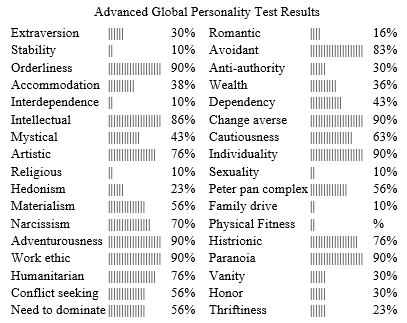
Take Free Advanced Global Personality Test
personality test by similarminds.com
Trait snapshot: depressed, introverted, neat, needs things to be extremely clean, observer, perfectionist, not self revealing, does not make friends easily, suspicious, irritable, hates large parties, follows the rules, worrying, phobic, submissive, dislikes leadership, cautious, takes precautions, focuses on hidden motives, solitary, familiar with the dark side of life, hard working, emotionally sensitive, prudent, altruistic
Lightning Steve and the Blaze Team
Hahaha, I love these guys.
“Football is a sport…go Packers.”

 Eigenblogger