Euclid, NOO!
So as I said yesterday, NaNoWriMo is over! My actual word count was well over 50,325…I just managed to fall asleep at the computer and by the time I woke up it was past midnight and I couldn’t update again, haha.
Anyway, here is this year’s Wordle (click to enlarge!):
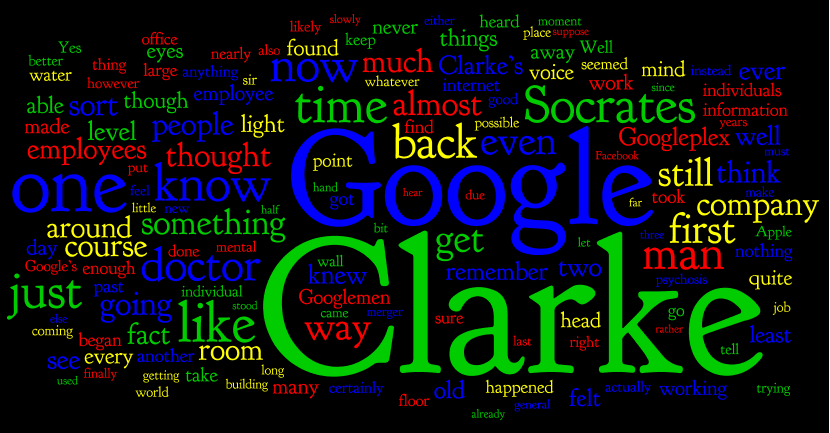
I kind of like where this year’s novel is headed, though that’s mainly because it was an idea I pulled out of my butt at the last minute and things just kind of fell into a nice coherent plot after the first 10,000 words or so. I don’t think it’s comparable to Prime, but Prime is special to me.
Now to not plan ahead for NaNo 2011 and have another panic attack the first week of November!
Today’s song: Uprising by Muse
proc blog post; run;
I finally put a damn summary/extract up for my NaNo. And I apologize for all the previous as well as all the forthcoming blogs solely about NaNoWriMo. It took me about 15 days to get into it this year, but now I actually have a plot, I like said plot, and it’s fun obsessing over something other than school/applications/the unknown future.
Also, if you’re one of my friends who is not doing NaNo, I highly recommend giving it a try next year (or trying to get the 50,000 in the 9 days remaining). It’s more fun/less stressful than I originally expected.
Woo!
Today’s song: Last Leaf by OK Go
It’s not a Claudia plot until someone dies
So my plot, after half the month has passed, has finally come into its full form, I think. Totally out of nowhere this afternoon I let someone die, which is not that unusual for my plots (far from it; I think Prime was the only story I’ve written in like 10 years in which a major character didn’t die, but that was probably due solely to the fact that all my characters were numbers) but, like I said, came completely out of nowhere for the story that I’m currently working on.
It made the plot finally have something to say, though, and it is now out of the awkward teenager plot stage wherein it didn’t know whether to be an interesting plot or be just another “1984 crossed with Fight Club” rip-off.
Gnarly.
I think I’ll finally put a plot summary up on my NaNo profile too, haha. Oops.
Today’s song: Disturbia by Rihanna
PLOT MURDER
AAAHHHHH LAST TIME I PROMISE.
I’m killing my plot. Stabbing it in the back. Sorry, plot.
Now I’m writing about Google and the internet and all that good stuff. It’s like 1984 mixed with Pi. Nothing beats good old paranoia for a story, eh?
2,083 words per day is totally doable. I think at the end of November last year I was doing like 6,000 a night. I should have saved that graph, it was hilarious. Recreation:

WOO!
Today’s song: Ex Ex Ex (In Flagranti Mix) by In Flagranti
BLAAHHHHHHHHH
I love how “may cause drowsiness” on medicines translates to “you won’t be able to stay awake for more than half an hour” for me. Same as “may cause dyskenesia” translates to “good luck sitting still for more than five minutes.” I guess passing out to sleep every hour or so is better than being too jittery to sit through class.
Anyway.
NaNo.
YES I KNOW I’m already behind. Read the first paragraph of this blog again and you’ll find one of the main reasons why. However, I’m super glad I impulse-bought that iPod Touch, because it’s been a godsend on the bus rides. I don’t have room enough to pull out a pen and notebook, so I just type on the iPod until I get to wherever I’m going. Snazzy.
My plot so far consists of ye olde science vs. religion issue, but not in a traditional way. I guess I decided to try and challenge myself by trying to write in one of my least favorite genres (science fiction), so who knows how that’s going to go. Hopefully soon I’ll get used to the meds and stop feeling like I got hit by a bus so I can actually concentrate.
Blaaaaaah.
Today’s song: When You Close Your Eyes by Night Ranger
NaNo Decision 2010
GENRE JUMP!
So I got to about 1,700 words yesterday, reread what I’d written this morning, said “screw this crap” to it, deleted it, and am starting fresh. What genre will Claudia be writing in for this year’s NaNo?
SCIENCE FICTION.
Yeah, I know, what in the hell has gotten into me, right? I’m not a big sci-fi fan. I really only like Verne, Wells, and the awesome world that is Dune. I was going to really try to challenge myself and write some fantasy, but I’m not a mental masochist. Fantasy bugs the hell out of me.
SO.
This year’s plot is something I’ve kind of had in the back of my head for a year and a half or so. It was originally for my second short story for Intermediate Fiction back in spring 2009, but a (very long) discussion in which a plausible plot was developed led me to believe that it was far too complicated to be contained in 25 pages. So I guess it’ll be my NaNo.
Random aside, University of Pittsburgh, I found out, has a class on Leibniz. A WHOLE CLASS. I almost had a heart attack.
Today’s song: Swing Bop by Der dritte Raum
It’s October 29th. Do you know where your plot is?
‘Cause I sure as hell don’t.
I have about 3 ½ different plots rolling around in my head as feasible options for the impending NaNo, but I’m not sure which one I want to go with. I’m half tempted to genre jump into a genre I either hate (fantasy, for example) or a genre I rarely read (mystery, chick lit insanity, etc.).
Haha, Prime went so smoothly last year. Writing karma is kicking my ass right now.
Today’s song: Don’t Stop the Music by Rihanna
Creation? DAMNATION!
So the number of possible ideas for NaNo has exponentially grown over the past like five days.
Crapcrapcrapcrapcrap.
Maybe I just won’t have a plan and go from “hey, this might look good on paper.”
It’s worked before.
But so has planning.
Short sentences!
End blog.
Today’s song: Life In Technicolor II by Coldplay
A Wordle for Prime
It’s because I’m bored. And because I totally forgot I wrote this story, haha. AND because Wordles are fun.

Today’s song: Cast Away – End Credits by Alan Silvestri
Hey guys, remember me? Yeah, neither do I.
Sometimes freewrites just have to happen.
If you let the words flow, they will. Right now I’m not letting them flow.
I’m charting out a structure in my mind for where this bit of writing will go.
Thus it is not a freewrite.
Sometimes I wish I was a brain in a vat, like in all those old philosophy and psychology questions that everyone has to reluctantly and hesitantly discuss in at least one college class. If I were a brain in a vat, if we were all brains in a vat, things would just happen. Causality would be illusory, as would free will. One thing would happen, and then the next. That’s it. A would not cause B, nor would my decision Q cause B. We wouldn’t be in control. Would that make things simpler or more difficult? I guess it would depend on whether or not we brains in vats argued about the goings on of our vat-populated universe.
I’m very lonely, even though my last typed IM said “kinda lonely.”
I miss you.
I bet we all, at least once in our lives, have wished for a “save” button, something that would freeze our lives in the moment, something that would grant us the safety net of going back and doing things over starting at that point if we decided we took the wrong path the first time.
Brains in vats don’t need save buttons, partially because they wouldn’t be able to physically press them.
If we have, in fact, been granted the power of free will, why does it operate so subconsciously? We only really think about choices when they’re big; otherwise, we seem to fly on automatic pilot.
(I don’t care about your Vista problems, please stop talking about your damn computer).
What was I going to say?
If I had a save button—if I could use it just once—I would use it now. I would press it, then walk away from this. “Goodbye, grad school,” I would say. Maybe then I would go back to Moscow. Or maybe I’d go wherever I desired at the time.
I would go see you and we’d figure something out where we could hang out for at least a few more years. Hopefully I wouldn’t screw things up.
That’s the problem with the idea of the save button. You can only use it once, and if you take option A and screw something up during your risk-taking, you’ll either have to go back to the life you had before and not attempt the risk at all, or attempt the risk and hope that option B will provide a better outcome.
I could get some menial job down at one of the research stations in Antarctica. I’ve always wanted to do that.
I wouldn’t mind washing dishes for a living for the rest of my life, I really wouldn’t.
And now I’m going to stop, because I just realized how much more appealing washing researchers’ dishes sounded than grad school.
Fuck this.
Sometimes freewrites just have to happen.
Today’s song: Bad Romance by Lady GaGa (Lady GaGa always makes me feel better)
Short Blog is Short
NaNoWriMo 2010 idea breakthrough!
That is all.
Today’s song: Around the Bend by The Asteroids Galaxy Tour
Blog 1,313: A Blog
HELLO LADIES AND GENTLEMEN!!
Now it’s time for NaNo stats!
Prime (remember, this is unedited)
Number of words: 50,027
Number of sentences: 3,507
Average sentence length (in words): 16.85
Average number of syllables per word: 1.6
Gunning Fog Index: 10.36
Fun times.
This small accomplishment was very needed
Yay!
So I actually was able to finish my first NaNoWriMo, with a final official wordcount of 50,027.
It was totally awesome…going to do it again next year, hopefully with a better novel resulting.

That is all.
The plot needs to thicken by at least 7,500 more words!
OH MY GOD, Prime was not meant to be a novel. A novella, yes, but not a novel. My plot petered out at about 37,000 words or so, and ever since I’ve been pretty much connecting scenes and writing filler dialogue to see what comes of it. I’ve gotten some good stuff that might replace old stuff, but putting all this crap in detracts from the story, I think. But what the hell, I love writing this story.
Explain
I’ve been spending an enormous amount of time on the NaNoWriMo forums with the attempts to procrastinate writing more BS for Prime and in leiu of doing research for a project I have yet to care about.
What’s the big attraction with the fantasy genre, I must ask? Am I the only one who sees next to no appeal with fantasy novels? I think 95% of the novels for which I’ve read summaries on the NaNo website are fantasy.
Why?
I just can’t wrap my head around the appeal.
But then again, I’m a person who loves statistics, so I probably shouldn’t talk.
NaNoOhNo
Hahaha, dammit, I’m still way behind for my wordcount. The plan in place will get me to 50,000 by the 30th, but the little graph is discouraging me…
Also, I may run out of plot.
NaNoWriMo Update Central!
Word count at which I’m supposed to be: 25,000
Word count at which I actually am: 15,035
Percentage of story so far written that is dialogue: 92.1%
Let me reiterate from blogs prior: my story is about NUMBERS. Numbers do not have physical properties. Thus, I cannot write about physical properties—visual, action-based, or otherwise—in this story.
Thus I’m stuck with dialogue and the thought processes of my MC (yes, yes, I know numbers also can’t talk or think…shut up, it’s my world!). And since I’m a stickler for interesting, realistic dialogue, I’m finding it very difficult to create quantitiy over quality with my dialogue.
I’m also finding it very difficult to refrain from making obscene amounts of math puns throughout this.
Must…refrain from math puns…must…refrain…
Plot? Pfft.
Why in the hell did I choose a NaNoWriMo plot that made no allowance for physical description? I’m realizing how much I rely on that in my writing. Oh well. A chance to improve on my dialogue, I guess.
Even though I haven’t made much progress yet, I’m finding the whole NaNoWriMo thing more of a stress relief than I thought I would. Which is odd.
General synopsis of my story, by the way:
Once the new outlook took hold in the Numerical community, it was difficult for any one of the Positives to turn against it. The idea that they were superior to the Negatives chewed with an insatiable hunger at their minds and turned them against their counterparts with a speed and illogicality that had never before been witnessed in the Rational world.
The divide widening, the 0verseer useless and indecisive, the Primes alone were unaffected. A collective anachronism from a time when unity was a common theme throughout the universe of mathematics, they alone stood left to bear the decision of whether to restore harmony to the Rationals, or to banish the Negatives to a different realm, perhaps to the Irrationals or the Imaginaries, or even to a new category of Numbers all together.
But they needed an insider–a Number not of their own caliber, a Number with connections in both the Positive and the Negative realms–in order to determine the best course of action.
And in the end, they chose Twenty Seven.
Yeah. This stems from the short writing exercise thingy from Intermediate Fiction I put up here a few months ago.
NaNoWriMo, bitches!
So today it begins.
Or tomorrow for me, really, since I went to bed around 2, woke up at 4, and spent from 5:30 until 1 getting back to my apartment up in Vancouver. But I wrote a bunch of crazy on the plane before I started getting motion sickness (of course), so we’ll see.
So I’m thinking…
The main character for my NaNoWriMo will be the number 27.
Ah, why not…
So after reading Maggie’s written submissions to DeviantArt (very nice, by the way) as well as her comments, I have decided, against my better judgment, to give NaNoWriMo a shot. I wanted to do it last year, but by the time November rolled around I’d completely forgotten about it.
So I’ll try it this year, and hopefully I won’t forget in a month.
I might use the premise from a short-write from Intermediate Fiction, I’m not sure yet.
“He’s stealing your cups because he has werewolf instinct”
Hahahaha what the hell.
As I was transferring all my crap from Vaio onto Vaio II, I came upon this little bit of writing I did in 5th grade. Our job was to pick a well-known fable and modify it as much as we could while keeping the general idea. My idea was to mess with “The Boy Who Cried Wolf,” but as you can see, I got a little…um…carried away with other stuff.
Dear Davis Love III,
This letter was just written to you from a remote nuclear power plant in Russia. At this moment now, some crazy English sheep, who seem to be drunk on herbal tea, are crying out my name (which, by the way, is Vladimir Rimidalv) and beckoning me to join them for their afternoon tea. If you ask me, they’ve been obsessed with this ‘tea’ thing ever since Dimitri (their owner) took away their cigarettes. Dimitri had worked at the plant all his life except for the three years he spent on the Russian Space Station. Of course, he gave me the most formal greeting a guy with a half-liquefied brain could: “Welcome to the Russian Space Station.” Then he broke out into a round of the Russian National Anthem. If you could have heard his rancid voice and seen his crazy gestures, you’d know what I mean when I say he should’ve stayed in space where he belonged. Anyway, as you can tell, it is chaos up here. I‘d like to know more about Roswell, NM, and, by the way, weren’t you a famous golfer at one point? Sincerely, Vladimir Rimidalv.
Dear Vladimir Rimidalv,
I think your living by a remote power plant is really interesting. Have you ever thought about opening a soup kitchen there? I bet you would get lots of money. Hey, why don’t you sell herbal tea to those annoying sheep? When you write about Dimitri, it began to worry me. Do you know about werewolves? I’ve been doing some research on them, and I’m pretty sure he is one. Here are some things to look for: séances every full moon, extra hair, and dangerous-looking teeth. Roswell, NM is really sort of like your place. I would send you one of my school pictures, but they got burned up one day when I was walking home from school (they accidentally set off a nuke!). Watch for the signs.
Sincerely, D.L.3.
Dear Davis Love III,
I opened that soup kitchen you suggested, and my business is not that great. I’m selling more than soup, too. Cappuccino is the only type of thing that gets me money; the groups of sheep come at least three times a day. I’ve learned a lot about them in a week. The leader, who buys all the tea, is named Keith. He’s not the smartest though…Roberto is. He’s the one who invented the coffee filter. The most proper is Marvin. He’s always telling me how to pour the tea. I’ve been watching Dimitri. I’ve purposely been making key chains that say: “Welcome to the Russian Space Station” just to get him over to my shop and get a closer look at him. And I’m afraid to report that I think he really is turning into a werewolf! He’s growing more hair on face and his teeth are turning silver. Also, he’s stealing my cups. What’s up with that??
Vladimir Rimidalv.
Dear Mr. Rimidalv,
An answer to your question: he’s stealing your cups because he has werewolf instinct. They can’t stay away from Styrofoam. Anyway, keep the cups away from him. They encourage the developing werewolf.
Sincerely, DL3.
Dear Davis,
You won’t believe what happened! It was all the boy’s fault! And the sheep’s! And yours! Anyway, I was selling tea to the sheep, just like normal, and having a nice conversation with Marvin, when the boy came up, looking more like a werewolf than ever, and snatched up about 2/3 of my cups! So naturally, I started screaming “Boy! Boy!” I grabbed the burning hot coffee from Marvin’s paws and dumped it on Dimitri. Of course, the sheep began to freak out. They were all galloping all over the place until Marvin, who had uncurled from his hiding position, said, “Hey! That’s not a werewolf! It’s Dimitri!” All the chaos stopped. “But he is a werewolf,” I shouted. “Really! He’s turning hairy, his teeth are silver, and he is stealing my cups!” “No, I’m not a werewolf,” he replied. “I’m growing a beard, I got braces a few days ago, and I’m taking your cups because I want you to stop getting my sheep drunk!” I looked at the sheep. The sheep looked at me. With Marvin’s help, I pushed him into a sinkhole, and he was never heard of again. The sheep went with me on a tour of England, and we made a fortune selling herbal tea.
Sincerely, Vlad R.
In this blog: Claudia goes “blah, blah, blahblahblahblahblah.”
“Nocturne”
The coldness reminded me of home, which wouldn’t have been so bad if I hadn’t already been homesick. It was windier than it had been when we arrived that morning and the deluge of wet flakes had started as soon as we’d left the school (of course) so we stood in a group huddled like penguins, our dress clothes less than adequate in such wintry weather, waiting for our bus. I stood next to Jenny, the hem of my black skirt soaking up the moisture from the deepening snow underfoot. It was too cold to hold our umbrellas, so we stood with our hands shoved in our jacket pockets, bouncing on the balls of our feet to keep warm, leaning forward to prevent our umbrellas precariously balanced on one shoulder from tipping too far backwards.
The Prodigy stood on the outside of the crowd, talking to Jake Hullen. Jake appeared disinterested in what the flautist was saying; he shifted his trombone case from one hand to the other, the free hand going into his pocket to remain warm until his other grew too cold and he switched the trombone again. His breath plumed in front of him as he sighed, his eyes leading off to the left, looking for the bus.
We all felt as Jake did—tired, cold, uninterested in the rest of the world. We hadn’t been expecting such a high placing at the competition, and in all honesty we hadn’t been wishing for it, either. Our placement meant that the long bus ride home would be delayed even longer and our Saturday evening would be spent waiting in the band room of an unfamiliar school until we were scheduled to play a second time in the same school’s unfamiliar auditorium, the piece we’d brought from across the county to be judged by those much less forgiving than our parents and peers.
Our tall, colorful conductor’s excitement made up for its lacking in the rest of us, however. Mr. Spien, upon hearing of our placement, clapped his slender hands like an excited child and bounced on his heels, uttering a proud but still restrained, “good job, good job!” to all of us, dusting us with praise with his shaking hands. He moved toward The Prodigy, who stood in the back of the crowd, his flute in hand.
“Excellent job, young man, excellent! Your solo won the judges’ hearts for sure.” He patted the flautist on the back, drawing only a small smile as a reaction, but heated stares from many of the rest of us who happened to hear the praise. He’d only been at the academy for a few months, but already the amount of recognition he’d received from Mr. Spien had far surpassed our instructor’s complements to the rest of us. He’d even, in a manner of days, stolen the first flue chair away from the rest of us—something that immediately brought him several enemies.
Jake had moved inwards toward the rest of the crowd. The Prodigy was right on his heels, still discussing something of dire importance, his bright pink lips moving rapidly, his breath hitting the cold air with quick bursts of fog, wet curls of black hair bouncing as he used his free hand to rapidly rub his other arm, trying to generate warmth.
As soon as The Prodigy’s talent as a flautist had been unearthed by Mr. Spien, the nickname surfaced and spread with a speed only attainable by high school gossip. His real name was Maurice Malmeen, a name that left in my mouth the greasy taste of regurgitated vowels. For this reason alone I called him The Prodigy; I was one of the few who were indifferent to him rather than exceedingly jealous or exceedingly avoidant. He seemed unconcerned with his talents when he didn’t have his instrument to his lips, which was peculiar but wasn’t something I thought much about in my spare time. Only when he played did his gift emerge unconcealed, the high voice of his flute cutting like a diamond the air of whatever particular venue at which we were performing. When there existed any occasion for jealousy to arise in me, it was usually overthrown by the fact that I could never muster the courage to play solos myself and the fact that I was always encouraging of good flute players. The band needed more of us, anyway.
Lauren moved closer to me, her cheeks red from the biting wind, and nudged her chin in the direction of Jake.
“Look at the poor guy,” she said, smiling. “The Prodigy’ll talk his ear off.”
“Unless the cold freezes it off first.” I shivered under my formal clothing, the cotton shirt brushing against the inside of my coat. Even beneath my coat, the case of my flute felt like ice. Our salvation came, however, in the form of the transportation that had brought us half way across the county to the competition. “There’s the bus.”
“Finally.” Jenny tucked her chin further into the collar of her jacket and bent down to pick up her baritone. The sun was setting already behind the covered sky, the colors of its sunset hidden by the haze of the snow-bringing blanket of clouds. The early night light hovered like a haze, the drizzle from the sky blending with the gray of its origin. In less than an hour the world around us would be dark; I made a mental note to call my parents in the morning to tell them the news of our placement in the competition, excitedly anticipating my father’s long-distance praise.
We lined up like little ducklings in front of the bus door as it slid slowly to a stop in front of us, our snow-frozen feet in a hurry to get us into the warm cabin that would carry us home. Once inside we kicked off our uncomfortable dress shoes, unbuttoned our neck adornments, and requested that the driver crank up the heat and change the radio station to 97.5 FM. The soft piano playing of Chopin soon wafted through the bus speakers, and we all got to settling into our seats for the ride home.
Those of us with umbrellas briefly opened our windows, shook the moisture off of the water resistant fabric, then wound them up and hung them upside down by the wrist straps on the latches of the windows, like dripping multicolored bats wrapped in their wings.
We’d sat in these types of buses dozens of times—the 8’ televisions at angles only owls could watch without getting cricks in their necks, the semi-soft seats bleeding upholstery from broken seams in the brightly-dotted fabric, the overhead compartments that never quite closed and every once and awhile spat something we’d stored in them back at us during a particularly sharp turn or while we traveled over a rough road. Since coming to the academy I’d grown accustomed to traveling to performances in a bus rather than in a car with just my parents, as I had back home. I always felt that the bus drivers never took snowy roads as seriously as my mother had, but I tried not to think about it as we began our ride home.
Jenny and I shared pair of seats near the middle of the bus, spread out our things, and had our delayed dinners—sandwiches and chips—that we’d packed early that morning and brought with us. After we finished, Jenny sought out two open seats on which she could sprawl out and fall asleep.
“I’m tired from lugging that baritone around,” she said. “Are you sure you don’t mind?”
“I have to work on my math homework anyway,” I replied, glad for the chance to work without distraction and hopeful that math would take my mind off of how homesick I was feeling.
“Fun.” She packed up her things and moved to an empty pair of seats further back in the bus. I opened my trig book and got to work.
The light outside had changed from haze to a palette of blue, the dark branches of the trees we were passing standing out in sharp contrast to the cerulean snow-covered hills behind them. Large flakes of snow were falling now, grazing the window with their back-lit silhouettes, acting as a damper on the sounds of the world. The steady rumble of the bus tires on the road beneath us was growing quieter and further into the distance as if the earth were falling into a dream-filled sleep.
Nocturne, I thought. The aptly-named piece we’d played at the competition had fit this atmosphere so well. Meticulously, Mr. Spien had worked on our perfecting the mood of the short, 25-measure song. He spoke his commands only in whispers, forcing the room and all of us in it to fall still and remain quiet enough to hear his hushed words.
“You have to be able to hear everything, everyone,” he explained to us, his voice like air flowing out of the end of a rusted through pipe. “This is night. The world is asleep. You’re playing a dream, but not even a dream. The memory of a dream.” He got us to the point where we sat in silence a good minute or so before we played, basking in the silence of the room, to the point where someone’s raspy breathing would draw scowls of disapproval.
These practices went on for weeks until at last we sat in the large auditorium of the school on the other side of the county, their ceiling slanted downwards toward the stage where ours remained flat, their seats padded where ours remained plain steel, on their stands the words “North Elmwood High School” where ours read “St. Cecilia’s.”
We sat in our starch-pressed and itchy performance attire, our necks held stiff by the tight formal ribbons around our collars, our arms pressed close to our sides, camouflaging from the audience the nervous sweat stains ringing our armpits. Mr. Spien stood in front of us, looking unusually regal in his formal wear, his stance akin to a sprinter about to break from the starting position. His hands were raised in front of him, commanding our attention.
“Shhhh.” He let his call for silence trail off his lips until it was nothing. He stood poised as a statue, the baton tweezed lightly between his fingers, his eyes rolling about in their sockets until his pupils met each of ours to be sure we were ready.
“Like a memory,” he whispered. A slow upswing of the baton, a steady inhale, and we began to cast nightfall upon our audience.
“Hi Amelia.” I looked up from my math to see The Prodigy standing in the aisle next to Jenny’s open seat, his low, quiet voice bringing me back to the present. His hair had dried into a mess of curls the vague shape of a thunderhead, loose coils falling in front of his eyes as he bent his tall frame to speak to me. He held his backpack by a shoulder strap in one hand and had his flute clutched protectively in the other.
“Hi Maurice,” I replied warily. What did he want?
“Jake said he wanted to work on homework, so I figured I’d move. Mind if I sit here?” He smiled sheepishly, drawing his head slightly into his shoulders as if he were afraid of my rejection. I was a bit annoyed; my math book lay in plain sight on my lap and there were other seats open around us.
“I’d go further back in the bus,” he explained quickly, taking note of my hesitation, “but any further back and I start to get carsick.” He shrugged. “Bus sick, I guess.”
As much as I wanted to finish my math homework, I figured I should be nice to him.
“This is where Jenny was sitting,” I said, “but you can sit here until she comes back if you want.”
He smiled again. “Thanks.” He turned sideways and shimmied into the seat, his billowy blue coat sleeve, still cold and a little damp, brushing up against my bare forearm as he sat, sending goose bumps racing up my arm and across my neck and chest.
“Whatcha doing?” He glanced at my math book and I braced myself for a conversation that would rival in length his prior conversation with Jake.
“Trigonometry.”
“Oh.” He adjusted himself in the seat and pulled out his iPod. “Never understood that stuff.”
He said nothing more, to my surprise, but watched over my shoulder as I tried to concentrate on the problems. Mozart’s Requiem was now filtering through the bus’ speaker system, aiding my work, and I completed a few more problems before glancing back up at The Prodigy, who had pulled a sandwich out of his backpack and was eating it slowly. He wasn’t watching me anymore and was turned instead to the right, the blue mixture of scenery outside the window across the aisle holding his attention. Looking at his profile I noticed his nose was sharply pointed, like someone had pulled on the tip, warping it and the rest of his face so that it at all directions led to the point.
Through the buds shoved deep into his ear canals, the sound of drumming and heavy electric guitar could be heard over the Mozart playing through the bus speakers. I laughed to myself. He’d really be The Prodigy if he went deaf and could still rock the flute.
“What are you listening to?” I said it loud enough so that I thought he could hear me. He had just taken a bite from his sandwich and he turned with a look of surprise towards me as if he hadn’t expected me to talk to him, his cheeks bulging out like a chipmunk. He chewed a few more times before speaking through clenched teeth to avoid making a mess when he opened his mouth.
“Metallica.” He went back to chewing.
“You don’t like the Requiem?”
He shook his head as he swallowed. “Hate it. Much prefer James Hetfield to any choir.” I didn’t know who James Hetfield was, but I ascertained that he was anything but Mozart.
“Metal, huh?” I said. “Why don’t you play guitar or something, then, instead of the flute?”
He shook his head. “I can’t. I have to shut my eyes when I play, especially during solos. If I try to read the music—if I look at anything, really—I screw up.”
“Oh.”
“I tried guitar a couple years ago and I had to keep looking down at the frets to place my fingers. I couldn’t play anything more than a couple notes at a time.”
I tried to visualize him standing in front of the judges today, performing with his eyes shut. His solo had been flawless; it was probably the component of Nocturne that had boosted us so high in the competition. We had approached the end of the piece delicately, barely touching our lips to our mouthpieces, tiptoeing across the notes as we climbed and descended the staff as vines climb and twist about garden posts, our collective volume swelling and falling away, until every sound but the subtle drone of a horn in back hung in the air.
Mr. Spien held us in a fermata as Maurice stood, his chair creaking softly. I sat behind him and never saw anything but his back when he played. I watched his shoulders rise as he took a preparatory breath, and from his flute he ushered the melody we had all heard before but that, as was the case each time he played, held us in awe, our breaths suspended until he finished. Each note sounded as if it described a lifetime, the tender tones hovering in the air, resembling the gentle humming of a wet finger running along the rim of a crystal wine glass. The solo was only five measures long, but the voice he gave it lasted for hours in our heads. His final b-flat rose, hung, and then slipped hauntingly away, absorbed by the air of the auditorium. The room was left in the quiet stun of the note’s presence and all that had preceded it and it remained quiet until the clapping finally rose out of the memory of the deceased song.
Mr. Spien stood aside and presented us to the audience with a wave of his arm, then specifically acknowledged Maurice. The applause grew louder, and as much jealousy existed on the stage, I’m sure all of us were at least secretly amazed by his performance.
I was watching him now as he sat next to me, his head bobbing lightly to the music coming from his ear buds, his hand lightly keeping beat against the case of his flute. I was curious as to why he chose me—aside from Jake—to talk to that evening. I liked the company, but I wanted to know why, I decided to be bold and ask him.
“So why’d you come sit back here?”
“Huh?” He pulled the ear buds out of his ears entirely.
“There are like five open seats. Why’d you come sit by me?”
He spoke as he turned off his iPod and rolled the headphones around it. “Well,” he said, “It’s because I can’t go further back on the bus without getting sick, like I said. Also,” he shifted as he put the iPod back into his coat pocket, “you’re one of the few people on this bus who’ll willingly talk to me. In all honesty, though, I hadn’t been expecting 20 questions.” He smiled at me jokingly, but I felt my cheeks get hot.
“Sorry.”
“No, hey, no worries. I like to talk. Like I said, not a lot of people talk to me willingly.”
“You were talking to Jake before we got on the bus,” I said, recalling earlier.
“Talking at, not to. He wasn’t interested, I think I annoy him.” He was quiet for a moment. “What is it you guys call me? The Savant?”
I was taken aback at is acknowledgement that he had a nickname. I figured we’d all kept it from him well enough so that he didn’t think he was known by anything other than Maurice Malmeen.
“The Prodigy,” I replied.
He laughed. “Yeah. A lot of people are jealous of me. Or are afraid of me, or something. I’m good at flute—that means I’ve got it made, according to them.”
“It’s a pretty impressive talent you’ve got,” I admitted. I tried to be truthful while trying to avoid stroking his ego.
“Thank you,” he replied. “But there’s a reason I’m in music and not in anything else.”
“Your parents?” His mother and father were a sinewy Yuppie couple from the northeast who always showed up to the concerts we held back at the academy. They sat in the front row and gave a standing ovation after every piece in which their son had a solo. Though my own parents hadn’t been exceedingly pushy about my pursuing music, I figured that his might have been.
“Nah. Well, they encouraged my flute playing when they saw what I could do, but they encouraged it even more after they saw that I was failing trig.”
“You’re failing?” Trig was difficult, but not that difficult. “How?”
“Let’s just say my abilities in music don’t apply to anything else.” He paused, hesitating over what else to say. “I have dyslexia,” he said finally. “Pretty bad. I mix words up most of the time. Numbers, too. That’s why classes like this—” he reached out and tapped my now closed trig book “—are such nightmares. But for some reason it doesn’t affect my ability to read music, so I do that. Also, once I know the song, I don’t need to look at the pages anymore.”
“I didn’t know you had dyslexia,” I responded, not knowing what else to say.
He shrugged. “It’s why I’m never in class. While you guys are going at a normal pace, my tutor works with me to help me even catch up. If I’m not practicing my flute, I’m trying to finish my homework.”
“Bummer.”
“Yeah.”
Our conversation ceased. We passed a rest stop to our left, the lonely streetlamp hovering over the pairing of bathrooms illuminating the glittering snow that was falling faster now than it had all day. A set of tire tracks slowly being filled in by the falling snow was the only trace of anyone having been there that day.
The scene brought me back to my days before St. Cecilia’s Academy, back when I was at home with my parents. I was younger but still heavily involved in music; every other day a practice, every weekend a recital. I had dressed in black and white—a modest skirt and a button-down top—even in the cold, snowy climate back home.
We would always be the last to leave recitals, my parents lingering to speak with the teacher or with other parents whose child, tired and wanting to go home as I did, would spend his or her time swinging from the banisters of the auditoriums in which the recitals were held or slowly removing, button by button, their uncomfortable dress clothes until their parents would notice and usher them away with the explanation that “we really ought to get this little one home.” My mother would kiss me as she buckled me into the backseat, promising me pancakes in the morning. My father, night-blind and therefore forced to relinquish the driving to my mother, would sit in the back with me, watching with reserved amusement as my head grew heavy with sleepiness, bobbing up and down until I finally would succumb to sleep. He would then remove his overcoat and drape it over my body, staving off the goosebumps that would, had I been left uncovered, arise beneath my less-than-warming concert attire. I would sleep beneath his coat until we reached home and I could be properly put in bed, a scenario that had played itself out nearly every weekend until I was sent to St. Cecilia’s.
“Hey, what’s the matter?” Maurice’s voice was full of concern as he saw me wipe away the beginnings of tears that the memory brought.
“Nothing.” I sniffled, trying not to look like I had to blow my nose. “I just kinda miss my parents.”
“Homesick, eh? That’s right, you’re not from around the academy, are you?” I shook my head. “That’s tough. How long have you been coming here?”
“Since ninth grade.”
“Your parents wanted you here?”
“Yeah, my dad especially. He’s a pianist. As soon as he saw I had an interest in music—” I shrugged “—I was going to St. Cecilia’s, come hell or high water. Not that he forced me or anything,” I quickly corrected. “I wanted to go. He wanted me to go, too.”
Maurice smiled softly at me. “Sounds like a good guy.”
“Yeah.” I tried to pull myself together a little better. “I don’t know what my problem is. I think all this snow reminds me of home and my parents.”
He nodded. “It’s a good memory to have.”
“Yeah.”
The whole bus was quiet now; the majority of the overhead lights had been switched off, the ones remaining had been left by people who had accidentally slipped into sleep. The soft yellowish light provided by these few bulbs was enough to be able to make out one’s immediate surroundings, but very little else—most of the bus was cast in black silhouette, the heads of my band mates poking up over the head rests, the few pairs of feet dangling in the aisles from those supine across two seats, sleeping.
I figured it was sometime past ten-thirty or so as I looked over at Maurice, who was quietly observing the same scene I was. I wondered if anybody on the bus knew as much about him as I did now, even after such a short conversation.
“I can help you with trig, if you want.” I said it after we sat in silence for a bit.
“What?” He turned toward me, the moistness of his eyeballs shining in the dull light, his features softly illuminated in yellow.
“I can help you with your trig. I mean, I know you said you already have a tutor, and I don’t know much about dyslexia, but I get this stuff, so I thought that would help.” I shrugged. “If you want.”
“Really?”
“Sure.” I saw him smile at me in the darkness, his teeth reflecting the light generated by the few bulbs still in use on the bus.
“That’d be awesome,” he replied quietly. It was dark enough outside now that I couldn’t tell the trees from the hills from the sky—all that was rushing past was blackness. The bus shook pleasantly as the tires carved their way through the freshly-fallen snow that no other cars had had the chance to break up. I could no longer prevent myself from drifting to sleep, the back of my head softly hitting the headrest as my consciousness began to slip. Slowly, the last threads of my awareness of the world faded away. I heard movement beside me, the crinkling of fabric the last sound hitting my ears, and as my eyelids fluttered open briefly before closing for the night, I saw the dull shine of the overhead lights reflecting off of Maurice’s blue coat as he draped it across my shoulders.
I was in a warm, familiar place again—beside my father in the car, riding home after a late-night recital, the lull of the car’s motion on the road shaking me soothingly to sleep. I felt my father’s overcoat across my chest, keeping me warm, and I could hear his soft breathing next to me as I drifted away, and though I was somehow aware that what I was experiencing was not reality, everything in my mind truly did exist in the moment, seen through a lens hazy and just slightly unclear—soft, happy, and delicate—like a memory.
Why doesn’t somebody buy Godot a watch?
“The revolution almost started today, but it ceased as quickly as it began due to the discovery of the 1.3511 trillionth digit of pi—it was Three this time, and we all congratulated him for being the last in the longest string of continuous digits identified, all the while knowing full well that pi was infinite and that Three would not be the “last” digit for long—but we celebrated, as per usual, congratulating each other on being masters of the universe—jokingly, but with a hint of truth, as was the norm—letting aside for the day all the qualms with the Negatives who, having no parallel conception of pi or e or any of our other numerous (pardon the pun) successes, could not be trifled with on a day such as this; no, the revolution would start tomorrow in the celebration’s wake, the dissonant relationship between ourselves and the Negatives reemerging as the talk of the day, given fuel by our recent success, and we would again unite ourselves with the resolution to rid our ordered, rational world of our negative counterparts with the claim that they were not needed in pure mathematics—that everything could be explained and calculated using us only—and that they should be banished to another category of numbers all together, perhaps grouped with the Irrationals or the Imaginaries or even given their own category, all the while never quite realizing as a group the irony of us as Rationals acting with such blatant illogicality towards our fellow numbers.”
Our assignment for my English class today was to write a 250+ word sentence using only one semicolon (if necessary). Fairly easy ‘cause I use a lot of dashes in my sentences anyway. I think I might use this as a premise for my second long story for the class, but I’m not sure.

 Eigenblogger