TWSB: Continuous, Continuous Everywhere but Not a Derivative to Find
WOAH, I’m pretty sure I’ve heard of this before but didn’t know what it was.

This is a Weierstrass function. Pretty, isn’t it?
Know what else is cool about it? While it’s continuous everywhere, it’s differentiable nowhere.
This challenged the notion that every continuous function was differentiable except on a small set of isolated points when it was discovered and published by Karl Weierstrass in 1872 (though some suggest that Riemann had made this discovery in 1871).
Haha, and I didn’t know this, but examples like this (functions that are continuous but not differentiable except only on a set of points of measure zero) are called monsters of real analysis.
That would be a FANTASTIC thrash metal band name. They could tour with Step Reckoner (the other fictional metal band I came up with, named after Leibniz’ calculating machine).
TWSB: Nature’s Bling
Ever wonder what the shiniest living material in the world is?
(Me neither, but aren’t you curious now?)
Well, apparently it’s this type of fruit that grows in the forests of central Africa. The plant, Pollia condensate, produces these iridescent berry-sized fruits in little clusters. And while iridescence is not too hard to find in the animal kingdom (jewel beetles, butterfly wings, the wings of some birds), its much rarer in the world of plants.
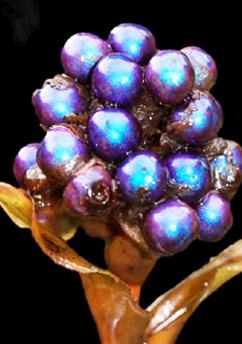
Investigation of the fruit at a microscopic level reveals that the outer part of it contains layers of thick-walled cells, each of which contains even more layers of cells and fibers. It is the distance between these layers combined with the angles of the fibers that amplify beams of light and create super strong colors. The technical term for this is “multilayer interface.”
But the coolest part of this whole thing is WHY scientists think these plants have such ostentatious fruit.
The fruit of the Pollia is of practically no nourishment—they’re dry, seed-filled husks. Thus, animals don’t naturally want to eat them. But Pollia tend to grow in the same region as the Psychotria peduncularis—a plant that also produces blue berries but whose berries ARE edible and ARE desirable by animals. So scientists who study the plants think that the Pollia evolved fruit that would imitate the look of the more desirable plant, thus tricking animals into eating them and thus spreading their seed around.
How freaking cool is that?
TWSB: Mendel’s Boxcars
Matt, I think you’ll dig this (if you ever get a break from babies, haha).
BoxCar2D is a program that learns to build a little boxcar using a genetic algorithm. Starting off with a population of 20 cars in generation 0, the 20 cars all run (or don’t, some of them are pretty pathetic, haha) and those that run the longest “reproduce.” If you let it run long enough, you really see pretty dramatic improvement from the 0th to the nth generation. There is also a mutation rate in play that you can set on a sliding scale from no mutations to “100% mutations”, where all components of the car are changeable.
I’ve got a run going in the background as I type this. It’s on generation 6 and some of the cars are running for a whole minute.
Read about the algorithm here.
Check it out, it’s really cool! You can also design your own.
TWSB: Exploding lakes? Okay, who had the canoe full of potassium?
HORRENDOUS JOKE HAS NOTHING TO DO WITH ACTUAL EXPLODING LAKES!
‘Kay.
So up until this point, I think the scariest thing I’ve posted involving lakes was this drilling accident that happened in 1980 on Lake Peigneur.
But I just stumbled upon the Wikipedia article for a phenomenon called a limnic eruption. A limnic eruption occurs when a large amount of CO2 gas “erupts” out of a lake that is nearly saturated with it. The eruption of CO2 kills pretty much every oxygen-dependent thing in the near vicinity and also may trigger a tsunami from the rapid displacement of the gas.
Limnic eruptions are said to be triggered by such things as landslides and volcanic activity. Luckily, though, they’re rare; only two have been observed in recent history. The first occurred in 1984 at Lake Monoun in Cameroon and killed 37 people. Two years later, a much deadlier eruption occurred in Lake Nyos, a neighboring lake to Monoun, which killed between 1.700 and 1,800 people.
The consequences are fairly immediate. The CO2, denser than air, displaces the breathable atmosphere close to the ground. People either suffocate from lack of oxygen or die by CO2 poisoning. The erupting gas is also supposedly cold enough to cause frostbite, as the survivors of these two historical eruptions had frostbite-like blisters on their skin. Also, according to Wiki, “the survivors also reported a smell of rotten eggs and feeling warm before passing out; this is explained by the fact that at high concentrations, carbon dioxide acts as a sensory hallucinogenic.”
Even though this type of natural disaster is rare, scientists are keeping a close eye on Lake Kivu, a lake between Rwanda and the Republic of Congo. A much larger lake than Nyos and situated in a much more densely populated area, Kivu’s CO2 and methane saturation levels have been increasing over the years, making it a potential candidate for an eruption sometime in the future. It is also near Mount Nyiragongo, an active volcano that last erupited in 2000. As of now, scientists are trying to figure out if scrubbing the lake of CO2 could have any real impact in reducing the danger of a limnic eruption.
Freaky stuff, nature, freaky stuff.
TWSB: Happy birthday, Sir Ronald Fisher!
Happy birthday to one of the greatest statisticians ever: Sir Ronald Fisher!
Fisher (1890 – 1962) was an English statistician/biologist/geneticist who did a few cool things…you know…like CREATING FREAKING ANALYSIS OF VARIANCE.
Yes, that’s right kids. Fisher’s the guy that came up with ANOVA. In fact, he’s known as the father of modern statistics. Apart from ANOVA, he’s also responsible for coining the term “null hypothesis”, the F-distribution (F for “Fisher!”), and maximum likelihood.
Seriously. This guy was like a bundle of statistical genius. What would it be like to be the dude who popularized maximum likelihood? “Oh hey guys, I’ve got this idea for parameter estimation in a statistical model. All you do is select the values of the parameters in the model such that the likelihood function is maximized. No big deal or anything, it just maximizes the probability of the observed data under the distribution.”
I dealt with ML quite a bit for my thesis and I’m still kinda shaky with it.
I would love to get into the heads of these incredibly smart individuals who come up with this stuff. Very, very cool.
TWSB: Prime News
New giant prime! New giant prime!
(It’s still really hard for me not to automatically capitalize “prime” after NaNo.)
Curtis Cooper at the University of Central Missouri came across the prime as part of the GIMPS computing project.
GIMPS, the Great Internet Mersenne Prime Search, is a distributed project designed to hunt for the rare Mersenne Primes, of which there have only been 47 found. Mersenne primes have the special form of 2p – 1, where p is itself a prime number.
The new colossal number has been confirmed as the 48th instance of a Mersenne Prime, which makes it super special. To prove the primality of the incredibly huge number, one of Cooper’s computers ran for 39 straight days. Other researchers then had to verify the primality.
I can’t wait to see the spazzing everyone falls into when we find the next DOUBLE Mersenne Prime. There are only four of them thus far discovered, you know.
COOL HUH?
TWSB: The Beauty of Stats
Here’s some beautiful stuff, people.
This Galton board (or “bean machine” or “quincunx”) demonstration of the Central Limit Theorem is one of the most beautiful things in the world to me.
While the data and trends are fascinating themselves in this demonstration, it’s really Rosling’s enthusiasm about how freaking cool this stuff is that makes me love this video. Yes, I know I’ve posted this one before. Watch it again, it’s badass.
I apologize for how sparse my TWSB posts have been lately; school exploded last week and that’s basically all I’ve had time for. Expect a lot more calculus-related blogs, though, so if you’re into that…
TWSB: Boston Dynamics Takes Alpha Dog to Obedience School
GUYS IT LISTENS TO US NOW!
Alpha Dog, Boston Dynamics’ creepiest freaking dog creature to date, has been updated and now is able to follow vocal commands. He’s quieter than his predecessors and is still able to carry 400-pound loads, navigate uneven terrain, right himself when he bites it, and creep people out.
Video!
Haha, 2:16: “LS3, do a barrel roll!”
2:22: “Nailed it! Let’s go.”
TWSB: Weighty Matters
Happy Birthday, Stephen Hawking!
Woah, I had no idea he was in his 70’s. He’s like 40 years old in my mind for some reason.
I’m not going to BS my way through this and attempt to describe in any significant detail some of Hawking’s major discoveries and theories, so instead I’ll just post something that’s sciency but pretty much totally unrelated to Hawking. ‘Cause I’m dumb.
Anyway. The KILOGRAM!
The kilogram intrigues me. It’s my favorite SI unit. Of the seven basic SI units, it’s the only one still based on a physical object. The blog post actually started my This Week’s Science Blog series was, in fact, about the kilogram. At that time I’d read an article detailing how several of the actual “copies” of the kilogram—that is, the various chunks of metal that all once weighed exactly the same—have been damaged/broken over the decades, resulting in different countries’ kilograms all being defined as slightly different weights.
But now, scientists have discovered that several copies of the kilo have gotten heavier due to surface contamination in the form of carbon and mercury. The actual gain is no more than tens of micrograms, but that’s a big deal considering that things like radioactive materials are often restricted by weight. A few more micrograms of radioactive substance could mean a lot in some situations.
Scientists hope to “clean” the kilo using ozone and ultraviolet light, which would, according to research, not harm the actual metal. But a better solution according to many would be to actually redefine the kilogram based on some law of nature rather than a physical object—something that has been accomplished for the other six major SI units.
Hang in there, kilogram…your day of reckoning is coming!
TWSB: The Plane Truth
Happy New Year, everyone!
I just realized that I only moved once in 2012. A good year indeed.
Actually, 2012 wasn’t too bad. At least the latter half. I think Vancouver Karma is finally reversing itself. I really hope 2013 is as good or better.
Anyway. To the blog!
Abraham Wald was a mathematician born in Austria-Hungary (present day Romania) in 1902. He studied mathematics and statistics and worked for the Statistical Research Group (SRG) during WWII. Wald’s job was to estimate the vulnerability of aircraft returning from battle.
To do so, he made note of the location of bullet holes on a ton of returning Allied aircraft to determine the best places to reinforce the planes to promote survival. He made several diagrams showing where the planes were most bullet-ridden (which was pretty much everywhere but the cockpit and the tail).
Showing these diagrams to his supervisors, the supervisors concluded something a lot of us would probably expect—that the best course of action to increase the rate of survival of the planes was to reinforce the areas that were the most damaged.
But Wald came to a different conclusion. He stated that rather than adding reinforcing armor to the bullet-ridden areas of the planes, the plane manufacturers should instead reinforce the areas that were bullet free. His reasoning behind this? The planes survived the battles because the cockpit and tail were undamaged. That is, the parts most vital for the planes’ survival were untouched by bullets. The planes that had been damaged to the point of being destroyed, of course, would not be able to make it back and be observed by Wald and his team. Since only planes whose cockpits and tails were undamaged were returning to be sampled, Wald concluded that it was likely planes sustaining damage to the cockpits and tails were the ones that were not surviving the battles—thus, those two parts of the airplane were the most vital to the survival of the plane overall. The wings/body/etc. were sustaining damage, but the planes were able to return even after sustaining this damage. Wald concluded, therefore, that extra armor should be added to the components of the plane that had to remain undamaged for the planes to survive.
Wald’s observation actually helped to prevent the SRG from making conclusions under the influence of “survival bias”—including only the aircraft that survived the battles and not including the planes that were damaged beyond repair and did not return to be included in the sample.
How cool is that??
There is a paper by Mangel and Samaniego discussing Wald’s findings and the math behind them. It gets pretty technical pretty quickly, but if anyone’s interested, here you go!
TWSB: Math: Ur Doin It Wrong
So today’s topic immediately brought to mind this little joke, which I’m sure you’ve all seen if you’ve traversed the Tubes for more than ten minutes:
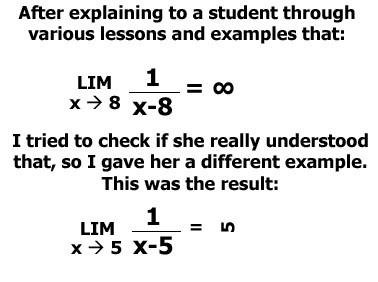
I know it’s not the same thing, but that’s what it reminded me of.
Anyway.
Today’s science blog has to do with the phenomenon called anomalous cancellation. Anomalous cancellations are arithmetic procedural errors with fractions that, despite being errors, will still result in a correct answer.
Examples from Wiki:
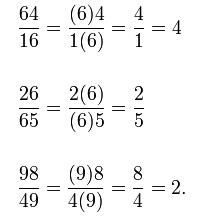
So it’s basically like looking at a problem and, as if you don’t know how to correctly solve it, trying to solve it intuitively based on the features of the numbers in the problem.
I might just be imagining it (because I’m me and I’m a spaz), but I feel like I come across this type of thing a lot. That is, I feel like I come across many situations in all my stats stuff where the correct answer can be achieved by seemingly “simple” methods that, in actuality, are incorrect method-wise but still lead to correct answers.
But again, I might be imagining it.
Anyway, I felt this an adequate topic for today’s blog, as I’m sure we’ve all come across problems like this but were not (at least, I was not) aware that such things had an actual name.
Numbers are crazy buggers, aren’t they?
Edit: Get your butts over to YouTube and listen to this awesome discussion of Leibniz’ Monadology. This pretty much made my week.
Edit 2: I don’t know why I didn’t just embed the freaking video in the first place. Claudia dumb!
This Week’s Science Blog is Absolutely Cool
(HA TEMPERATURE JOKES DON’T YOU JUST LOVE ME?)
Here is a fascinating PBS documentary on the history of cold and absolute zero. I don’t really know what else I can really say here aside from WATCH THIS! Seriously, it’s really quite interesting.
TWSB: Death by Sunspots
We are so damn screwed when the sun decides to solar storm us to death.
In fueling my paranoia about our nearest star, I came across the Wiki article for the Carrington Event. The Carrington Event was a massive solar storm documented in 1859. In late August/early September of that year, the sun produced a bunch of sunspots, solar flares, and a giant coronal mass ejection that motored its way to earth in just 17 hours (normal travel time = 2 to 3 days). It blasted our magnetosphere and atmosphere with enough force that auroras were seen all over the globe (including in the freaking Caribbean. Can you imagine?). This was the largest geomagnetic storm ever recorded.
Telegraphs all over the world failed, with some acting very strangely—sending and receiving messages even after they’d been disconnected from their power sources.
I did some more research and, as I’ve mentioned in my science blogs before, a lot of astronomers say that we’re overdue for another mega solar storm. Some are predicting what’s being called a “Solar Katrina”—a catastrophically huge solar storm that would, if it hit earth, knock out the entire planet’s electricity for weeks, possibly even months.
Can you imagine humanity suddenly reverting to pre-electricity conditions? I can’t even comprehend the chaos/panic/death that would cause. Holy freaking sunspots.
That would make good material for NaNoWriMo though…
TWSB: So a “Squircle” is a Thing.
And it’s exactly what it sounds like. “A squircle is a shape with properties between those of a square and those of a circle,” according to the almighty Wiki. The general equation for such as shape is (x-a)4 + (y-b)4 = r4, where (a,b) is the center of the squircle and r is the minor radius of the squircle.
A squircle is not a rounded square, which is formed by arranging four quarters of a circle and connecting the loose ends with straight lines. The equation for a squircle is simpler and more generalizable than the rounded square.
So what the heck are squircles used for, other than for amusing people with their name?
Well, apparently the shape is very useful in optics. If a light is passed through a 2-D square aperture, the diffraction pattern’s central spot can be modeled by the squircle.
Squircle dinner plates also have an advantage of their round brethren—a squircle has a larger surface area than a circle with the same radius, but will still occupy the same amount of space in a cabinet. And efficiently wedging dishware into cupboards is what science is all about!
Additional note: a squircle with unequal vertical and horizontal dimensions is called a rectellipse. That sounds like a hemorrhoid medication.
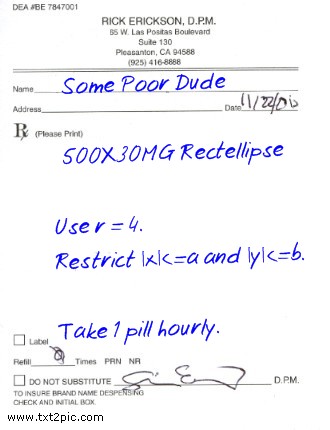
(The amount of time I spent searching for an “Rx pad generator” just to make that stupid joke is embarrassing.)
TWSB: The Colors of Google
So as is tradition, there’s some sort of major character death in my NaNoWriMo novel. At least this time it doesn’t happen until the end. Or near the end.
Or both.
Anyway.
I was going to put up my ending as an excerpt to torture you all today, but then I stumbled across a really cool science article. Considering I haven’t done my science blog yet this week, you get that instead!
Well, I guess it’s more math/pattern analysis, but hell, that’s science, ain’t it? I need to add a “math” category to my blog.*
Alrighty. So I stumbled upon this article by Ric Dragon of DragonSearch Marketing in which he makes a few educated conjectures about what the next color would be in the sequence if the Google logo had another letter.

The Google logo, as pictured above, has four colors: blue, red, yellow, and green. Mr. Dragon breaks up the letters into sequences of three to get this pattern:
- 1st sequence: blue, red, yellow (compliment to the combo of blue and red, purple)
- 2nd sequence: red, yellow, blue (compliment to the combo of red and yellow, orange)
- 3rd sequence: yellow, blue, green (combo of yellow and blue)
- 4th sequence: blue, green, red. Green = blue + yellow, but since blue is already in the sequence, he takes green-blue=yellow; thus the sequence is blue, yellow, red, with red being the compliment of blue and yellow, green.
From this, he makes the claim that the third color in any three-letter sequence must always be the result of mixing the first two colors or is the compliment of those first two colors.
So, again after removing the blue from the green in that last sequence, the next sequence of three would be yellow, red, ?
So if the rule here is combo, the next color would be orange (yellow + red)
But if the rule is compliment, the next color would be blue (compliment of yellow + red)
He talks a bit about iGoogle, too, which kind of messes up his patterns, but I actually just realized that I have a lot of stuff I should be doing other than blogging, so you’re just gonna have to read the article instead of my crappy summarizing. But it’s a cool thing to think about, eh? The mysteries of Google.
CLAUDIA OUT!
*Of course, that will require eliminating an old category to keep the total number of categories at 35. So some reassigning shall have to happen. Not that anyone else cares about that. Why the hell am I still talking?
TWSB: powers of ten
First, I want to apologize if I’ve posted this video on here before. I’m currently too lazy to go back through ye olde archives and check (read: I’m too lazy to type “powers of ten” in my little search box), so I’m just going to go with it.
I logged into my older, rarely-used YouTube account today and was looking through my favorites list and I found this video.
I don’t care that it’s from 1977, I don’t care that I’ve watched it like 80 times. It still blows my mind. So I thought I’d share it for this week’s science blog.
Like I said when I posted that other video about the universe a few weeks ago: I don’t know how we could ever feel disconnected from one another when we’re all part of this working machine of huge and small alike.
TWSB: Angles of Understanding
Geometry makes things so much clearer, doesn’t it?
TWSB: Wake Up in the Mornin’ Feelin’ Like Vivaldi
Here’s a cool little science-y blog for y’all:
As each metronome reverses its direction at the top of its swing, the energy is transferred to the platform below and, through the platform, to the other metronomes. At first, these transferred energies are all out of sync and the different waveforms interfere with one another. This continues until balance is eventually created, meaning that the interference pattern is a standing wave and is causing the metronomes to be “locked” into sync with one another.
Even that little rebel on the right.
Cool, huh?
[haha, get the title? ‘Tik Tok’ like metronomes going “tick-tock? I’m not TOTALLY crazy*.]
[*debatable]
TWSB: Back on the Chain Gang
This week’s science-related blog has to do with CALCULUS because calculus is awesome and because we actually just got tested on using the Chain Rule on Wednesday. The Physicist over at AskAMathematician.com responded to this question awhile back: “Is there an intuitive proof for the chain rule?” Which, when you think about it, is a really interesting question. We’re taught in calculus that when we’ve got a function “embedded” within another function [e.g., f(g(x))], when we take the derivative of that function, we take the derivative of the “outside function” f’(x) and then multiply it by the derivative of the “inside function” g’(x) to get f’(g(x))g’(x).
But why the heck do we need to do that?
As the Physicist very elegantly points out, it all has to do with slope. When you multiply a function by some amount, you squish it up by that same amount. Using their same example, say you’ve got a function f(x) and it’s “squished” function f(2x). These two functions are the same when x=6 and x=3 respectively, but that’s not the case for their slopes. The squished function 2x will have a steeper one by two. When you take the derivative of this function, then, you have to re-multiply it by two to deal with the squishing.
So how does this work out in general? If you replace the 2x with a more complicated function g(x), you get f(g(x)), and the slope of the whole thing depends, then, on g(x). So when finding the slope (taking the derivative) of f(g(x)), you have to re-multiply it by the slope of g(x) (or the derivative of g(x)) to deal with whatever g(x) is doing to the whole of f(g(x)).
And there’s your chain rule!
Take a look at the actual article. They’ve got pictures and actually have the derivatives and functions written out like I can’t do here.
VERY FREAKING COOL, PEOPLE.
TWSB: Hot n’ Spicy Pi
Today’s science blog is about pi!
But why? It’s not pi day or casual pi day or tau day.
Well, because today’s date occurs in pi as well: at position 336 (not counting the “3.”). In fact, you can easily find if any sequence occurs in pi (and if so, where) using this cool tool:
http://www.angio.net/pi/piquery (searches the first 200,000,000 digits).
Anyway.
I found that cool site by reading an article by the Mathematician at askamathematician.com. The question asked was, “Since pi is infinite, do its digits contain all finite sequences of numbers?”
The answer: while pi is infinite and does not contain an infinitely repeating sequence, it has yet to be proven that every digit from 0-9 occurs an unlimited umber of times in pi’s decimals. Thus, it hasn’t been determined that pi contains every single finite sequence of numbers.
However, though pi isn’t random, its digits appear to show up randomly in sequence such that any given chunk of pi has approximately equal numbers of digits 0 through 9 (I tried this out, it’s true!), which indicates that if that’s the case throughout and pi is indeed infinite, then according to the Mathematician, “there is a probability of 100% that such a number contains each and every finite sequences of digits, and pi has the appearance of being statistically random.”
This Week’s Science Blog: Taking You to a Higher Dimension
Okay. So this week’s science blog is really, really awesome, but I think if I try to summarize it and put it in my own words here it’ll lose a lot. So I’ll just copy down a few highlights. This is another question answered by the Physicist at AskAMathematician.com: What would life be like in higher dimensions?
Seriously. Really cool answer.
Highlights:
- In 4 or more dimensions orbits are always unstable, and in 1 dimension the idea of an orbit doesn’t even make sense.
- f you set off a firecracker in 3, 5, 7, etc. dimensions, then you’ll see and hear the explosion for a moment, and that’s it. If you set of a firecracker in 4, 6, 8, etc. dimensions, then you’ll see and hear the explosion intensely for a moment, but will continue to see and hear it for a while…it may not even be possible to understand people when they speak.
- Which elements are stable, and the nature of chemical bonds between them, would be completely rearranged.
- Every element after helium would adopt weird new properties, and the periodic table would be longer left-right and shorter up-down.
This Week’s Science Blog is Sweet!
Well this is about the coolest study ever.
Windisch, Windisch, and Popescu (a trio of badass Austrian scientists) wrote a paper detailing the best way to enjoy spherical candies like M&Ms and Skittles.
The researchers placed whole and fractured candies into bowls of tap water (tap water has approximately the same pH as saliva) and mechanically agitated the water slightly to mimic movement in the mouth. They videotaped the candies from above to observe their dissolve rates.
As might be expected, they concluded that to maximize the life of the candy, consumers should try to maintain the candy’s spherical shape for as long as possible. Fracturing the shape increases the surface area, causing the pieces to dissolve faster.
But the best part is their conclusion: “Even though we now know how candies dissolve in time we stress that the best thing to do when eating a candy is to forget about these considerations, since they draw your attention away from what candies are made for: enjoyment.”
Read their paper and stats here.
TWSB: Nosy Mice
OH, WHAT NONSENSE IS THIS?!
Researchers at the University of Michigan have come up with a way to restore the sense of smell in anosmic mice!
Experimenting on mice that had lost their sense of smells due to a type of cilia dysfunction, researchers at the University of Michigan infected the mice with a modified strain of the common cold virus. The virus, containing the desired DNA sequences, rewrote the mice’s cells as the infection worked through their bodies. Once the mice had recovered, they were once again able to smell.
Dr. Jeffrey Martens explains that the virus was used to reintroduce neurons that transmit the sense of smell to regrow the cilia that the mice had lost. Unfortunately, though, the lack of cilia in the mice was due to a specific birth defect that affected a specific protein. A similar birth defect occurs in humans, but is usually fatal. So for now, there are no immediate applicable cures for human anosmics from these researchers’ findings, but hopefully the techniques and approach they’ve employed will lead them down the road that will one day allow those of us who lack olfaction to finally smell.
TWSB: Head Banging
Did you know there are nine species of hammerhead sharks? I was unaware of this.
Anyway.
I came across this cool article today discussing the strange shape of these super cool sharks. And perhaps not surprisingly, the reason for their funky heads has to do with hunting prey.
Sharks have specialized sense organs that allow them hunt efficiently through the water. One group of these organs is called the “ampullae of Lorenzini.” It allows sharks to detect the electrical fields that are created by their prey.
This group of organs is spread out across the broad head of the hammerhead shark, making them super sensitive and super helpful in detecting their main prey: stingrays that lie along the ocean floor.
Their funky head shape also gives them amazing binocular ability and the ability to see both above and below themselves at all times.
Finally, and perhaps the coolest feature of the head, when they finally do come across a stingray, they hammer slam it to the ground as they kill it.
Sharks rule.
TWSB: Salt of the Tongue
Quick—of the four (or five, or seven) basic tastes, which one is the one confounding scientists regarding how it works?
It’s SALTY!
Surprised?
Scientists have traced the tastes of sweetness, umami, and bitter to specific receptors on the cells of the tongue, and are close to finding the receptor for sour. How we perceive saltiness, however, still remains elusive. Scientists believe the trouble stems from the fact that humans are so sensitive to sodium: we need it to function, but too much will kill us.
Because we need sodium in pretty much every important bodily function, from nerve firing to blood pressure control to cell water saturation control, molecules that are sensitive to sodium are embedded in cell membranes all over the body.
Why is this a problem? Because the process for locating the other taste receptors involved finding a likely gene for the receptor, destroying it in mice embryos, and testing whether the mice could still experience the taste. If the genes for salt reception are destroyed, the mice won’t live long enough to even be born.
To get around this, two research groups worked to develop a drug method of temporarily blocking a certain type of sodium channel in the mice’s mouths.
So what did they find out when they did this? When the treated animals were deprived of salt, they were unable to distinguish between salty and plain water. This is what they expected if the blocked sodium channel, ENaC, was required to taste salt.
But they found something surprising. Even when the ENaC was blocked, the nerve that carries salty sensations from the tongue to the brain was still showing some activity. They also found that the ENaC-less mice didn’t actively seek out salt and avoided water with very high concentrations of it. So even though they couldn’t taste the salt, the drug treated mice avoided bowls of salty water like normal mice.
This suggested to the researchers that our perception of salt involves two different mechanisms: one involving something that makes salt attractive/tasty, and another that makes high concentrations of it something to avoid. This makes sense biologically: lack of salt can kill us, as can too much salt.
So the search is currently on for the second receptor, the one that makes us reject salt. Come on, taste scientists, you can do it!

 Eigenblogger