TWSB: Neptune’s Birthday
So apparently tomorrow will mark the first time Neptune will have made a complete revolution around the sun since it was discovered back in 1846.
TWSB: Portals, Portals, Everywhere and Not a Cake to Eat
Matt, This Week’s Science Blog is for you, ‘cause I know you really dig Portal.
Here on the Steam forums is a list of Portal physics answers (warning: not devoid of childish internet arguing and name-calling).
I like the crushing one (the second scenario). This stuff makes me want to play around with Garry’s Mod.
Speaking of Garry’s Mod…
Just a little tidbit of the internet to lighten your day. My day’s pretty much sucked, at least, so I hope yours is going better.
TWSB: Well, it certainly would make the cartographer’s job easier…
My favorite TWSBs involve hypothetical situations. Today, the hypothetical situation in question is as follows: what would earth be like if it were a cube instead of spherical?
Quick summary of coolest points:
– oceans and atmosphere would “puddle” into the centers of the six sides of the cube.
– life would be isolated to the perimeters of these ocean puddles, and it is very likely that each of the six regions would be completely isolated and each region would pretty much be its own biosphere.
– huge seasonal temperature fluctuations due to—again—the isolation of the atmospheres.
– sunrise and sunset would be sudden, not the gradual niceness we see on regular earth.
How cool, eh?
This Week’s Science Blog: The Fast and the Fourier
http://www.sixtysymbols.com/index.html
Why I haven’t featured this as a TWSB yet, I don’t know.
But it’s happening now, so be happy!
Those frequenters of YouTube out in my readership (all two of you!) have probably come across one of the videos from the Sixty Symbols gang.
Run out of the University of Nottingham, the scientists behind Sixty Symbols seek to explain some of the coolest symbols used in physics and astronomy. They’ve got more than sixty symbols total right now because they’re working on a second set, so that’s even cooler.
Some of my favorites include:
– Planck Length
– Summation
– Star Classification
– Large Numbers
– Lambda (eigenvalues!!)
– Brazil Nut Effect
– Imaginary Numbers
– Kelvin (Kelvin needs more love in the temperature world)
Woo, science!
This Week’s Science Blog: Kiss My Asterism!
An asteroid first observed on January 16, 2009 is set to pass within about 0.9 lunar distances (less than 384,000 km) of earth next Thursday.
The asteroid, Asteroid 2009 BD, is what astronomers believe to be a “co-orbital asteroid,” or one that follows the orbit of a major planet (in this case, the Earth, duh), not receding more than 0.1 AU away.
Scientists and astronomers assert that this little parasite the Earth has taken on will not be a threat to life, as if it were in fact on course to impact the planet rather than narrowly pass by, it would not directly impact but rather kind of skid through the atmosphere and cause a huge atmospheric explosion. This explosion would be damaging (or lethal) within a 10-20 km radius of the initial explosion, but would not cause us all to fall into a dinosaur-esque mass extinction.
So don’t worry, be happy, and have Bruce Willis on speed dial just in case things get messy.
TWSB: Planetary Perturbers: Space’s Version of Peer Pressure
So this is pretty awesome: apparently NASA’s found a Jupiter-sized planet that orbits its sun in the opposite direction of the sun’s rotation. No, this isn’t like Venus rotating in the opposite direction of the other planets…this is a planet revolving its sun in a direction that supposedly defies physics.
Wait, how in the hell…?
Let’s start with how solar systems are formed. First you need a huge cloud of particles. The collapse of this cloud and the result of the pull of gravity causes the cloud to begin to spin. As it spins, the densest part of the cloud condenses and forms a sun. Less dense parts condense into smaller balls of matter and become planets.
Now it makes sense, since all these stars and planets and such arose from a single spinning cloud of debris, that the balls of matter would all be either rotating (the sun) or orbiting (the planets) in the same direction, the direction of the original spinning cloud.
So how the heck could a planet single itself out and rotate in the opposite direction?
NASA scientists suspect that the change in rotational direction is actually due to the influence of a planet external to the solar system containing the rebel revolver. They suspect that the opposite-orbiting planet originally revolved around the sun in the correct direction. However, it was also close to another planet, most likely a giant, that was slightly further away from the sun. Thus, it was stuck in a sort of gravitational tug-of-war. Its gravitation interacted with the giant planet’s gravity, with each pass between the giant planet and the sun causing a decrease in the angular momentum in the planet in question.
As the planet began to lose its momentum, it began spiraling in towards its sun (since momentum is what keeps planets from just falling into their suns). But because its plunge to near certain doom gives the planet some additional angular momentum in the opposite direction of the sun’s rotation. This additional momentum causes the planet to stabilize and establish a new orbit—one in the opposite direction of the rest of the solar system.
And how freaking crazy is that?
TWSB: Shut Up, Sun Chips!
Those of you who dig SunChips have probably been aware for quite some time of the “issues” regarding their somewhat new compostable bag. Mainly, the fact that it’s ridiculously loud.
If you’re not—and hell, even if you are—check out this video and subsequent article on Gizmodo extolling the decibel assault the bag pumps out onto your eardrums. I love the fact that there’s a Facebook group about this.
Anyway, earlier this year PepsiCo (SunChips’ parent company) responded to the issue, creating a quieter yet still completely compostable bag. Check it out (and the science behind it):
Rock on to Mr. Rodgers and PepsiCo for making the effort to keep people buying the more eco-friendly packaging. My only question is this: why aren’t they implementing this echo-technology for all their chip packaging, not just SunChips?
TWSB: Water, Water (Used) Everywhere
We all know the whole “carbon footprint” thing, right? The amount of greenhouse gas emissions caused by an individual via things like transport, food production, fuel, housing, etc.? Yeah, that.
Well today I stumbled upon a website that allows you to calculate your water footprint. Again this is exactly as it sounds and, in my opinion, is even scarier in terms of the freakish amount a single human requires.
Here is the calculator I used, and here are my results:
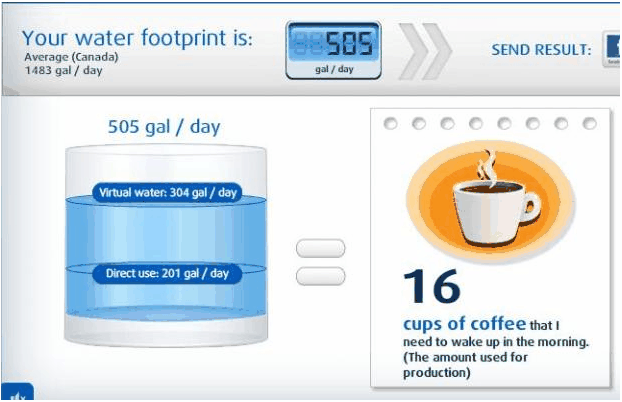
According to Wikipedia, the global average footprint is 1,240 cubic meters of water per person per year. That’s 1,240 metric tons, or 2,733,704 pounds of water.
That is ridiculous.
The United States, of course has the largest average water footprint in the world (2480 cubic meters), while China has the smallest at 700 cubic meters.
What’s your water footprint, ladies and gents?
TWSB: “Space Debris”
Today NASA is celebrating 30th anniversary of the first space shuttle launch. How? By announcing the final resting places of four retired spacecrafts: Enterprise, Discovery, Endeavor, and Atlantis.
Apparently there’s been quite a lot of vying over who gets the retired shuttles—21 official proposals were submitted to NASA, some with petitions 150,000 signatures strong behind them, others with plans to construct dedicated buildings to house the shuttles.
In the end, though, NASA administrator Charles Bolden announced that the Intrepid Sea, Air, and Space Museum, a wing of the Smithsonian’s National Air and Space Museum, the California Science Center, and the Kennedy Space Center won out for the Enterprise, Discovery, Endeavor, and Atlantis, respectively.
Smaller shuttle artifacts, like fuselage trainers and commander seats, are being offered to various other museums, according to NASA. And those museums may be better off financially when it all comes down to it—the four winning spaces will have to find room and money to house these 170,000 pound, 122 feet long giants.
Totally worth it though, right? I’d definitely hang with a shuttle if I got the chance.
TWSB: Arch Rival
For whatever reason, today from the deep recesses of my mind I recalled my last (only?) visit to the Gateway Arch in St. Louis. Back in the days before life was complicated and strange, my grandparents lived down in Missouri and my mom and I would occasionally jet down there to visit. Mostly because of Cracker Barrel, my grandpa’s set of Tinker Toys, and the Magic House, I found St. Louis to be a pretty sweet place.
But let’s get to the science. The Gateway Arch was completed in October 1965 and opened to the public in June the following year. It’s the tallest manmade monument in the States, required more stainless steel than any other project in history, and (though it doesn’t look like it) is as tall as it is wide.
According to Wikipedia, its shape is that of a catenary, not a strict parabola. A catenary is the shape that a hanging chain or cable assumes when it is supported at its ends and is acted on only by its own weight (Wiki gives the examples of a loose single-chain fence or the strands of a spider’s web).
Actually, the arch is (very similar to) an inverted catenary, as it is heavier on its ends. Architect Eero Saarinen claims the inverted was chosen over a regular catenary for aesthetic purposes—an ordinary catenary would “look too pointed.”
I actually remember watching a really fascinating building on the construction of the arch, particularly its topping out, but I can’t find the vid on YouTube or elsewhere right now. I’ll post it if I ever do find it.
More fun facts:
– In 1970, the whole arch shrunk three full inches due to cold weather.
– It is able to sway up to nine inches in one direction during high winds.
– It can withstand an earthquake. Unless the earthquake caused it to sway more than nine inches in one direction, I’m assuming.
– The windows up at the top are so small because larger windows would not be able to withstand the pressure (500+ tons) used to separate the legs of the arch in order to insert the final piece.
Cool, huh? If you’re ever in the St. Louis area, go and check it out. I was like five when I went up there and I still remember it.
TWSB: Japan’s Earthquake and Day Length
I heard about this a few days ago, but I’ve been listening to the news on the radio pretty much continuously since the 8.9-magnitude earthquake struck off the coast of Japan on Friday. I just finally got around to finding an actual article about it.
According to NASA geophysicist Richard Gross, it turns out that the massive quake accelerated Earth’s spin enough to shorten the length of the day by 1.8 microseconds (a microsecond is a millionth of a second). The earthquake changed the distribution of the earth’s mass, shifting more of it towards the equator and thus causing the faster spin (like when you spin on a wheely chair and tuck your legs in to go faster. Don’t pretend you’ve never done it). The quake actually moved Japan’s main island about 8 feet. 8 feet. Think about how insane that is.
The Chilean earthquake last year also shortened earth’s day by about 1.26 microseconds, and the Sumatra earthquake in 2004 shortened it by 6.8 microseconds. Gross believes that the aftershocks, smaller but great in number, could have a cumulative shortening effect on earth’s day as well.
Crazy, no?
TWSB: Super Moon = Super Lunacy
You know what the best part of This Week’s Science Blog is? How insane people get over the smallest things.
Well, largest things.
Hold on, let’s start again.
On March 19th, the moon will be the closest to the earth it’s been in 18 years. This particular lunar perigee is also special because the moon will also be full that night. Moon enthusiasts (lunatics?) are calling the event an “extreme supermoon,” and of course you’ve got the conspiracy people saying that the closeness of the full moon will lead to—what else?—terrestrial Armageddon.
While scientists have indeed shown that earthquakes are actually more frequent when the moon is closer to the earth, particularly when it is lined up with the sun (owing to the greater gravitational tug-of-war for the earth between the moon and the sun) and historic years involving supermoons have had worse weather, the dudes at NASA remain calm and assert that “there’s nothing really special about this.”
The moon will be closer to earth than it’s been in the last 18 years, true, but NASA scientist Dave Williams says that it’s closer by about half a percent more than usual—which is fairly trivial.
Even so, I’m hoping that the night of the 19th will be one of those super rare cloudless nights here in Vancouver so I can see the brightest, biggest moon we’ll have seen in 18 years.
WOO!
http://abcnews.go.com/Technology/supermoon-/story?id=13097014&page=1
TWSB: Science + Creativity = PLUSHIES!
I usually prefer my weekly science blogs to be my summaries of recent science news or old (but interesting) science phenomena. However, I happened to stumble upon The Particle Zoo’s website this evening and, though I’ve seen the website before (and I’m sure you all have too), Strange Quark is so freaking adorable and all this stuff is so fantastically awesome that I must dedicate this week’s blog to:
The Particle Zoo plushies (which has expanded quite a bit since I last visited, so it may be worth checking out again even if you’ve already seen it) and a map of the relationships between the particles (the main website is pretty snazzy, too).
Side note completely unrelated to blog content above: desire for tattoo = strong.
TWSB: Sometimes Lunacy is the Answer
Way back when these weekly science blogs started (or maybe it was before that?) I discussed the issue of the helium shortage we’re experiencing here on earth. Within the last year, thanks to this shortage, the price of the isotope helium-3 has risen from $150 per liter to $5,000 per liter. Nearly all of the helium on the planet exists within a single storage area within 250 miles of Amarillo, Texas. And that’s probably the least safe place for any rare commodity (‘cause Texans, man, Texas…). Helium experts (assuming such people exist) are afraid that we’ll run out of helium completely within 20 years if we remain at our current consumption rate.
Oh crap! What do we do?
Answer: mine the hell out of the moon.
After bombarding the moon in 2009, NASA scientists found—among other things—that the lunar soil is very rich in helium thanks to solar winds showering it for however long the moon’s been around (I think it’s like 4.4 billion years old or something, but don’t quote me on that). Not only does our natural satellite have helium, but it also apparently contains a bunch of rare earth elements (common-moon elements?), including europium and tantalum, both of which have applications in solar panels, hybrid cars, and other green energy applications. Right now China is the biggest exporter of such elements, but is currently reducing such exports, indicating the possibility of a shortage.
So yeah. It’ll be interesting if we ever decide to actually utilize the moon as an orbiting mine and if doing so would ever be a cost-effective procedure. The funniest part is the fact that NASA utilizes—guess what? helium—to pressurize space shuttle fuel tanks.
TWSB: Kitt Peak
So This Week’s Science Blog is going to be a little different. Why? Because my mom, Kurt, and I went up to the Kitt Peak National Observatory to stare at some badass stars and galaxies this evening.
So I shall tell you about that.
The KPNO is part of the National Optical Astronomy Observatory and has a total of (I think) 21 telescopes, including a badass sun telescope (seriously, HOW COOL?).
Anyway. Here is a picture of the sunset from up there. This is the only picture I took because, obviously, we were up there mainly during the nighttime.

First we saw Jupiter, and when I asked the guy there he said that it still wasn’t clear whether or not the southern equatorial band was reappearing yet. Through the telescope we could see the giant planet plus the Galilean Moons.
Then we got some star charts and went outside to try and find Orion, the Dippers, the Seven Sisters, and a bunch of the astrological constellations. I also found out that no matter how good the binoculars are, I still suck at using them.
We then hung out in one of the telescope rooms and stared at the Andromeda galaxy, some orbiting star pairs, a couple globular galaxies, and then the moon, which was ridiculously detailed in the telescope and pretty much blinded all of us.
If you’re ever in Arizona, get up to Kitt Peak and check out the firmament of awesomeness above us. And if you’re there during the day, for the love of GOD go check out the largest solar telescope on the planet.
Woo.
TWSB: Hey Baby, What’s Your Sign Test?
Stats jokes. They never get old.
Anyway.
David McCandless, among other cool people over at informationisbeautiful.com, gathered over 22,000 Yahoo! Horoscopes to prove what many of us already knew: repetitive predictions that generalize greatly across all 12 signs. Getting someone to access Yahoo’s archived horoscopes, these awesome dudes compiled every type of horoscope available—teen, love, daily, etc.—and extracted the generic daily ones. They utilized TagCrowd to extract the most popular words used for each sign. They then removed the “common” words—words that could really be found in any analysis—and produced a second table of truly unique words per sign.
Draw your own conclusions. I think this is fantastic. Check out their full article (plus meta-horoscope) here.
Also: happy birthday, Sean!
This Week’s Science Blog: Good (and Smelly) Vibrations
http://news.sciencemag.org/sciencenow/2011/02/do-vibrating-molecules-give-us-o.html
Smell has long been explained by the “lock and key” hypothesis, which holds that we smell when odor molecules—each with a particular shape—“lock” into matching smell receptors in the nose. What’s the problem with this hypothesis? The fact that there are only a few hundred of these receptors in the human nose, yet humans are able to detect thousands and thousands of different odors.
So how exactly do we smell, then?
Researchers at MIT are looking now at the role vibration plays in our ability to sniff stuff out. They believe that the reason certain odor molecules can have similar structures (like vodka and rotten egg odors, apparently), they have radically different vibration properties, which may be the key to our being able to differentiate between so many different odors with so few receptors.
The MIT scientists performed experiments with fruit flies in which the flies were placed into a maze into which two nearly identical odor molecules were pumped. Despite the molecular similarities, the flies showed preference to one odor over the other, indicating that they could tell a difference between the odors—a difference the scientists say is due to different vibration patterns.
While this study doesn’t apply to humans necessarily (obviously), the scientists are looking to extend its results to tests with mammals.
Because I’m me, I wonder how figuring out how smell really works would play into treatment for anosmia and parosmia. If at all. You never know, biology is weird.
TWSB: Comic Sans—Coming to a Classroom Near You
Yes, I’m counting this as a science blog. You can’t stop me.
I also think the authors came up with these studies so that they could put bold and italic type in their title.
Putting Comic Sans to its first good use since…well…since it was invented, the authors of this study took it upon themselves to examine disfluency—the subjective experience of difficulty associated with cognitive operations—and its relation to the retention of learned material. Basing their hypotheses on previous research, they surmised that disfluency leads to deeper processing of information, thus leading to better retention.
They decided to test this hypothesis by altering fonts used in teaching settings. In their first experiment, the researchers developed scenarios in which participants were to learn facts about fictional aliens by reading and memorizing the facts as they were presented to them. In the disfluent condition, the material was presented in Comic Sans or in Bodoni, both at a smaller point than the Arial font used in the fluent condition. Participants were given 90 seconds to memorize the list of facts, distracted for 15 minutes with an unrelated task, then asked questions based on the facts they were told to memorize.
Participants in the disfluent condition successfully answered 86.5% of the time, a statistically higher percentage than those in the fluent condition, who only answered correctly 72.8% of the time. The authors point to the results as evidence for their theory and point out that the discrepancy between the conditions could be due to several issues, including higher frustration levels in those who had to read the more disfluent fonts (I know if I had to read something school-related in Comic Sans I would probably stab myself in the eyes).
The second study was done with actual high school students in real learning environments. Sections of classes with varying levels of difficulty were randomly assigned to a disfluent or control category. Similar to the first study, the disfluent category required the fonts of all the learning materials to be either Haettenschweiler (which is about as difficult to read as it is to spell…and it’s partially difficult to spell because you can’t read its name to spell it), Monotype Corsiva, or Comic Sans Italicized. The font in the fluent category was unaltered. No other changes were made to the learning environments, and teachers were blind as to what condition they were in.
The effects of the disfluency were analyzed via the results of the assessment tests for the classes—particularly, a short survey was administered to test the effects of disfluency on motivation and motivation factors. Students in the disfluent condition scored statistically significantly higher on the classroom assessments than those in the control condition, indicating that retention of material—regardless of the subject and actual difficulty level of the class—could be heightened by use of disfluent reading material.
So basically, both of the studies done by these guys indicate that even something so seemingly simple as the font by which material is presented can have an effect on how well individuals learn and retain the material.
Which is pretty insane, but pretty awesome nonetheless.
New goal: type my MA thesis using Wingdings.
TWSB: Get a Muon, Nothing to See Here
More stuff related to the sun!
So it turns out, in a rare twist of events that doesn’t involve lasers, that scientists have determined that the weak nuclear force isn’t as weak as was previously thought. How did they figure this out? By determining to a more precise degree the lifespan of the muon, a subatomic particle similar to the electron.
[insert twenty minutes of me dinking around on Wikipedia reading about subatomic particles]
Apparently the muon lives for only 2 millionths of a second—or, more exactly, about 2.1969803 microseconds. This precise number was determined by scientists using a proton beam and graphite to create muons and by subsequently measuring the muons’ deaths with some sort of special detector thingy (technical, eh?). Over 2 trillion muons provided the data that led to the average lifespan of a little less than 2.2 microseconds.
So why do this? Because a more precise estimation of muon lifespan can be used to determine the intrinsic strength of the weak nuclear force. And why worry about the strength of the weak nuclear force? Because it is at least in part responsible for protons turning into neutrons inside the sun, which is pretty much a step before these particles are turned into heavier elements (like helium!) and…well, you know the rest.
The Fermi constant, a number used to capture the strength of the weak nuclear force, has been upgraded by about 0.00075 percent due to the muon experiment. Professor Michael Ramsey-Musolf, an expert on the weak nuclear force at the University of Wisconsin, says that “this implies that the sun does indeed burn more brightly and that the decay of nuclei is somewhat faster.”
And that’s pretty cool.
Or hot.
Ha. Puns.
This Week’s Science Blog: Statistics Porn
This is not a cop-out TWSB post. This is like porn to me. It’s also like an hour long, so just FYI, watch it when you’ve got some time.
This Week’s Science Blog: Sliding scale fun!
Here’s a short and sweet TWSB for you all, since I spent all afternoon at Sean’s and just rediscovered this while using the airports’ free internet. You’ve probably already seen this already, but it’s still awesome.
Today’s song: Mademoiselle by Berry
TWSB: To the Ends of the Earth…Er, Solar System
First off, if I were to ever become a supervillian, I’d want my name to be Heliopause. Just ‘cause.
Voyager 1, launched 33 years ago, is now approaching the edge of our solar system.
Scientists know the craft has reached such a point by observing a change in the particles that surround it. These particles, emanated by the sun, are, instead of travelling outwards, are flowing sideways. This means that the particles are shifting in order to go down the tail of the heliosphere, which is indicative of Voyager 1 making the jump into interstellar space.
Around the heliosphere is the heliosheath, in which temperatures rise and wind speeds slow to zero. Scientists are measuring particle speeds around Voyager 1 to be nearly zero, thus they believe this is where the craft is. It is suspected that it will make the cross-over in the next few years.
The initial goals for Voyager 1 (and its sister Voyager 2) was to survey the outer planets Jupiter, Saturn, Uranus, and Neptune (and Pluto, too, back then I guess). This was accomplished back in 1989. Now it’s breeching the outermost reaches of our star.
How freaking cool is that?
Today’s song: Guilty Pleasure by Cobra Starship
TWSB: Canada – A Weighty Issue (Or “massy,” rather; shut up, it’s a pun)
Canada: being the nonconformist country since 1867.
For over 40 years scientists have been trying to figure out why parts of Canada—specifically the Hudson Bay area—experience lower gravitational pull than other parts of the world.
Yeah, seriously.
Freaking Canada.
There are two theories that have been put forth to explain this phenomenon. The first has to do with the convection currents of the earth’s magma. Scientists who support this theory think that convection beneath the Hudson Bay area is causing the continental plate there to be dragged down, thus decreasing mass and, subsequently, decreasing gravity.
The second theory has to do with the old Laurentide Ice Sheet. This ice sheet covered much of Canada and the northern US way back when glaciers ruled the world. The ice was about 2 miles thick in most sections (perspective: the Antarctic ice sheet covering the continent can be as thick as 3 miles) and thus was super heavy and weighed down that part of the earth, displacing the mass underneath it.
This ice sheet melted over the course of 10,000 years, but the earth that had been beneath it is still “rebounding”—that is, it is still quite a large depression that is slowly rising back up to what would be a normal level if the ice sheet had never been there. Because this depression still exists, that is the cause of the lower amount of gravity in that region of the planet.
Apparently, it turns out that both theories are correct. There’s mega convection going on beneath the earth’s surface under the Hudson Bay, but there’s also been a measured effect of the earth rebounding from the glacier. Though this rebound will take about 5,000 more years, the change that is occurring is prominent enough to be observed—the sea level, which is rising in other parts of the world, is noticeably dropping along Hudson Bay.
So yeah. Convection + Ice Age influence = Canada’s weird.
Cool, huh?
Today’s song: I Turn My Camera On by Spoon
TWSB: BLACKER THAN THE BLACKEST BLACK TIMES INFINITY
Oh, NASA.
NASA’s telescopes and cameras in space require the use of a super black paint dubbed Z306 in order to reduce photon contamination by absorbing erratic light that ricochets off the instrument components.
However, Z306 is apparently not black enough, as NASA scientists have been working towards and have finally developed a new material that is like 10 times blacker than Z306 and is made of carbon nanotubes grown on titanium. The big breakthrough here, aside from the DARKNESS THAT IS THE NEW BLACK, is the fact that the scientists were able to develop a material that would allow the nanotubes to stick effectively to it, therefore reducing the risk of them scratching off under wear.
You can read more about it here. Sounds pretty snazzy, if you ask me.
Today’s song: Creep by Scala & Kolacny Brothers
TWSB: Yay, Jupiter’s going to be able to hold its pants up again!
(Obligatory belt joke taken care of)
This photo shows a picture of Jupiter’s SEB (Southern Equatorial Belt) returning after its disappearance was noticed last May. This picture and others capture plumes of energy breaking through the cloud tops.
So pretty soon, say scientists, Jupiter will return to looking like we’re used to seeing it.
Haha, I know this This Week’s Science Blog is short, but I’ve been wondering when the band would return since I became aware of it being gone.
Today’s song: Nocturne by Nomo

 Eigenblogger