More NaNo Thoughts
In addition to 1) wanting to continue working on last year’s NaNo, despite its lameness, and 2) wanting to retry my 2016 NaNo idea, despite its lameness, I have another (lame) idea that I’ve had in the back of my head for a while. It’s an idea that I’m sure has been done thousands of times…but hasn’t everything? It’s all about how you do it, right?
Anyway. It involves a cruise ship on which it is discovered that one of the passengers has some contagious illness (possibly one that the CDC hasn’t fully identified yet, but is dangerously contagious and deadly) and no port will allow the cruise ship to dock due to the risk of spreading the illness, so they’re forced to remain at sea as more and more passengers get sick and provisions run low.
Yeah, I know, dumb.
OH GOD NANOWRIMO
IT STARTS SOON
I AM NOT PREPARED
Part of me wants to keep working on my story from last year, even though I know the plot is dumber than dumb and I would do absolutely nothing with that story other than put it in the drawer (or USB) with all the other garbage I’ve ever written.
Another part of me wants to re-try the story that I attempted back in 2016. Like, same idea and stuff, but scrap everything I’d done that year and restart it.
I’ll probably do that, but who actually knows. There’s also a strong possibility that I’ll fail again this year because THAT SEEMS TO BE ALL I KNOW HOW TO DO ANYMORE.
URGE to WRITE
Dudes, I have had such a serious urge to write ever since NaNoWriMo ended. It’s freaky. I haven’t had just an urge to write in a long time.
More specifically, it’s an urge to keep working on my NaNo story, even though the thing is a piece of garbage and will never amount to anything.
Much like its creator.
But still. Maybe I’ll just have to keep working on it anyway. It’s really only like 30% – 40% done as far as the full story goes right now. Which is weird, ‘cause most of my NaNo stories (read: all of them) are at like 90% completed story-wise by the time I hit the 50,000.
ANYWAY. Time to write.
The WriMo has Ended!
Heeeeeeeeey, guess what? I actually won NaNoWriMo this year! The last time I won it was in 2014, which is way too long ago.
- Total words: 50,250
- Percentage of total story complete: I dunno, maybe 40%?
This is also the first WriMo where I’ve felt like wanting to continue to work on the story after the month was up. It’s also the first time I have a story that would actually work as a novel-length thing. Prime, Google, and Arborhood would all work better as novelettes, probably.
WORD CLOUD!
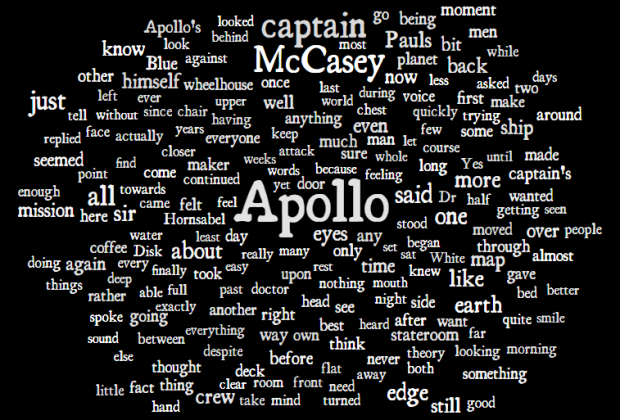
NaNo Soundtrack??
Aloha, bitches! NaNoWriMo is almost over and I have a very good chance of actually winning for the first time since 2014. Which is pretty cool.
So to distract myself from everything (especially Annabelle), I present to you the short but sweet set of songs that I would consider to be part of the “soundtrack” to my NaNo project this year. There’s not much, but there are a few tuned in tracks (ha), so let’s do it.
Clair de Lune (Debussy) – This is the song I hear in my head when my main dude (Apollo) goes out on the main deck during a cool, calm night and witnesses the captain up on the main deck already, staring up into the stars as if asking them what his purpose is in everything. Kind of a special little moment between the two characters without any sort of interaction at all.
Where We’re Calling From (Doves) – This song plays when they finally reach the edge of the earth. It emerges out of the fog; at first they just hear the rumbling of the ocean breaking over the precipice, then as they get closer, the fog clears up a bit and they see the great chasm below that is the abrupt edge of the world.
10,000 Miles (Mary Chapin Carpenter) – This song hurts my soul, but it’s perfect for the one of the main ending scenes (the one I posted on the 15th, actually). I wanted the end to be a very heart-wrenching experience for Apollo, and this song fits it perfectly.
Nano Excerpt 2017
HEYOOOOOOOOO
So it’s about that time in November where I annoy you all with an excerpt from my garbage bag of a NaNoWriMo story. SO LET’S GET TO IT!
Context: so this story exists in kind of a future world of ours where science has actually provided proof* that the earth is, in fact, a disk-shaped object rather than a spherical one. Basically, the timeline went from flat-earthers to, as I’m calling them, “round-earthers” (people who were convinced that the earth was a sphere, like we know today) to “disk-earthers,” or people who have come to accept the new scientific evidence that the earth is a disk.
The problem is that (for a number of reasons) no one has ever actually seen the edge of this disk. This story focuses on one crew who is trying to do exactly that: sail to the edge of the earth so as to obtain demonstrable proof of the fact that the earth is flat (and to, you know, explore, as explorers do).
[Edit: I had a different excerpt here originally, but I hated it and like this scene a little bit better.]
So the crew does turn out to be successful in their mission and they do in fact stumble upon the edge of the earth (though it takes them much longer to do so than their captain, McCasey, told them it would). However, once they see the edge of the earth from their ship, they are unable to get very close due to some extreme weather conditions that exist in the tumultuous atmosphere at the edge of the planet. So McCasey (who’s headed three previous missions to the edge of the earth, all of which had failed for one reason or another) has run the ship aground on one of the tiny islands near the edge and selected a group of men to proceed on foot so that they can get closer.
This scene is actually near the end of the story. Due to the amount of time it took for the ship to actually reach the edge of the earth, a lot of the men on the ship started doubting McCasey’s ability to lead (as well as his sanity; he starts getting weird and reclusive as time goes on). A decent number of these doubters are included in the small exhibition group that goes with McCasey to get to the edge on foot. Really, the only two people in the group who don’t doubt his abilities are the ship’s doctor (who’s also McCasey’s old friend) and Apollo. Apollo is the cartographer who’s been brought along to map the edge of the planet. He’s the only “disk-earth skeptic” on board and is one of the only cartographers around who still actively makes globes. He’s aboard because he’s one of the best cartographers in the world and because, upon hearing about the opportunity to sail to the edge of the earth, wanted to go along with it because he wanted to be there with others when it was revealed that there was, in fact, no “edge” because the earth was really round. Despite the fact that he and McCasey had vastly differing views about the shape of the earth (at least until they actually got to the edge), he and the captain became very close.
Anyway. A few days before this scene, there was an accident on their journey and two of the other men got killed. This really divided the group and basically set everyone except for the doctor and Apollo completely against McCasey. With the weather and conditions getting worse, everyone wanted to press on as quickly as possible, but McCasey still wants Apollo to do what he’d been brought along to do: sketch some maps of the edge of the planet. So he suggests that he stays behind with Apollo while the rest of the party continues ahead of them.
This scene occurs after a particularly rough set of days where McCasey and Apollo were stuck in near-blizzard conditions in sub-zero temperatures. They’re both very weak and sick (particularly McCasey) and so Apollo decides to set up their shelter for the rest of the day/night so that they can get a fresh start the next day. So he does that and the two hunker down for the night. Basically what happens here is McCasey knows that he’ll probably be the death of both of them if he keeps going in his injured/sick state, so he chooses to wander off into the snow instead.
I’m being really vague because I hate this freaking story and I know it’s no good, but the 15th is Excerpt Day, so y’all get to suffer through this thing with me. Also, this is me writing about something I know little to zero of (ships n’ stuff n’ exploring) with no time to research much (NaNo is writing, not research!) and zero editing.
So…enjoy.
(Nate, don’t read this, it’s terrible)
Apollo awoke to the sun blazing its way through the thin fabric of the tent and a looming feeling of dread in the pit of his stomach. That familiar hint of alarm was slight and it barely caught his attention, but it was strong enough that he did notice it.
It took him a second to register that he was alone. McCasey wasn’t beside him as he slowly transitioned from being half asleep to feeling a bit more awake. Figuring the captain had already woken and was outside of their makeshift shelter, Apollo took his time getting up. He was warm – finally – and he had no desire to end the feeling until he absolutely had to. Taking advantage of McCasey’s tendency to rise early and to stay awake after doing so, Apollo helped himself to the captain’s portion of the blankets and wrapped them around himself, reveling in the cocoon of comfort he knew would have to be broken in order for them to continue their journey to reach the others.
He sunk down into the blankets with the intention of staying in them as long as possible, which meant until McCasey returned to the shelter and prompted him to pack up to continue their walking. But as he lay back to try and catch a bit more sleep in the interim before the captain’s arrival, Apollo realized that the barely perceptible feeling of dread he’d experienced upon waking had transformed itself into something stronger. It felt now more like a pulsing ball of worry that was starting to eat at his stomach.
Apollo tried to rationalize this dread that had seemingly come out of nowhere. It was likely it was just a manifestation of his feelings regarding the whole second half of their mission. Ever since they had stepped off the ship to continue their journey on foot, things had seemed to go wrong at a fairly consistent pace. First the shock of how difficult it was to breathe in the thin atmosphere at the edge of the planet, then the rough going through the snow and wintry conditions, then the accident and deaths of Johnson and Davie.
The fight between Pauls and McCasey had truly been what separated the group, but the actual physical separation had come when McCasey had insisted on Apollo’s completion of the map and his unyielding desire to remain with the map maker until he finished, forcing the others to go ahead under the direction of Pauls. There was also McCasey’s second injury of their journey by foot, which had made it all the more difficult for him and Apollo to catch up with the faster moving group of crew.
Still, though, McCasey had remained optimistic throughout all of it, and had assured Apollo that if they got early starts and were able to keep up a steady pace during daylight, they would be able to catch the rest of the crew in less than four days, five max.
Where was McCasey?
Thinking of the captain made Apollo realize that the man had yet to return to the shelter. Surely using the bathroom or just getting some fresh air wouldn’t normally take him so long. Maybe his injury was slowing him down.
“Captain?” Apollo called it from inside without moving, not yet wanting to release the warmth from his cocoon of blankets. He waited for a moment for a response, and when he got none, he called again.
“Captain? Sir? Are you out there?”
The feeling of dread in his stomach was boiling now; Apollo unwound himself from the thick blankets and tossed on outer jacket as quickly as he could to try to contain the heat still radiating from his warmed body. He poked his head out of their shelter to see where McCasey was.
“Sir?” He had to shield his eyes from the sting of the blowing snow, the storm having come in quickly on the fast- moving morning wind. The sun, which had woken him with its brightness, was now muted by the dense clouds above him. But even without the stinging blaze of the sun in his eyes, he couldn’t see the captain anywhere.
“McCasey, sir? Are you out here?” Apollo ventured out of the shelter now, more earnestly scanning around their shelter to see if there was any indication of where the captain was. He plodded around a bit, eyes blinking away the stinging snowflakes, looking. Had McCasey gone back in the shelter behind him, and Apollo had just missed him?
“McCasey!” Apollo spoke a bit louder. He turned to check behind him, and that’s when he saw the footprints. They were unmistakably McCasey’s and were fairly fresh, though were quickly being filled with the rapidly falling snow. For the briefest of moments, the thought flashed through his head that McCasey had gone on without him, trying to catch the group by getting an earlier head start than he could have if he’d waited until Apollo was awake.
But this thought disappeared as quickly as it arose as Apollo realized that the tracks McCasey had left were going off in the wrong direction. Rather than heading in the same direction that they had been going when they’d stopped the night before, the footprints went off in a perpendicular direction – nowhere near where the others were and nowhere near anyplace that Apollo could think was worth going.
“McCasey!” Apollo called. Nothing answered him but the wind and its whipping through the falling snow. Apollo took a few bumbling steps in an attempt to follow the footprints, then called again. “McCasey!”
Nothing. More earnestly than the first time, Apollo attempted to run in the direction of the footprints. He grunted, the newly-fallen snow making the otherwise natural action incredibly difficult and tedious. In a manner of less than a minute, he was gasping for breath and struggling to stay upright.
Had the captain been trying to scout out a route to follow and mistakenly gone off in the wrong direction? Had he just gone outside to get some fresh air and gotten lost in the falling snow? Had he gone further away from the shelter than he’d originally planned, and in trying to get back, gotten lost in the near white- out conditions? The circumstances of the weather and of their predicament made all of these options possible. But as Apollo continued his vain attempt to follow the footprints, which were rapidly disappearing under the falling snow, he knew that none of these were what had really happened.
Apollo was gasping from exhaustion and from anger now, his tear-filled eyes straining to follow footprints that were little more than shallow indents in the thick snow underfoot. He gritted his teeth and, with every ounce of strength and every molecule of oxygen he had in his body, he lifted his head and yelled.
“Coward!” Apollo shouted it into the falling snow, his voice breaking with a sob. “You coward!” But as soon as the words burst from his lips, he regretted them. Stumbling, he finally succumbed to the heavy snow around him and collapsed to the ground. “I’m sorry,” he whispered into the snow, shaking, hot tears falling from his eyes and burning through the cold whiteness beneath him. “I’m sorry.”
The coldness that had been so all consuming a mere five minutes ago had now left him. Through his tear-blurred eyes, Apollo could see the rapidly-building snow begin to pile around his lower arms as he remained motionless and kneeling in the snow. For the briefest moment, he succumbed to it, accepting his fate as the white flakes began to bury him. He was content to be consumed by it.
But in another minute that feeling was gone and replaced with nothing but numbness. Somehow he pulled himself up and out of the snow. Somehow he made his way back to the makeshift shelter and climbed inside. He made no effort to warm himself in the blankets and instead remained on the cold, hard floor, shaking from cold and fear and anger.
Time passed. Apollo knew not how much. His eyes were glazed with tears, his mind clouded with a numb feeling of shock and fear. But the cold finally returned to him and, shivering, he crawled beneath the shelter of the blankets that he had left to go search for the captain. And as his body warmed, his mind seemed to come back to him.
Perhaps McCasey would return. Perhaps this was nothing more than a mistake. A quick survey of the captain’s belongings suggested he had taken nothing with him when he departed. It had been a scouting mission, Apollo thought. It had to be. He would return, hopefully before dark.
But the approaching night showed no inclination for lenience. Beneath his cocoon of blankets, Apollo watched the shadows as they moved along the walls of the shelter, bending as the sun traveled on its low arc through the sky. Around what Apollo assumed to be five in the evening, he consumed his portion of the dinner ration, his eyes never moving from the door of the shelter, keen still on seeing the shadow of the captain approaching from outside.
McCasey was not back by nightfall. The sun sank, darkness filled the void left by the departing shadows, and Apollo used precious lamp oil to keep the tent’s hanging lamp as bright as possible all night—a lighthouse in a sea of snow and cold. As much as he tried, Apollo did not make it through the night awake, and was ashamed when the sudden brightness of the abrupt morning of the edge of the earth startled him into a wakeful state. Momentarily panicked, he glanced around to see if any of the inside of the shelter had been disturbed, suggesting that the captain had returned in the night. Finding nothing, he stumbled free of the blankets and unzipped the shelter door to get a glance outside.
The snow drifts had piled up so high during the night that Apollo actually had to push away a decent amount of snow from the other side of the door to even be able to see out, but this and the fact that there were no visible signs of footprints outside suggested what Apollo feared but what he had seemed to know all along.
McCasey had not returned.
*This involves a whole bunch of nonsense that I’m not going to get into here, so just take it as fact in the story.
Panic! At the Winco
So NaNoWriMo’s actually going decently well this year. I got way behind on like day 2 but was able to catch back up and have been pretty steadily on pace for the rest of the days.
The thing that’s the best, though, is the fact that I’m doing a lot of my writing at night after Nate goes to bed…which means that half the time I’m in my weird half-awake/half-asleep state of mind where I do and say things that I later have no recollection of doing or saying.*
I’m only about 17,000 words into this thing, but here’s some nonsense that has snuck its way in due to my weird half-sleep brain.
- I spend half a page talking about Girl Scouts. Girl Scouts has absolutely nothing about this story. I’m writing about explorers on a ship. No Girl Scouts. But my idiot brain made this really dumb transition from talking about the usefulness of the scientific method to talking about whether or not it’s a good idea to force little girls to join Girl Scouts. Because the two things are so related.
- Pretty sure phrases like “tender throat” belong in erotica, not in this particular story.
- HAHAHA, so my main character’s name is Apollo, but apparently there’s been at least three separate instances where my half-asleep brain has misspelled “Apollo” so terribly that auto-correct has changed it to “appalling.” I agree, auto-correct. Appalling.
- Semicolons; so many semicolons.
- Parts of this really read like a bad porno and it’s making me seriously reconsider the genre.
- Genre: “Adventure.”
- There are swaths of this thing that I honestly don’t remember writing. When in the hell did I write half of this?
GOD THIS STORY IS TERRIBLE
*For example, not too long ago I was browsing Reddit on Big Compy late at night and the next thing I know I’m waking up on the couch having zero memory – zero – of when and how I got on the couch. It’s actually kind of scary when this kind of stuff happens.
WRITING IS HARD
UGH I’m already way behind on my NaNoWriMo words. I should be at 6,667 words today to be on pace, but instead I’m at 3,407.
Balls.
The worst part of NaNo is just getting started. Like, once I’m at 7,000 to 8,000 words, I feel like I’ve got some momentum and some actual substance to a story and can go from there. But until then?
Me @ 9:00: I should do some writing.
Me @ 9:30:
Me @ 10:00:
Me @ 10:30:
Me @ 11:00:
Me @ 11:30:
Me @ midnight: WELL I GUESS THIS DAY IS OVER
Get on it, Mahler.
Oh, right. NaNoWriMo.
That starts in a few days, doesn’t it?
Hell.
Well, I have an idea, even though it’s a garbage one. Though that kind of describes all my NaNo ideas, so…
I’ll give it a shot. Might not be able to win this year because of the combination of work, my walking goal, and the fact that Nate and I just bought Rock Band, but hey. WE’LL SEE I GUESS!
FFFFFFFFFFFFFFFFFFFF
I deleted my NaNoWriMo novel because IT IS GARBAGE AND SO AM I.
Edit: I also deleted my NaNoWriMo profile because EVERYTHING I WRITE IS GARBAGE AND SO AM I.
In the Key of Spook
I’m super into my dumb NaNoWriMo story right now. I know it’s early in the month and I have very little written right now, but like I always do, I have a few songs that I think “match” well with the tone/theme/goings on of my story. So here’s the list for Ghost Town Realty:
- I Died So I Could Haunt You by The Five Ghosts. Kind of an obvious choice, of course, but how many songs about ghosts/haunting are this upbeat?
- Hello by Adele. I like how wanting this song sounds. There’s a yearning behind it that I think matches really well with the relationship between one of my living characters and one of my ghost characters.
- Indigo by Epica. I don’t know what the climax of my story will be yet, but this would be the song to go along with it.
- Life is Beautiful by Vega 4. Another kind of mournful/yearning song, but with a slightly different feel. My main character and his struggles with live vs. death needs a mournful song.
- When It’s Cold I’d Like to Die by Moby. The right-after-the-climax song or the sad-but-resolute-end-of-the-story song.
Geist, Geist, Baby
So I don’t have too many “large” sections of my story yet, but I did kind of write out short descriptions of the ten different types of ghosts featured in the story. So that’ll be my excerpt I suppose. ONWARD! And keep in mind that this is all rough draft, unedited nonsense. And it probably won’t even be in the “final” draft of the story anyway; it was just a good place to kind of stop and describe the ghost types.
Anyway.
The encounter with the suspected Drone that afternoon had left him shaking; upon returning home, he quickly dug out his Bureau manual – something he hadn’t touched in years – to check and see if he had actually seen a Drone and not just an unusual looking lower form of ghost.
However, he was familiar enough with the lower types that he suspected the latter not to be the case. The lowest type of ghost, the Ghostlet, was one he had seen since he was 21 years old. His first encounter with this type of ghost involved all the typical encounters with Ghostlets. Nick had been playing video games in his basement when he’d heard a commotion upstairs. Upon investigating, he found an odd, clumsy being stumbling about in his kitchen, knocking over things on his counter and opening and shutting every cabinet it could find.
Luckily, Nick’s childhood fascination with ghosts had carried on into his teen and early adult years, and he was studying to become an employee of the Bureau of Death and the Deceased. He recognized right away that the being was a ghost and, specifically, that it was a Ghostlet. The characteristic clumsiness, as well as the way it stuttered when it finally spoke to him after he’d calmed it down, suggested as much. After much stuttering and sputtering from the ghost, Nick eventually gathered that he wanted out of the house, but had forgotten how houses worked since becoming a ghost. He had been opening and closing the cupboards to try and find the exit. Nick had led it to the door and the Ghostlet, clumsily grateful and apologetic for the mess he’d made, disappeared down the road. Nick had never seen him again.
But he’d seen many Ghostlets since then. Apart from the clumsiness and stuttering, he knew them to be characterized by their close appearance to their human counterparts. They were, of course, the ghosts closest to the living in terms of timeline. Thus, they held on to their physical human forms, sometimes even appearing indistinguishable to humans for those who were near enough to their deaths to see them. In fact, the Ghostlets had been one of the last recognized ghost types, as those who didn’t see them felt no experience – good, bad, or otherwise – from them, and those that could see them would often confuse them for living beings rather than ghosts.
But the Phantoms were different. The next step up, the Phantoms were the “stereotypical” ghosts that a lot of people thought of when they heard the word. A Phantom ghost was one who had lost all the “flesh” of a human and, unlike a Ghostlet, stood like an almost transparent projection of a human being. Social, drawn to humans, and naturally curious, the Phantoms were the ones most often accidentally photographed and the ones that many haunted house claimers used to justify their assertions that ghosts lived in a property. As harmless as a ghost could get, the Phantoms were usually the most benign of all ghost types. Their friendliness led to a particular law being passed that stated any house occupied by a Phantom could also, should both parties agree to it, be occupied by a human or multiple humans as well. Of course, as is the case with any other ghost, only those close enough to their deaths could see the Phantoms. They were common – not as common as Ghostlets, but a ghost that was seen frequently by the common person and by those in the Bureau.
Standers were Phantoms but with social anxiety disorder. That was the lighthearted way Nick’s manual had treated them and how it explained the difference between them and the step from which they evolved. Shier than Phantoms, Standers were usually stranded amongst people solely due to the reason that while many felt as if they could float through walls and floors at this stage in their existence as a ghost, moving through solid, non-organic objects was something that didn’t happen until a ghost was, at the very least, a Blue Type. But the Standers always seemed to be confident in their ability to warp physical space around them and were always disappointed when they’d planned to use this ability to escape sticky situations but were instead left to deal with the people around them, many of whom able to see them.
The next progression, Blue Types, were another general ghost stereotype. Blue Types were the first ghost stage able to transfer through matter, and thus were the ones that often appeared sliding through walls or beneath rugs or between stories in a house. True to their name, these ghosts emitted a soft, blue haze about them. Blue Types were commonly lonely and liked to be around people, but were more elusive than the Standers, as they could finally fade through a wall or drop through the floor when they no longer felt like being social.
Blue Types, like most ghost types, were often very quiet, their presences felt more by sight and touch than by audible cues. However, as they progressed in age, the Blue Types became Drones, the loudest of all the ghost types. The sign that a person hadprogressed from being able to observe the Blue Types to being able to observe the Drones – and thus, the sign that a person was that much closer to their own death – was not seeing this new type of ghost, but rather, steadily becoming aware of a low, persistent, unreal hum that seemed to be emanating up from the ground wherever the person went. The sound came from the sidewalk, from the pavement, from the garden, from the trees. It was all-encompassing and, for many, something that was difficult to deal with during the first year or so of having to get used to it. In fact, though it took a couple of years to do so, doctors and psychiatrists finally correlated the relationship between when many individuals progressed enough Witness Levels to be able hear the Drones and when many people tended to experience mid-life crises.
Ghosts that progressed past Drones quieted down once they entered their next stage: the Haunters. Haunters floated. They floated everywhere. They followed people, followed cars, followed flocks of livestock around farms. Perpetually curious about the human world they’d left behind, Haunters were always observing, and doing so quietly. In fact, a great number of people nearer to their deaths than most tended to appreciate the Haunters the most, as they were the calm, quiet sanity that followed at least a decade of having to hear the Drone’s low, mournful whine.
Once a ghost progressed to a Soul Slick, they stopped being bound by many of the laws of nature. Soul Slicks were small – the smallest, usually, of all the ghost types – and failed to resemble their original human form even in the most basic sense. Abstract, elusive, and commonly quick to move from location to location, the Soul Slicks were usually the ghosts responsible for misplaced items, objects moving without seeming to be moved by anything that could move them, and for many mirror experiences involving ghosts.
Soul Slicks, after a substantial period of time, became Whispers. Television static that seemed to talk, voices on the phone line that seemed to be there behind the steady drone of the dial tone, garbled words that crawled out of the sink drain as the water sucked and spun down – these were the work of Whispers. This form of ghost was fragile, fleeting, and difficult to capture, even by someone who was advanced enough towards their own death that they could clearly see them. Most were too fragile to attempt a possession, and the rare Whisper that managed its way into the being of a living being usually had little time to do anything with the body before the being’s life expelled it as if it were a poison. In general, as it stood, Whispers possessed no desire to interact with living things. They were, in most cases, a higher level version of the Standers.
As gentle, fleeting, and shy as the Whispers were, Screamers were the exact opposite. It was common knowledge that a ghost could not cause the death of a creature in any way (apart from, perhaps, a human having a heart attack from fright – which in itself was rare, since everyone spent their lives with ghosts and thus were rarely startled by them). However, if a human came into contact with a Screamer, it was not unusual for them to feel like this common knowledge was about to meet the ultimate test.
Screamers were aggressive. As such advanced ghosts, many of them were attached as strongly to their respective residences as any human would be. It was widely assumed that Screamers, like every other type of ghost, knew that it could not cause mortal harm to a human. However, very few of them acted without the restraint provided by this knowledge. Reports of Screamer encounters usually involved some sort of struggle or trauma – being thrown down stairs, getting slammed against walls by the ghost as it hurled itself through behind, furniture thrown about and causing blunt force trauma, and various other injuries that resulted from the interaction of an overly aggressive ghost and a terrified human.
Then there were the White Lights. The top level. The end. The point at which there was nothing beyond. Nick’s manual had had a surprisingly thick chapter on the White Lights, despite the fact that the first sentence of the chapter somewhat shamefully admitted how little humans knew about this final ghost form.
All information about White Lights, he’d read, had had to be gleaned from those rare and often traumatized individuals who had, for some reason or another, seen their White Light as they faced the brink of death but who had then been grabbed and pulled back into the world of the living. These people, few and far between, all seemed to have slightly different experiences with their respective White Lights. Some said their Light spoke to them. Others said that their Light was silent, but had beckoned them closer with a cold, bright, finger – like appendage. Even others said that their White Light had appeared so far off in the distance that they had the compulsion to run towards it in order to not let it escape.
Plot Whole
HI AGAIN.
So remember a few days ago when I blogged about NaNoWriMo and mentioned that I’d update that post with a plot summary?
Well, I’ve got absolutely nothing of interest to say today, so I’ll just post that plot as today’s blog.
Because I can.
Okay. So the world my story is set in is exactly the same as our world now, except everyone knows and accepts that ghosts are real and exist among the living. In fact, everyone can see ghosts, but when a person able to see them and what types of ghosts they’re able to see depends on how close the person is to his or her own death.
It’s like this: ghosts are classed into one of ten types, depending on how “old” they are (that is, how long the ghost has been a ghost) and the properties that they have. Ghosts range from Ghostlets, which are the “just dead” ones who still resemble the people they were when they were alive and are super clumsy and awkward because they’re not used to being ghosts yet, to White Lights, which are the oldest known ghosts and have the job of ushering people through the final stages of death (which is why many people who survive a near-death experience say that they saw a white or bright light). The closer a person gets to their own death, the more types of these ghosts they’re able to see. People start with seeing Ghostlets and progress from there.
While ghosts and humans get along (in most cases), the government has decided that it’s a good idea to keep humans and ghosts separate as far as living spaces go. This is the job of the Bureau of the Dying and Deceased. Many of the people in this Bureau basically act like realtors for ghosts, ushering them to dwellings that are unoccupied by humans.
My main character, Nick (named, of course, after my awesome friend Nick who seems to have dropped of the earth. Hi, Nick, if you ever read this!), is an employee at the Bureau. He goes around making sure that ghosts have proper living spaces and remain out of the living spaces of humans. Of course, he can only work with the types of ghosts he can see—which, at the beginning of the story, are just the three “youngest” types.
However, Nick notices that his ability to see older and older ghosts is progressing very rapidly for someone his age, which suggests that he is quickly approaching his own death. While the progression differs from person to person (e.g., one person might be “stuck” seeing a certain type of ghost for a much longer period of time than another person), he knows that his own progression is abnormally fast. So he spends most of the story trying to figure out what might be causing him to progress so quickly towards his own death. He knows he can’t stop the progression, but he at least wants to see if he can slow it. A lot of this involves Nick talking to ghosts of various ages/types to try to figure out what’s going on with himself.
Haha, it sounds so dumb when I write it out like that. But I’m having fun with it so far.
NANOSTART
Heyyyyyyyy, it’s that time of the year again: NaNoWriMo!
So I’m not currently super confident about my idea, but that might mainly be due to the fact that it was what I wanted to do last year, but ended up not even getting started on it due to extraneous circumstances (read: school). That gave me a year to kind of mull it over in my head, which usually leads to making the idea worse rather than better. So that’s a bit terrifying. I prefer to be, in the terminology of NaNo, a “pantser.”
So we’ll see how it goes. I’ll update this with a plot at some point.
NaNoIDunno
NANOWRIMO STARTS IN FOUR DAYS
I HAVE ZERO IDEAS
AHHHHHHHHHHHHSLDFJSLDFSAFL;HFLKSDF
(Quality blog post.)
NaNoWriMo restart!
The NaNoWriMo website has been reset, meaning that NaNoWriMo 2015 is approaching quickly!
I’m preeeeetty sure I’m going to participate this year…that might change due to school stuff if necessary, but barring that, I’m totally going to do it. I think my idea for this year’s novel will come from a dream I had awhile back. It was about this realtor in some town out in the desert who not only had to act as a realtor for the living inhabitants of the town but for the dead ones as well (the ghosts). That is, he had to figure out how best to divide the real estate market between those who wanted to live in houses and those who wanted to haunt them. Every time he screws up, someone ends up living in a haunted house.
It’s a pretty dumb idea, but I like the title “Ghost Town Realty” for it even though it’s not really a ghost town he’s dealing with.
Blah. We’ll see how it goes.
Primin’
HELLOOOOOOO!
So I’ve edited 45 more (single-spaced) pages of Prime since I started working on it about a month ago. That may not sound like much, but it’s 45 more pages than I’ve edited in the past year and a half. (Blame Nate, he’s giving me the motivation to write/edit.)
So.
I seriously doubt I’m going to ever do anything with it (mainly because it will still be crap even after the 30th edit or whatever), but it’s nice to be working on it again. As crappy as Prime is, it’s my baby and I love it.
OH CRAP
I’m pretty sure hell has just frozen over, as I’ve decided to go back and edit Prime some more. I was on an editing streak way back in summer of 2013, but then I stopped because I got to a rough part at the end of one chapter and I wasn’t quite sure where to go from there to get to the next chapter I’d written. And being me, I didn’t want to just skip a part and continue editing—I wanted to edit everything in order.
So I just…stopped.
But I’ve had the urge to work on that story for about a week now, and today I finally just went back and started where I’d left off. I finished editing the chapter I’d left and then continued on. Is the edit good? Not really. But it’s better than what it was, and it’s not like there won’t be more drafts of this nonsense (if I don’t just get completely sick of it and delete it off the face of the earth) in which I can make things even better.
That is, if an 80-or-so page setup for a really horrible “divide by zero” joke is even capable of being bettered.
So yeah. Prime’s still around and it’s finally going to be worked on again. Yay for everyone.
NANOWRIMOVER
It’s November 30th and I have won NaNoWriMo!
Final word count: 50,094
I actually have the desire to finish/edit this story. I don’t think it would ever be publishable, but I like my tree characters and the plot isn’t too bad.
Anyway.
Here’s a final Wordle!

“Arborhood” Excerpt
Hey, so tomorrow is the halfway point of NaNoWriMo 2014, which is traditionally (not really) the day I post an excerpt. But tomorrow I’m hoping to hit 500 miles and thus I’ll be dedicating my blog to that.
So let’s break (non-)tradition and post an excerpt today!
So here’s the setup you need to understand the excerpt: I’m writing about TREES! Specifically, I’m writing about six giant redwoods in the Grove of Titans in California. The basic plot (so far) is this: Hesher is the oldest tree in the grove at 2,762 years old. Dooser, the tree growing next to him, is quite a bit younger but is the tallest tree in the grove. Since the two trees grow so close to one another, they are practically best friends.
One night, Hesher secretly tells Dooser that he is tired of living—he’s lived so long he feels like he’s seen everything and is tired of every day feeling the exact same. He doesn’t tell Dooser to kill him, but he tells him that it would be a great favor to him if ever an opportunity would arise for Dooser to somehow shorten his life.
(I know that sounds like the most morbid, emo plot ever, but Hesher is looking at death from an optimistic standpoint—he realizes that he’s been alive a very, very long time and feels in part like it’s time for the next step, which is to become part of the earth once more and be recycled back into nutrients for other trees).
Anyway. One night there’s a pretty bad wind storm that’s powerful enough to shake even the redwoods. After some thought, Dooser determines that this is one of those opportunities Hesher had been talking about, so during a particularly big gust of wind, Dooser lets one of his larger branches fall on Hesher. This causes the older tree to collapse (he was partially rotted through in the lower portion of his trunk) and he is mostly uprooted once he falls to the ground
The other trees, of course, are extremely upset by this, as they know that Hesher will now die a slow death on the forest floor. Some of them blame Dooser and claim that the “accident” was no real accident. Dooser, however, keeps quiet about this, as he knows that if he tells them about Hesher’s wishes, he’d be disrespecting him and his authority as the oldest tree.
Following this storm, there is an extremely hot and dry period with no rainfall and very little relief from an abnormally hot summer. Dooser starts been spending his nighttime talking to the fallen Hesher, keeping him company, but one night Hesher falls asleep as the sun sets while Dooser stays awake at night. However, he realizes that Arrodine, the tree across the grove, is awake and he starts talking to her. The two are about the same age and have been friends for a long time, but they had grown apart recently, partially due to the branch incident. This is their first one-on-one conversation in a long time.
(Note that this is unedited NaNoWriMo blathering, so apologies for the lack of quality.)
But one of those rare nights during which Hesher slept, during the midst of the drought when there was still no rain in sight, Dooser found that he was not alone in the dark. Around sunset, Hesher had fallen into a sleep that had started out restless but progressed rather rapidly into a deep, motionless sleep. It was rare for trees to be completely still, even when asleep, but Hesher was so completely exhausted that there was not even a flutter of his leaves, save for the bit of motion caused by the winds that managed to make it to the forest floor. Dooser didn’t know if Hesher’s stillness was due solely to exhaustion or to the death that was slowly taking over his body. He didn’t want to think about the latter option.
But as he stood towering into the night sky, unable to sleep as always and keeping a watchful eye over his fallen friend, he realized that Arrodine was awake across the grove. He couldn’t see her, of course, save for the dim glow of moonlight flickering against her leaves and coating the rough edges of her sheaths of bark in a velvet-like glow. But he could tell by the way she was moving that she wasn’t asleep like the others.
He ventured to speak to her, but as soon as he spoke her name he knew it had been too soft for her to hear. He was so used to speaking to Hesher, who was much closer and much quieter (Arrodine would have to hear him over the rustle of her great mass of leaves; Hesher wasn’t able to move his leaves like he used to) that his voice now naturally took a quieter, more gentle tone than it did during the day.
But to his surprise, the large tree answered from across the grove. “Dooser? Are you awake?”
He gave a rustle of his branches in confirmation. “Can’t sleep?” he asked her, relieved to find that he wasn’t going to have to spend the night alone in silence.
“I can’t,” she replied. There was a hesitation before she spoke again. “I…I’m thirsty.” Though there was an undertone of shame in her admittance to this fact—she never liked to admit discomfort—there was also a great sense of relief in her voice. Dooser suspected she would probably never admit such a grievance to any other tree in the Grove.
“I’m thirsty, too,” Dooser said, hoping to validate her complaint by stating that he felt the same way. “I wish it would rain. We all need it so badly.”
“I hate this drought,” Arrodine said. “I hate not having enough water. I hate being so dry. It makes it easier for the bugs—” She paused, giving her massive trunk a quick torque—one that was enough of a twist to disrupt the dozens of bark beetles that had chewed their way through her dry, brittle bark and had made a passage to her inner trunk. They scuttled out and over her rough surface, their shells glittering in the moonlight, and disappeared into the forest floor from whence they came.
Arrodine resumed her sentence. “—it makes it easier for the bugs to latch on and chew on my bark. They’re trying to get to my heartwood. I’m surprised they haven’t yet in this dryness.”
Dooser looked across at her. She was no more illuminated than she had been when they first started speaking, but the twist of her trunk left her leaves in motion and they glimmered like twinkling stars against the dark night. The great presence that was her trunk groaned and creaked as it settled back into place. For a brief moment, Dooser’s attention turned to Hesher, whom he could see slightly better owing to the tree’s supine position on the forest floor. Hesher was clearly illuminated by the moon, and Dooser could tell that he was still in a deep sleep. He was in such a sleep, in fact, that a conversation with Arrodine wouldn’t wake him.
So Dooser spoke again. “I’m sorry about your beetles,” he said earnestly. Arrodine had been plagued on and off by the bark beetles and similar other pests for as long as she had been growing opposite of him. What made her more of a frequent target than any of the other trees around her, Dooser didn’t know. Perhaps it was because the sheer size of her trunk made it almost impossible for her to monitor every inch of it every second of the day. Dooser himself had a hard enough time doing that, and he was probably a fourth of her size, volume wise. He tried to change the subject to something a little bit more optimistic, though he found himself unable to talk about anything but water. “I can’t wait ‘till it rains.”
“Neither can I,” she replied. “I almost forgot what it’s like to drink from saturated soil. My roots are as deep as they can get and they’re starting to run out of moisture. If only there was a way to get closer to the ground in order to dig deeper and—” She let her sentence trial off. Dooser felt her glance toward Hesher, who lay as close to the ground as any redwood could possibly get. He realized that she didn’t find it appropriate to talk about such a thing when their oldest member lay dying on the forest floor.
“Do you think Hesher will make it ‘till it rains?” He asked, thinking about the fallen tree.
“Dooser! It’s not right to talk about such a thing. Of course he’ll make it to the rain.”
“You don’t know that,” Dooser countered. “I don’t know that. I don’t think even Hesher knows that. It depends on a lot of things.”
She spoke after a bit of hesitation. “Like how many roots he has still functioning,” she eventually said, as if to rationalize what factors were needed in order for the old tree to live until the drought had ceased.
“Yes.”
“And how deep they are.”
“Yes.”
“And whether or not there’s a fire.”
“Don’t talk about fire,” Dooser was quick to comment, shuddering at the thought of flames ripping through the dehydrated forest. “It’s too dry for there to even be clouds. No chance of them, so no chance of lightning.”
They were quiet for a moment or two.
“I’m starting to think that half the forest won’t even make it until the rain,” Arrodine said finally. “It’s so dry. We’re so thirsty. When the sun comes up in the morning, I think to myself, ‘this is it, it’s going to start turning around today, it can’t be this dry forever.’ But then I see those firs behind you—there’s five of them—who sit in a sunny patch all day long—I see the dread that overcomes them as the sun’s rays hit the very tops of their branches and then slowly descend down their entire trunks. They’re suffering, Dooser. They’re brittle and they look almost ready to collapse. And as the day goes on I see no relief in the dryness, and the sun just keeps shining on those firs. They’re so relieved when the sun goes down. So am I. I’m starting to like the night more and more.”
Dooser didn’t quite know what to say to this. “It will rain,” was his weak, unconvincing response. “It always rains. I’ve been through bad droughts before. It always rains.” He stopped. Arrodine said nothing in response, so he said, “I like the nights, too.”
“I hear you talk with Hesher,” she said softly, almost gently, as if she were forbidden from doing so. “Every so often I wake up for a few minutes or so; you’re always talking when I wake up like that. Do you talk to him a lot?”
“Every night,” Dooser replied with a bit of caution. He didn’t want to accidentally make her feel guilty for not speaking to the old redwood as much as she had when he’d been standing, but he also didn’t want to draw attention to the fact that it was one of his branches that had downed Hesher in the first place—a fact about which he was sure the other trees thought he should feel guilty. He added, “does that bother your sleep?”
“No,” she answered. “Not at all. I like the sound of it, of the two of you talking. It’s almost—” She paused, thinking, and Dooser suspected she was going to say that it was almost like old times—like when Hesher had still been standing.
But instead she said, “It’s calming. I like hearing conversation when I wake up. It makes the nights not as lonely, especially now that I’m starting to prefer them to the day.”
They were silent for a moment, with nothing but the dry sound of their branches swaying in the hot wind. Even at night they couldn’t escape the heat in its entirety.
Dooser said, “I miss talking to you, Arrodine. Remember how we used to talk at night so often?”
“I do,” she replied. “I miss it too.”
In the silence that followed, a memory was shared between the two trees: a memory of their younger selves staying up well past sunset until the others of the Grove went to sleep, and then, in hushed tones, discussing anything and everything they could think of. Apart from Hesher, Dooser’s relationship with Arrodine had been the closest relationship he’d ever had to another being. The fact that they had been slowly drifting apart in the sense that their nightly conversations had grown more and more infrequent—not to mention shorter and shorter—was a fact that he hadn’t wanted to face up until this point. But here it was, staring straight at him.
Across the Grove, he heard Arrodine shift her branches restlessly. Was it the silence getting to her? Or the memories? Or possibly just the heat?
“We should start talking like that again,” he said to break the uncomfortable silence.
“I’d like that,” she said.
“It will be just like it was, back when we were younger. And shorter,” he laughed, referencing himself.
She laughed, too. “And smaller.” She creaked her trunk for emphasis.
“We should talk again soon,” he said, excited about the prospect of revitalizing his relationship with the large tree across the Grove.
“Yes; soon.”
“After—” It was Dooser’s turn to stop himself. After what? He couldn’t help his gaze from traveling down to Hesher. The fallen tree lay still in his deep sleep. For now, he was oblivious to the heat still hovering in the air, making the other trees and plants and creatures uneasy and uncomfortable. He was oblivious to the extreme lack of water plaguing the forest, this by virtue of the majority of his roots either being ripped from their anchoring or simply snapped as he had fallen. He was oblivious to the passing of time that would once again bring a new day and would bring him, thus, one day closer to his death.
And he was oblivious to the fact that this inevitable death of his was now being used as a marker in the future—a point at which Dooser could resume his nightly talks with Arrodine. He felt shame at even hinting at such a thing wash over his body, but Arrodine was quick to attempt to repair his blunder.
“After the rain?” She suggested.
Dooser heaved a sigh of relief, though he was sure that she was just being kind and had realized that he had unconsciously been referring to Hesher’s death.
“After the rain.” He ruffled his leaves as she did, trying in vain to relieve himself of some of the heat. He peered up into the night sky, its color a deep, velvety blue-black dotted intermittently with the pinpoints of stars. Even in the vast expanse toward which he reached, into which he towered further than any other living thing as far as he could see, Dooser could not escape from the heat. He could not escape from the here and now.
He let his branches come to a shuddering standstill, listening as the dry, browning leaves crackled against one another until they all became silent, not to speak again until he wanted them to, like a million dying creatures waiting for an excuse to voice their last thoughts.
He sensed Arrodine looking across at him and he looked back at her, the massive tree swaying her branches and creating the slightest breeze. Her leaves, like his, crackled like death.
“I hate this drought,” he said.
Tree Tunes
So this is the first NaNo where it’s felt like my story should have a soundtrack. Not sure why. If this were ever good enough to be adapted into a movie, it’d sure be a slow-moving one, what with the main characters being trees and the whole story mostly consisting of tree thoughts and tree conversations (though there is a fire). But over the past few days I’ve already found some good tree music (both in my music library and in general), so I figured why not make a list of songs that sound very “tree-like” to me.
Onward!
- I Bet My Life – Imagine Dragons (this would be like the main song; this is very tree-ish to me for some reason)
- I See Fire – Ed Sheeran
- Magma – The Vein
- All That We Had Is Lost – Postiljonen
- Touch the Sky – Iambic
Haha, okay, so I guess there aren’t that many. BUT STILL.
Sorry, not much to say today.
2spooky4nanowrimo
Happy Halloween!
And happy midnight kickoff of NaNoWriMo!
So I’m definitely doing my tree story. I have no idea what the plot’s going to be yet, but I have two character names in mind. Considering this is the most I’ve ever had planned out before a NaNo, I figured why not.
Be prepared for a lot of tree posts.
(I tried to think of a good pun but I failed. Great start to the new month, huh?)
I’m actually going to try to have a plan this NaNo
My NaNoWriMo this year is going to be about trees.
Probably from the perspective of one (or more) trees.
Because hell, when has any one of my NaNo novels made any damn sense?
(Sorry, I got nothing today)
NaNoWriMo: T-Minus 3 Days
ALRIGHTY.
SO.
NaNoWriMo.
I probably shouldn’t do it this year ‘cause I have a TON of other stuff to do, but what the hell. That’s never stopped me before, right?
But I think I’m going to do things a little differently this year. I have one more “long” story due in Fiction on the 20th. I’m going to use that as an excuse to be a NaNo rebel this year. Instead of a novel, I’m going to get my 50,000 words in a bunch of short stories. Hopefully one of these will develop into something good enough to turn in on the 20th.
And I may or may not post them here as I complete them. I probably won’t ‘cause they’ll probably suck, but who knows?
I also have to remember to actually update my wordcount on the NaNo site. For some reason, I’m really bad at doing that consistently.
ONWARD!
NaNo Done!
WOO!
So despite the 4 million+ other things I’ve had to do this month, I was actually able to win NaNoWriMo. Whistler’s Father ended up at 50,085 words by midnight. It’s definitely not by best work by any stretch of the imagination, but it doesn’t suck as badly as last year’s and it actually has quite a bit more plot to go. But I probably won’t continue it ’cause I don’t like it.
SUCH IS LIFE!
Anyway. Now I can concentrate on not freaking out about finals (HAHA like that’ll happen).

 Eigenblogger