WOO
I graduated!

In my defense, there was a Master’s degree and a year off in between those two degrees, so yeah.
And yes, I dropped down to magna cum laude from summa. I got a B in Stochastic Methods and I HATE MYSELF FOR IT.
FARTFARTFARTFART time for Minecraft.
“Trompe l’oeil” is a fantastic phrase
HEY FOOLIOS!
So I’ve always had this suspicion that, on average, grades are better in the spring semesters than in the fall.
And because I’m an idiot, I didn’t find this until just now.
So let’s do some analyses!
The U of I has data from fall 2003 until fall 2013. I decided to use the “all student average” value for my analysis, and I also decided to do a paired means test where the “pairs” were made up of the average for the fall semester paired with the average for the following spring semester. Since most students start in any given fall semester and graduate in any given spring semester, it made the most sense to thing of fall-spring sets, since a fall semester and the following spring semester would most likely be made up of most of the same students, at least in comparison to any other pairing.
Also, there are a total of 10 pairs, so the sample size is OBSCENELY SMALL, but I’m doing it anyway.
Here we go!
Hypothesis: the average GPA for a year of UI students will be lower in the fall than in the spring. In other words, µfall < µspring.
Method: averages were collected for all spring and fall semesters between fall 2003 and spring 2012. Fall and subsequent spring semesters were paired.
Analysis: a paired t-test was performed on the 10 pairs of data and the above hypothesis was tested at an α = .05 level.
Results: here’s the table!
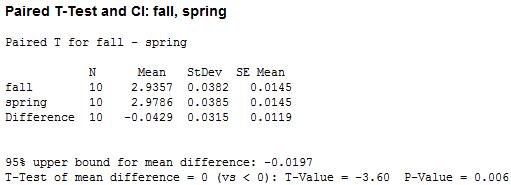
We’ve got a small p-value! That suggests, at a .05 level, that we can reject the hypothesis that the average GPA in fall and spring are equal and conclude in favor of the hypothesis that average GPA is lower in the fall than in the spring.

WOO!
Alright, it’s rant time
So I’m on Tumblr a lot. I like Tumblr because I can find fellow AH fanatics and not feel so weird about quoting Gavin Free to myself all the time I like to watch trends. I like to watch how certain things work their way around Tumblr and how quickly/slowly they do so.
There’s been one or two posts that have been going around lately that I would like to comment on, if y’all don’t mind.
(If you do mind, just skip this blog, ‘cause I’m gonna rant here anyway.)
(AGH TUMBLR IS DOWN WHY DO YOU FAIL ME WHEN I NEED YOU?!)
So I actually can’t pull up the posts at the moment like I wanted to (see above sentence), but the gist of them is this: people who do well under the implementation of our current educational methods (sit down and be lectured to, then take tests) aren’t actually learning and don’t actually know anything about the material they’re being taught. They’re just good at working the system. This whole thing links in with the opinion that GPA is just a measure of how well someone can work said system.
‘Kay, let’s pause for a moment.
I think most people who make this argument against the current most common delivery of information in our schools don’t think that people who just don’t do well in school are stupid and are incapable of learning. They just can’t work the system. They’re perfectly intelligent individuals who are fully capable of learning and retaining new info; they just don’t learn well when they’re forced to sit and listen to a teacher prattle on about something. Maybe they’d do better in a situation where they were able to watch active demonstrations of whatever material’s being taught (like a chemistry teacher throwing potassium in water rather than just talking about how/why doing so causes an explosion) or doing activities involving the material being taught (like actually throwing the K into the H2O themselves).
In fact, this is the whole idea behind different learning styles, is it not? Some people learn better one way, some people learn better another. It’s a perfectly reasonable assumption to make—not everyone gathers information in the same way.
So think about this for a second. If people all have different learning styles and we accept that a good number of people don’t learn best when sitting in a classroom and taking notes as a prof lectures, shouldn’t we also accept that there are likely people who do learn best in that environment? I mean, I know that schools across the globe don’t all follow this “students sit and listen to teacher talk” template, but you’ve got to think that such template wasn’t dreamt up by a bunch of people who sat around snickering “haha, let’s force students to follow this method even though it doesn’t work for anyone!” It was probably, at least in part, originally conceptualized by people who either learned best this way themselves or thought others did.
And it does work best for some people. I know that for a fact because I am one of those people. I learn best when I’m “forced” to listen to someone talk about the material. I have a very good aural memory. And like quite a lot of people, I remember stuff better when I’m exposed to it multiple times. That’s why I write stuff down during lecture. I hear the material, I write down the material, and the written stuff is there later if I need to refer to it. That works for me. I learn things that way. I’m the type of person for whom “they system” just works because it just so happens to match my learning style.
I know a lot of people for whom lectures aren’t very beneficial but labs really help them learn. I don’t usually retain stuff that’s taught in lab-like settings because when I get “hands on” with material, I like to do it alone and on my own time. Labs are stressful and they don’t help me learn. If our current educational system was all hands-on lab-based, I’d have to work extra super hard to retain anything ‘cause that’s just not the way my brain works.
So I guess what this meandering rant boils down to is this: for a lot of people, the current system may not be their ideal way to learn, and therefore some have probably developed ways to “work the system” and look like they’re doing well even if they’re not retaining anything past what’s necessary to earn them an A in a semester-long class. But for some people, maybe they’re not working the system at all—for them, the system just…works.
So please think of that next time you have the urge to assume that people who do well in school nowadays are just good at faking their way through.
[rant over; commencing Achievement Hunter video binge]
This blog is worth 60% of your final grade
I have a bit of an issue with this article. Not because I’m like “oh hey, I got straight A’s through college and I don’t regret it one bit LOL,” but because half the things he cites as reasons to “regret” the experience are things that can be easily avoided.
1. No one has ever asked about my GPA.
Not after you graduated, probably not. But did you ever apply for scholarships? GPA certainly matters for financial reasons while still in school, so if some scholarship/funding/what not requires high grades in order to hand you cash, why not give it a shot? Research supervisors also look at this before they decide whether or not they want to work with you.
2. I didn’t sleep.
The only time I really had the “there’s physically no way I can fit sleep into my schedule” problem was during the 25 credit semester of doom, but that was also because I would spend four hours a night watching YouTube videos, talking to Sean, making dumb Flash, and just generally dinking around. Honestly, you CAN sleep and get a 4.0.
3. I’ve forgotten 95% of it.
If what you’re studying isn’t important enough to you for you to even attempt to remember it past the tests, you’re probably studying the wrong thing. Hell, I know I didn’t retain anything from my core requirements classes ‘cause I was like “pfft, this stuff is boring and irrelevant and I feel like making dumb cartoons instead.” But if I had been like that in every class, I would think I would have realized that I was not studying the right thing.
4. I didn’t have time for people.
Take a class with some friends (band, anyone?). Organize study sessions with those people who fall into the “we know each other from class fairly well” group of friends. Make one day of each week a day where you don’t do anything school-related (for me, this was and still is Saturday…it kept me sane, and it IS possible to do).
5. Work experience is more valuable.
It depends on the major, really. The physical sciences and engineering? Sure. Business and law? Definitely. The fine arts and things like philosophy? Maybe not so much. Also, it’s pretty difficult to find relevant work experience for some majors.
What about Graduate School?
Haha, yeah, no kidding. I think this should have been listed as a preface. “Does grad school apply to you? Ignore this entire list.”
Today’s song: American Cowboy by Jada
Huh…wouldn’t have guess this
StumbleUpon brought me to Wikipedia’s page on the “Latin honors” for college degrees. Not only did I find out Australia has two different levels of failure (off the “grade” page…and here I must interject: “WTF, mate?”), but the “see also” section also provided me with this.
I found this rather interesting, considering that for the majority of colleges, the U of I’s cutoff points for summa/magna/cum laude are higher than all of these listed. Maybe ‘cause UI is such a small school (SMALL SAMPLE SIZE = RANGE RESTRICTION) they felt the need to have such high cutoff points…who knows.
Haha, sorry, I like this kind of stuff. Had they provided more colleges, I would have made some sort of map to see how the different regions of the US compared in honors cutoffs. Bah.
Also this, ‘cause I found it freakishly funny (and interesting), especially since they were all cracking up the entire time:
Today’s song: Echo by Girls Can’t Catch

 Eigenblogger