Book Review: The Age of Reason (Sartre)
IT’S SARTRE TIME!
(Sorry for the long break between books. I got busy packing/panicking/wishing for death over the summer, but now I’m back and now I have the giant U of Calgary library to quench my reading needs. At least until I forget to return the books I check out and I rack up a $200 fee for late books.)
(It’s happened before.)
ANYWAY.
Have I read this before: Yes. End of 2009 I think? Not so long ago compared to some of the books I’m re-reading.
Review: I really didn’t remember much of this book from my first read. I remembered the names Mathieu and Marcelle, but that was pretty much it. I’ve heard a lot of people say that they find Sartre a very dry writer (both with his fiction and his philosophy), but I enjoyed the writing. I liked how he jumped between Mathieu and Daniel as kind of the “main” narrators for different parts of the story. And, of course, the angst they all feel—at different levels, of course—regarding their notion(s) of freedom. Interesting stuff.
Favorite part: The razor scene with Daniel. I guess it’s not so much of a scene as a pondering. But it’s very poetically written.
Rating: 6/10
Stats from the Past
While digging through the book bin at the recycling center, I came across this awesome find:
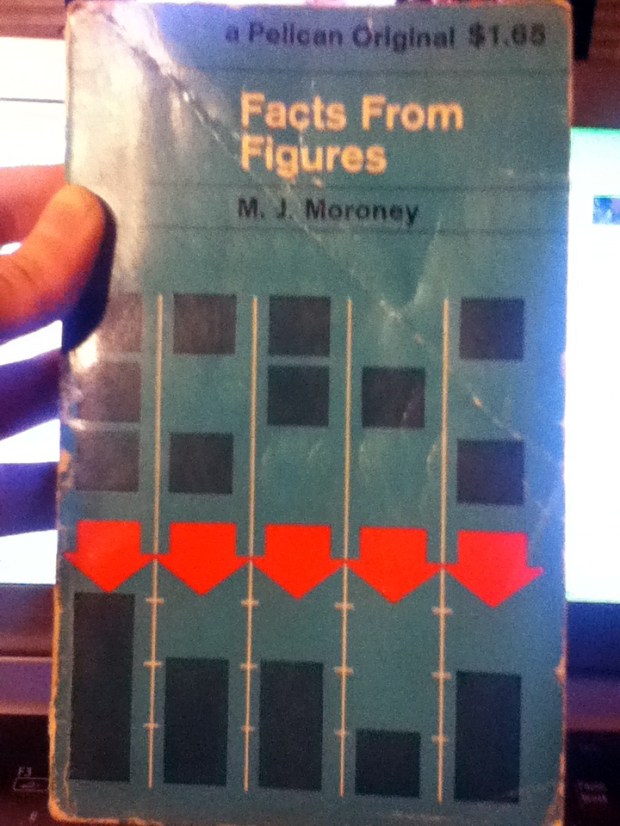
It’s a stats book from 1951!
It was really interesting looking through this, ‘cause this book was published way before SPSS, SAS, R, or any other software (at least, any other stats-centric software) was readily available.
Thus, we get examples in which all the calculations are done using the formulas rather than being read from an output table. Here’s some regression:

And t-scores:

And of course the t-table (in graphical format):
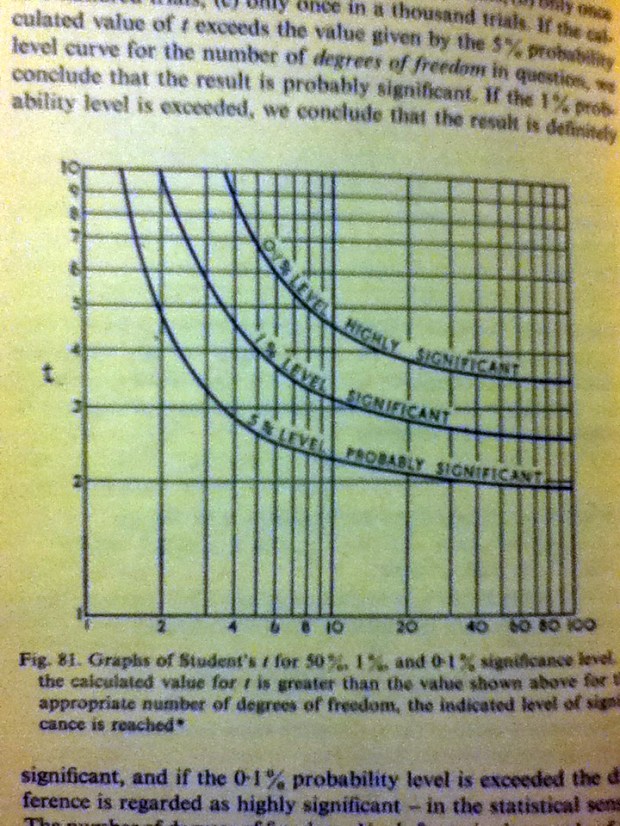
I didn’t even teach how to read a t-table in STAT 251. It was mainly because we just didn’t have time to do so, but considering we have ALL THE SOFTWARE today and, for all practical purposes, that’s what people use in “real life” nowadays, I focused instead on how to read output (and how to appropriately interpret it, of course!). I did have a separate sheet on how to understand a t-table that students could check out on their own if they wanted.
I’d show you pics of the ANOVA calculations, but there are a lot of them, haha.
DONE!
The Style of Elements
WOO, my mom and I just found a copy of the Wonderful Life with the Elements at Bookpeople!
What is this book, you ask? It’s written and illustrated by Japanese Artist Bunpei Yorifuji and features a walk-through of the Periodic Table that’s highly visual and artistic. Yorifuji takes features of elements—such as their state of matter at room temperature, the group they belong to, etc.—and translates them into physical features on little naked dudes. For examples: all the elements in the Noble Gases group have afros, all element-people that are gas at room temperature float like ghosts, and elements that are man-made are drawn as robots.
It’s super freaking awesome. If you want to get a used copy on Amazon, take a look at some of the reviews that freak out because all the elements are naked and have little visible penises. Oh, the horror!
Book Review: The Jungle (Sinclair)
Have I read this before: Yup, up in Vancouver.
Review: Want to feel depressed, disgusted, discouraged, and disturbed? This is your book.
Seriously, this ranks up there as one of the most depressing books I’ve ever read. It follows Jurgis, a Yugoslavian immigrant, as he and his family try to “make it” in Chicago during the early 1900s. The book opens with Jurgis getting married to Ona, and that’s about where the happies stop.
Jurgis gets a job in the meat-packing industry and basically faces tragedy after tragedy after tragedy throughout the whole book. Not only do we get the horrible details of what the meat-packing industry was like for workers back then, but Sinclair also details how impossibly difficult it was for immigrant workers to even keep the most basic of jobs because of how unsafe the whole industry was. And many got screwed out of reasonable rent/housing because of greedy landlords and the language barrier.
This is a hard book to read, man. Not because of the way it’s written or anything like that—it’s just depressing as all hell. Which was one of Sinclair’s main points in writing it. He wanted to show how terrible it was for immigrant workers during that time.
So read it. But make sure you’ve got your Zoloft ready.
Favorite part: God, how can you have a favorite part of this book? I suppose the very detailed descriptions of the working conditions.
The hands of these men would be criss- crossed with cuts, until you could no longer pretend to count them or to trace them. They would have no nails, – they had worn them off pulling hides; their knuckles were swollen so that their fingers spread out like a fan…and as for the other men, who worked in tank rooms full of steam, and in some of which there were open vats near the level of the floor, their peculiar trouble was that they fell into the vats; and when they were fished out, there was never enough of them left to be worth exhibiting, – sometimes they would be overlooked for days, till all but the bones of them had gone out to the world as Durham’s Pure Leaf Lard!
Rating: 6/10 (just because it’s sooooo depressing)
If you’re anxious and you know it, clap your hands (and then go cry in the bathroom for half an hour)
UH OH, it’s almost the first of July. Guess that means it’s time to read this again:
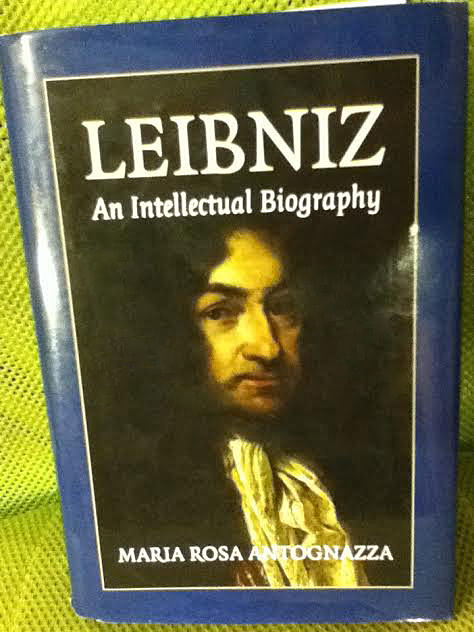
Maybe reading about the most awesome polymath that ever existed will keep the panic attacks away.
Unlikely, but we can always hope.
Book Review: The Great Gatsby (Fitzgerald)
Have I read this before: Yar! First time was in 10th grade English. We had a choice between this and some other book that wasn’t on my list. Hence, I chose Gatsby. I think I was the only one who did.
Review: Don’t make me review this. I don’t think I can. I love this book, yo. If you’ve read my 100 Things, you’ll know that character-wise, this is my favorite book. It’s such a compact story, but there’s so much in it. I think Gatsby is fascinating and for some reason I really like the fact that Nick, the narrator, doesn’t really have a voice of his own (at least compared to a lot of other narrators of books). He exists for things to happen around, it seems, and that puts an interesting twist on the whole story. He’s almost limited omniscient in that sense because he really gets the story from everybody’s angle but doesn’t get to be in anyone’s head but his own.
LSAjflakdjfasfjaskflj I just really like this story.
Also, if you ever want to listen to an audiobook version of this, I highly recommend the one read by Alexander Scourby. It’s unabridged and fantastic.
Favorite part: Oh, jeez.
“They’re a rotten crowd,” I shouted across the lawn. “You’re worth the whole damn bunch put together.”
I’ve always been glad I said that. It was the only compliment I ever gave him, because I disapproved of him from beginning to end. First he nodded politely, and then his face broke into that radiant and understanding smile, as if we’d been in ecstatic cahoots on that fact all the time. First he nodded politely, and then his face broke into that radiant and understanding smile, as if we’d been in ecstatic cahoots on that fact all the time. His gorgeous pink rag of a suit made a bright spot of color against the white steps, and I thought of the night when I first came to his ancestral home, three months before. The lawn and drive had been crowded with the faces of those who guessed at his corruption—and he had stood on those steps, concealing his incorruptible dream, as he waved them good-by.
UGH GORGEOUS.
Rating: 10/10
Book Review: The Three Musketeers (Dumas)
Have I read this before: Nopers. I started it back in the summer of 2008 but only got like 30 pages in for some reason. Not sure why I stopped.
Review: I really like Dumas. The idea of four sword-fighting dudes fighting for the king sounds like an appealing story on its own, but Dumas seems to up the intrigue quite a bit by the way the story proceeds. Also, poisonings. That seems to be a thing for Dumas.
Anyway. I’ve always enjoyed stories that have characters with very distinct, almost trope-like personalities/personality traits. This is one of them. It’s like the three Karamazov brothers, but with more swords and less Russian name confusion.
(Okay, it’s not, really, but can you imagine how fantastic that would be?)
Also, Porthos will forever look like Oliver Platt in my mind. THANKS, DISNEY.
Favorite part: The death of Constance is really freaking sad. I hate to call that my favorite part, but it is. The vast majority of The Three Musketeers is either action or humor (or both), but that part was definitely very sad.
I also really liked the friendship that built between Athos and d’Artagnan.
Rating: 8/10
Book Review: Far from the Madding Crowd (Hardy)
Have I read this before: Nope! Brand new to my eyes.
Review: This is what I learned from this book: if you’re going to mess with someone, it probably shouldn’t be anywhere near the level of implying you want to marry them when you have absolutely no interest in them.
Also: don’t piss off the farmers.
Far from the Madding Crowd chronicles three very interesting relationships of Bathsheba Everdene, a woman left in charge of a large farm in, as far as I can tell, the mid-1800s. First is Gabriel Oak, the shepherd we’re introduced to in the first chapter and who we mainly follow throughout most of the book. He loves Bathsheba from practically the moment he sees her, but is reduced to having to watch her other relationships blossom throughout most of the novel. They refer to him as “Farmer Oak” throughout but I kept reading it as “Professor Oak” (thanks, Pokemon), so that made for some entertaining reading.
Farmer Boldwood is the second lover and is the victim of a very poorly thought-out prank (it’s not even a prank, it was like, “hey, let’s screw with Boldwood, he’s weird”).
Finally there’s the soldier Francis Troy, who’s basically the 19th century equivalent of Zapp Brannigan. I read all his dialogue in Zapp’s voice and kept waiting for Kif to show up. Again, that made for some entertaining reading.
Anyway. It’s a soap opera on a farm. That’s always entertaining, right?
Favorite part: I feel bad calling this my favorite part, but Hardy did a great job showing how devastated Boldwood had become after he realized that the whole “Bathsheba loves you HAHA JUST KIDDING LOLZ” incident. I felt bad for the dude.
Rating: 6/10
Summer Reading List
Okay, so I know we’re still in March, but there are a few non-fic books I want to read this summer* and thus decided to make a list of them now.
GO!
Leibniz: An Intellectual Biography by Maria Rosa Antognazza
The only reason I haven’t read this beautiful bio of my main man more than once is because it deserves my full attention—something I haven’t been able to give it since last July. But it will definitely be read again!
Godel, Escher, Bach: an Eternal Golden Braid by Douglas R. Hofstadter
My mom bought me a copy of this book a loooong time ago, but I’ve never gotten past the first 15 or so pages. It seems quite interesting, I just haven’t been able to get into it yet.
Mathematics From the Birth of Numbers by Jan Gullberg
Another book I’ve had for a long time. Not so much a “reading” book as a “here’s everything about math ever” book—I think I finally have a strong enough math background to make sense of a lot of the components of this book.
A History of Mathematics by Carl B. Boyer
IF I CAN’T TAKE THE DAMN CLASS, I’LL READ THE DAMN BOOK.
If you don’t know why I want to read this, you don’t know me.
*I say “this summer” because it’s a lot easier for me to concentrate on awesome books when I’m not freaking out about school.
Book Review: Of Human Bondage (Maugham)
Have I read this before: Yup! In fact, this was the very first book I read when I started my book list back in 7th grade.
Review: This is one of the longer ones (~700 pages in the copy I’ve got) and it doesn’t really pick up until Philip, the main character, leaves England and heads to Paris for art school.
Ah, Philip. I don’t know if it was Maugham’s intention to have the reader get ridiculously frustrated with Philip’s on/off relationship with Mildred (who is the most obnoxious character ever), but if it was, mission accomplished. By like the time he takes her in after she’s destroyed his life for like the fifth time, I was like “COME ON, PHILIP, NO!”
Anyway. Other than that, this was a very appropriate book for me to read at this point in my life. The book basically chronicles Philip’s attempts at “starting his life” and, in this process, all his social awkwardness, self-doubt, career changes, and fear. I don’t remember it being so relatable in 7th grade, but I totally felt it now. Like I said, it takes a little while to get into this book, but I think it’s worth it, especially for those of us in our 20s.
Favorite part: There were a few good lines/sections in here, particularly regarding the idea of free will and determinism. I particularly enjoyed Philip’s conversation with Cronshaw in chapter 45, all about free will vs. determinism. And this quote in chapter 28, as Philip is renouncing his religion: “From old habit, unconsciously he thanked God that he no longer believed in Him.”
Rating: 5/10
YES
AAAAAAAAAAAAAAAAA LOOK WHAT I GOT!

$20, free shipping, on eBay. That’s the cheapest I’ve seen this book go for.
Doesn’t Blankie look like a serial killer?
Check the back:
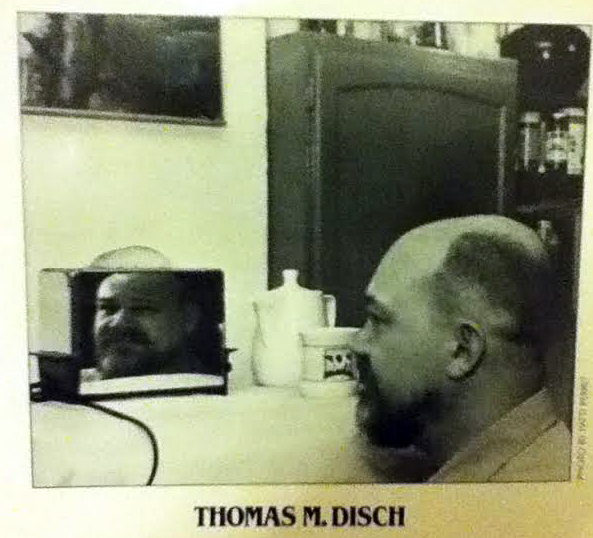
Mr. Disch is officially awesome.
AND THIS POEM:
Lives there a man with soul so dead
He’s never to his toaster said:
“You are my friend; I see in you
An object sturdy, staunch, and true;
A fellow mettlesome and trim;
A brightness that the years can’t dim.”?
Then let us praise the brave appliance
In which we place this just reliance.
And offer it with each fresh slice
Such words of friendship and advice
As “How are things with you tonight?”
Or “Not too dark but not too light.”
I’ve heard the book is quite different from the movie, so I’ll have to read it and check it out. Some of the pages are pretty loose, though, so I’m hesitant.
But I finally have a copy!!
Book Review: Brave New World (Huxley)
Have I read this before: Indeed (one of these days I’ll have the courage to go to the library and face my enormous fees). Back in high school, I believe. Maybe junior high?
Review: My memory of this book was actually pretty accurate—which is rare for me. Anyway, I’ve always really liked books that explore an altered society, and you can’t get much more altered than Brave New World (well, actually, that’s debatable on several levels). I think another thing I really like about this book is the mutability of the main characters. Bernard isn’t constantly against society; in fact, once he starts gaining respect for his dealings with John, he starts to really enjoy being an Alpha-Plus. Lenina seems like a “normal” member of society until she starts expressing actual feelings toward John. And even John lapses in and out of his self-imposed set of morals due to the pressure he’s feeling being in the new society.
Favorite part: Chapter 3. I love the intermixing snippets of Lenina and Fanny, Mustapha Mond and the students, Bernard, and the explanation of the Alphas/Betas/Gammas/Deltas/Epsilons.
Rating: 6/10
Book Review: Candide (Voltaire)
Have I read this before: Yes! First time was in Literature of Western Civilization, the class that first got me interested in philosophy. I’ve read it many times since, but it’s been awhile since I last read it.
Review: *dramatic sigh* THIS FREAKING LITTLE NOVELLA. I’m so conflicted. On the one hand, it’s probably the best bit of satire I’ve ever read (and is hilarious and tragic and disturbing all at the same time). On the other hand, one of the major things being parodied is Leibniz’ optimism and Leibniz himself—you can’t tell me there aren’t personal jabs in there, ‘CAUSE THERE ARE! [see the last line of chapter 28], and that makes me sad. Especially since his philosophy is definitely oversimplified and entirely not what he meant “the best of all possible worlds” to be.
But Voltaire is Voltaire, so what can we do?
Favorite part: It’s hard to pick one since it’s so short and everything really flows together. There are some great lines, though:
- Candide, trembling like a philosopher, hid himself as best he could during this heroic carnage.
- Candide said to himself, “If this is the best of all possible worlds, what are the others like?”
- “What’s optimism?” asked Cacambo.
“Alas,” said Candide, “it’s a mania for insisting that everything is all right when everything is going wrong.”
Book Review: a Tree Grows in Brooklyn (Smith)
Have I read this before: NO! I found a copy at Goodwill for like 99 cents, so I bought it.
Review: I’m usually not a huge fan of coming-of-age stories, but this one was actually quite enjoyable. The book follows Francie Nolan’s growing up in Brooklyn in the early 1900s, but gives a very comprehensive non-chronological-order history of her family as well. I think one of the reasons I’m not a coming-of-age fan is because in most of those types of stories I’ve read, it’s really quite difficult to see the change in the main character (assuming they’re the one that’s coming of age). In this book, however, it’s very clear when Francie starts seeing a change in the way she views the world and when she becomes mature enough to acknowledge that she’s viewing the world differently than she had. And this is all told in a very engaging tone, too, so it was fun to read.
Favorite part: I like this recurring idea of loving/being loved/being needed that Francie keeps coming back to over and over as she grows up. Like at the end of chapter 39:
“Maybe,” thought Francie, “she doesn’t love me as much as she loves Neeley. But she needs me more than she needs him and I guess being needed is almost as good as being loved. Maybe better.”
Or at the end of chapter 53:
“No! I don’t want to need anybody. I want someone to need me…I want someone to need me.”
A very relatable feeling.
Rating: 6/10
Book Review: Dune (Herbert)
Hey, so…remember that book list? I finally finished another book on there, haha. SHUT UP, SCHOOL IS ALL-CONSUMING.
Today’s book is Dune by Frank Herbert.
Have I read this before: Indeed! Way back in 7th grade in our “advanced” English group.
Review: There’s…a lot more to this book than I remember, haha. It’s hard for me to get past the sci-fi in here, which is funny, ‘cause Dune is pretty much known for how hugely it contributed to the genre. I do really like how Herbert seamlessly incorporates all the sci-fi/technology aspects into a story that’s really about power/relationships/family. But for my personal taste, it’s still a liiiiiitle too sci-fi. Not that I didn’t like it or didn’t appreciate it, it’s just not my usual style of book. I did enjoy it, though, especially now that I could understand it better than I could when I was 12, haha.
Favorite part: I have a soft spot for the Paul vs. Jamis fight, just because that’s the scene we “re-created” (in the loosest sense of the word) for our 7th grade reading report. Bloopers and everything.
Rating: 6/10
Well this looks like a super interesting book
The Luminaries: A Novel, by Eleanor Catton
“It is 1866, and Walter Moody has come to make his fortune upon the New Zealand goldfields. On arrival, he stumbles across a tense gathering of twelve local men, who have met in secret to discuss a series of unsolved crimes. A wealthy man has vanished, a whore has tried to end her life, and an enormous fortune has been discovered in the home of a luckless drunk. Moody is soon drawn into the mystery: a network of fates and fortunes that is as complex and exquisitely patterned as the night sky.”
The twelve locals, from what I’ve read, are supposed to be characters representing the twelve signs of the western zodiac. It just sounds like a really interesting story. I think I shall read it (at some point when I make it through my list and run out of Leibniz books).
Book Review: Lolita (Nabokov)
Alrighty, book time! Today we’re looking at Nabokov’s Lolita.
(Yes, it’s another installment of “Claudia’s Too Anxious to Check Out a New Book from the Library so She’s Re-Reading One She Owns.” Hopefully someday soon I’ll stop being a loser.)
Have I read this before: See above.
Review: Don’t call me a pervert, but I freaking love this book. I honestly love it more for the way it’s written than the actual story.
Edit: holy crap, I didn’t know it was written in English. I thought it was originally in French and just translated (yes I know I’m dumb, shut up).
Edit edit: He could speak English before he could speak either Russian or French. The more you know!
Edit edit edit: This isn’t so much a review as me freaking out about Nabokov. Sorryz.
Favorite part: Can I just say “the language” for this? ‘Cause holy gods.
“The two voices parted in an explosion of warmth and good will, and through some freak mechanical flaw all my coins came tumbling back to me with a hitting-the-jackpot clatter that almost made me laugh despite the disappointment at having to postpone bliss. One wonders if this sudden discharge, this spasmodic refund, was not correlated somehow, in the mind of McFate, with my having invented that little expedition before ever learning of it as I did now.”
The whole damn book is like that: beautifully written. Flawless Nabokov is flawless.
Rating: 9/10
A Slight Deviation from my “200 Books” List
I finished reading this today:
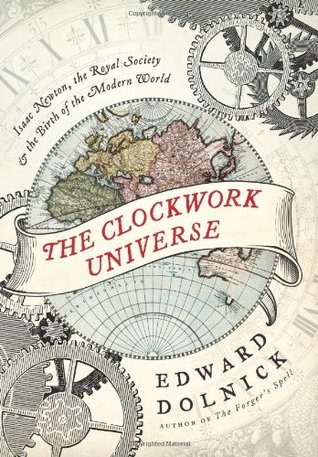
(Beautiful cover or beautiful cover?)
I’ve pretty much decided that my favorite time period/place has to be mid 16th- to mid 17th-century Europe. The intelligence that poured out of that region of the world during that time is downright ridiculous, not to mention the interactions of all the main intellectual players of the period: Newton, Leibniz, Kepler, Hooke, Pascal, Halley, Pepys, and Descartes, to name a few.
Edward Dolnick’s The Clockwork Universe is a pretty great discussion of how all these dudes—Newton, mainly—helped in the formation of the new methods of thought that developed during this time. There’s talk about the bubonic plague, there’s talk about Galileo, there’s talk about the various attempts to explain why the planets orbited the sun in ellipses rather than circles…and, of course, there’s talk about the Royal Society and how it got its start. The calculus debate’s in there, too, ’cause how could it not be?
The book ends with a rather beautiful little compendium of both facts and anecdotes about how the Principia truly impacted the scientific world, which I think was actually my favorite part of the book (apart from the little author’s note in the end where Dolnick proclaims proudly that he’s a Leibniz fan. Rock on!).
I recommend it if you’re at all interested in that fascinating period of time.
Book Review: Around the World in Eighty Days (Verne)
Have I read this before: Indeed! In high school, I think? I can’t remember exactly.
Review: Good lord, I love this book. Jules Verne’s characters are always awesome, but not a single one of them is more awesome than Phileas Fogg. I think he is my favorite literary character (with the possible exception of Captain Queeg).
“He was so exact that he was never in a hurry, was always ready, and was economical alike of his steps and his motions. he never took one step too many, and always went to his destination by the shortest cut.; he made no superfluous gestures, and was never seen to be moved or agitated. He was the most deliberate person in the world, yet always reached his destination at the exact moment.”
“…Mr. Fogg stopped him, and, turning to Sir Francis Cromarty, said, ‘Suppose we save this woman.’
‘Save the woman, Mr. Fogg!’
‘I have yet twelve hours to spare, I can devote them to that.’
‘Why, you are a man of heart!’
‘Sometimes,’ replied Phileas Fogg, quietly; ‘when I have the time.'”
How can you not love a character like that, seriously?
As for the plot itself, it’s pretty much classic Verne. I love how he’s always throwing his characters into seemingly impossible-to-remedy situations and then he’s like “AND SUDDENLY AN ELEPHANT” or something else and it saves the day. I reiterate from past blogs: Verne is awesome. And this is my favorite of his books (though re-reading 20,000 Leagues made me realize just how badass that one was, too).
Favorite part: “Stop the train, we need to have an emergency duel!” Nothing says “defending your honor” like wanting to use a brief stop at a train station to duel to the death. And, failing at that, nothing says “no seriously, I gotta defend my honor!” like ushering passengers out of a train car so that you can utilize said car for a duel to the death. Oh, Jules.
Rating: 9.5/10
Book Review: The Count of Monte Cristo (Dumas)
Have I read this before: Yes. Long, long ago in a galaxy far, far away (junior high).
Review: Actually, I don’t know where I was when I read this, ‘cause I swear I only remember the “breaking out of prison” part. From this whole magnificent book, that’s the only part I remembered. That happened like in the first 100 pages! What the hell, younger me.
Anyway.
Look at this chart of the character relationships in this book and tell me this isn’t a soap opera in novel form.
A LOT happens in this book, but it’s really hard to summarize without giving it all away. For some reason it strikes me as almost a little bit Princess Bride-ish in parts, but maybe that’s ‘cause Dantes is really good at keeping his cool (most of the time).
Favorite part: Hmm…probably the whole “why is everybody getting poisoned? Who is poisoning everybody?! ENOUGH WITH THE POISONING JEEZ!” part. You know what I’m talking about if you’ve read it.
Rating: 7.5/10
Book Review: Heart of Darkness (Joseph Conrad)
Have I read this before: Yup! I read it in the spring of 2007. It was required for my Western Lit. class.
Review: Y’know, this was actually quite a bit better than I remember. And more upsetting. I don’t know why, but Kurtz really, really strikes me the same way that Pinbacker from Sunshine did. Still trying to make that connection make sense. Maybe it’s because in Sunshine, the crew of Icarus II only hears about the failed mission of Icarus I from recordings made by Pinbacker. In a way, readers are only privileged to learn about the African wilderness/ivory trading/horror through Marlow’s narration, which is centered on events surrounding Kurtz. It’s like these two characters who don’t make appearances until the very ends of their respective stories are actually responsible for the stories in the first place.
There’s also this shared experience of duality: you form an opinion about both Kurtz and Pinbacker based on what’s said about them. This opinion (likely) changes once the men are actually confronted.
Bah, I dunno. Still fleshing it out. But that’s the thing that really stuck out to me most when I read this again.
Rating: 6/10
Book Review: 20,000 Leagues Under the Sea
I was going to do the whole “utilize random number generator to determine next book to read” thing, but I think I owe the library like $400,000 in late book fees and I’ve been having way too much anxiety to deal with people as of late, so I just decided to go with the first book on the list. Which was lucky, ‘cause I actually own this one: 20,000 Leagues Under the Sea by Jules Verne.
Have I read this before: YES! I read it in high school some time…let’s see…10th grade. 15 years old.
Review: I love Verne. I love this book. I love how perfectly it is written. I remember searching on Amazon for a copy of this and one of the many, many reviewers complained that this book was boring.
How the hell could anyone see this book as boring??
- Mysterious underwater thingy hunted by a ship.
- Misanthropic captain with a love for all things ocean.
- Shipwrecks.
- Atlantis.
- Underwater burials.
- The South Pole.
- Near asphyxiation.
- Giant squid.
- Maelstroms.
Hell, that list alone should make you excited!
I don’t want to give too much away about this one because I want people to FREAKING READ IT. Just know that it’s good. It’s very good. It’s freaking Jules Verne, yo.
Reeeeeeaaaaaaaaaaad iiiiiiiiiiiiiiiiiiiiit.
Favorite part: The South Pole, man. It’s, “are we there yet? Are we there yet? Are we there yet?” for like a whole chapter and then when they finally do reach it after making a ton of checks to see if it’s the right place (this was set in the 1800s, after all), the landing is described beautifully. Like I said, it’s freaking Jules Verne, yo.
Rating: this gets 9/10. Fantastic.
Also, happy 26th birthday to Michael “Rage Quit” Jones. Your Rage Quit vids got me into Achievement Hunter, whose videos have been a consistent source of amusement since about January of this year (which has been super helpful for my mental health). Keep ragin’, you awesome dude.
Book Review: The Remains of the Day
HEY LOOK it’s one of those book things off my book list that I said I’d read. Took long enough. I blame school/work/teaching/my obsession with the history of calculus/that amazing Leibniz biography.
Anyway. I utilized a random number generator to give me my first selection off the list and it landed on #157. That happened to be The Remains of the Day by Kazuo Ishiguro (which is good ‘cause I actually kinda stole that from the library by accident like 7 months ago).
Have I read this before: Nopers. First timer!
Review*: I think there’s kind of two different things I can react to here based on how I interpreted the book itself. 1: The main character as a person in his particular occupation; 2: the main character as a guide through a certain time in history.
1. The main character as a person. This was the part of the book that held the most impact for me. Stevens is a traditional English butler who, throughout his several day journey, reflects on his work and his life by way of describing several key characteristics that he believes a true butler should have. It’s a really interesting take on this idea of “living for the now” versus “living for a good tomorrow” but done in a very subtle way, I think. Very interesting. I really enjoyed the narration and the attention to detail in Stevens’ memories.
2. The main character as a guide through history. I think I would have gotten a lot more out of it if I knew my 20th century history a little bit better (been stuck in the 1600s, sorry). But I think people who DO know enough about that part of history will really, really get a lot out of this book.
But overall, very interesting. I’d possibly read it again if for no other reason than to try and absorb more of that personal reflection that Stevens subtly gives throughout. If you like stories told from a first-person perspective that have quite a reflective nature, I’d recommend this one for ya.
Favorite part: When Stevens is requested to tell young Reginald about “the birds and the bees” and spends like a whole day following him around trying to find some way to do it.
(Hmm…probably should have some sort of rating thing on these…)
Rating: 6/10.
*I haven’t really come up with a standard method for reviewing/summarizing/rating yet, so these posts may slowly evolve into something stable. Or they might stay like this. Or they might cease altogether one school commences again. However it turns out, I’ll try not to give any major spoilers in these things.
Bookin’ It
So as you may have read, one of my New Year’s resolutions is to revamp my 200 Books list and start over with it, this time writing a review after each book.
So that’s what I did today!
(Side note: the UI Library is kept at a toasty -23 degrees when the students are gone. Holy freaking crap, I had all my winter walking gear on and I was STILL freezing.)
New list is posted in the 200 Books tab. The almighty random number generator told me that the first book I shall be reading is The Remains of the Day by Kazuo Ishiguro. This was on my old list, but it was one that I never got to because it was always checked out from wherever I was trying to get it. But it was miraculously on the shelves this afternoon, so I picked it up.
I can’t guarantee any sort of time frame for when these reviews will be posted, especially since this semester looks like it’ll be crazy busy. But I’ll try to do them at a reasonable pace!
WOO!

 Eigenblogger
