So this is something I noticed a long time ago, but going through my playlists in iTunes this afternoon made the observation come to the forefront of my mind: when I sort my “Top Favorites” playlist by artist, I notice that a large amount of the songs (68%) are by artists whose names begin with a letter from the first half of the alphabet (A – M). When I sort my entire music library in this manner, I find the same proportion (okay, 67%…it’s pretty damn close). And you know what’s more interesting? If I sort by the TITLE of the song, I get the same proportion again! OOH, OOH, and sorting my freaking book list gives the same 67% as the music.
I find this quite fascinating. Has anyone else ever noticed this type of pattern in any of their things? It’s interesting to me that this 2:1 ratio keeps coming up. This requires exploration.
Hypothesis: this 2:1 ratio occurs because the first half of the alphabet contain more letters that appear more often as the first letters in English words.
Method: utilizing letterfrequency.org, I found the list of the frequencies of the most common letters appearing as the 1st letter in English words*. I used this list as a ranking and, using a point-biserial correlation, correlated this ranking with a dichotomized list of the letters, in which letters in the first half of the alphabet were assigned a value of “0” and those in the second half of the alphabet were assigned a value of “1.”
Results: here are the two values being correlated alongside their respective letters:
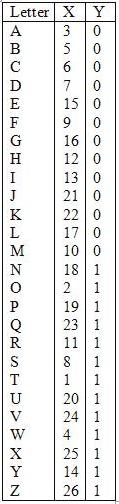
Where the “X” column is ranking by the frequency of appearance as the first letter of a word and the “Y” column is a dichotomized ranking by alphabetical order. Point-biserial correlation necessary because one of the variables is dichotomous. So what were the results of the correlation? rpb = .20, p = .163.
Conclusion: well, the correlation isn’t statistically significant (p < .05) by a long shot, but I’ll interpret it anyway. A positive correlation in this case means that letters with the larger dichotomy value (in this case, those coded “1”) tend to also be those same letters with a “worse” (or higher-value) coding when ranked by frequency as the first letter in English words. So in plain English: there is a positive correlation between letters appearing in the second half of the alphabet and their infrequency as their appearance as the first letter in English words. In other words, letters appearing in the first half of the alphabet are more likely to appear as the first letter in English words. Not statistically more likely, but more likely.
Meh. Would have been cooler if the correlation were significant, but what are you going to do? Data are data.
*Q, V, X, and Z were not listed in the ranking, but given the letters, I assume that they were so infrequent as first letters that they were all at the “bottom.” Therefore, that is where I put them.

 Eigenblogger
[…] first half of the alphabet (A – M) rather than the latter half (N – Z). I’ve done at least one other analysis regarding this topic, but I decided to do another slightly different one to see if it applied in […]
LikeLike