Shouldn’t a minor in geology be a “miner”?
So Megan and I were talking this morning (“What?” you say. “Social interaction??” I KNOW, RIGHT?!) and we concluded that if there ever were a time where time travel was invented and we were able to drag someone from like the 1600s to the present time, the first thing we would show them would be a vacuum cleaner.
Because that’s probably the most futuristic-looking thing we’ve got.
Seriously now. If I were to bring someone from 300 years ago into the present time and say, “we’ve developed technology that allows us to launch ourselves into space,” and ask them which of the following two objects is the thing that allows us to do so, which do you think they would pick (ignoring scale)?
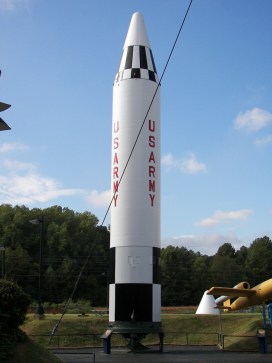

I’d be tempted to pick the second object. It would roll along a runway like an airplane and then launch once it hit a certain speed.
Fun fact: the Saturn V Rocket was a Dyson in disguise.
[end of pointless blog]
TWSB: Death by Sunspots
We are so damn screwed when the sun decides to solar storm us to death.
In fueling my paranoia about our nearest star, I came across the Wiki article for the Carrington Event. The Carrington Event was a massive solar storm documented in 1859. In late August/early September of that year, the sun produced a bunch of sunspots, solar flares, and a giant coronal mass ejection that motored its way to earth in just 17 hours (normal travel time = 2 to 3 days). It blasted our magnetosphere and atmosphere with enough force that auroras were seen all over the globe (including in the freaking Caribbean. Can you imagine?). This was the largest geomagnetic storm ever recorded.
Telegraphs all over the world failed, with some acting very strangely—sending and receiving messages even after they’d been disconnected from their power sources.
I did some more research and, as I’ve mentioned in my science blogs before, a lot of astronomers say that we’re overdue for another mega solar storm. Some are predicting what’s being called a “Solar Katrina”—a catastrophically huge solar storm that would, if it hit earth, knock out the entire planet’s electricity for weeks, possibly even months.
Can you imagine humanity suddenly reverting to pre-electricity conditions? I can’t even comprehend the chaos/panic/death that would cause. Holy freaking sunspots.
That would make good material for NaNoWriMo though…
TWSB: powers of ten
First, I want to apologize if I’ve posted this video on here before. I’m currently too lazy to go back through ye olde archives and check (read: I’m too lazy to type “powers of ten” in my little search box), so I’m just going to go with it.
I logged into my older, rarely-used YouTube account today and was looking through my favorites list and I found this video.
I don’t care that it’s from 1977, I don’t care that I’ve watched it like 80 times. It still blows my mind. So I thought I’d share it for this week’s science blog.
Like I said when I posted that other video about the universe a few weeks ago: I don’t know how we could ever feel disconnected from one another when we’re all part of this working machine of huge and small alike.
Holy crap
This is beautiful. I was freaking bawling throughout this whole thing, I swear to god.
How can there possibly be hatred on this planet when we’re all so undeniably and fundamentally connected?
I am you. You are me. We are this.
(Edit: this is actually just a third or so of the longer, full vid, found here. It’s just that the rest goes into the old “religion vs. science” insanity and is not nearly as awesome as this first part in my opinion. But anyway.)
This Week’s Science Blog: Taking You to a Higher Dimension
Okay. So this week’s science blog is really, really awesome, but I think if I try to summarize it and put it in my own words here it’ll lose a lot. So I’ll just copy down a few highlights. This is another question answered by the Physicist at AskAMathematician.com: What would life be like in higher dimensions?
Seriously. Really cool answer.
Highlights:
- In 4 or more dimensions orbits are always unstable, and in 1 dimension the idea of an orbit doesn’t even make sense.
- f you set off a firecracker in 3, 5, 7, etc. dimensions, then you’ll see and hear the explosion for a moment, and that’s it. If you set of a firecracker in 4, 6, 8, etc. dimensions, then you’ll see and hear the explosion intensely for a moment, but will continue to see and hear it for a while…it may not even be possible to understand people when they speak.
- Which elements are stable, and the nature of chemical bonds between them, would be completely rearranged.
- Every element after helium would adopt weird new properties, and the periodic table would be longer left-right and shorter up-down.
TWSB: I dare you to cross the line
WOAH, SCIENCE!
(Sorry, I’m hyper.)
Today I finished formatting a business textbook (barf) and actually started working on a fun textbook for once.
Astronomy! In the second chapter I read about something I’d never heard about before: forbidden lines.
What’s a forbidden line? According to Encyclopedia Britannica, it’s an emission line in the spectra of certain nebulae that is not observed for those same gases on earth. Why? Because apparently, on earth those gases cannot be rarefied sufficiently.
Forbidden lines result from electrons in the upper energy levels of gases transitioning to a lower energy level. This transitioning requires the atoms to be undisturbed (i.e., not bumping into other atoms) and takes a long time. The resulting photon emissions are very weak. In labs on earth, these transitions are even rarer (“highly improbable”) because the excited atoms have a much greater chance of hitting other atoms and disrupting the level transitions of the electrons.
In interstellar space, however, the atoms are able to be undisturbed long enough for the electrons to make these transitions. In fact, according to the Encyclopedia of Science, up to 90% of the visible brightness of some nebulae can be attributed to these forbidden spectral lines.
Cool, huh?
This Week’s Science Blog: Shuttle Show
I’m sure a bunch of you have seen this already, but it’s a pretty spectacular thing so I’d like to put it up here.
Shuttle program stats and info:
- 135 flights total between the five shuttles (Columbia, Challenger, Discovery, Atlantis, Endeavour)
- Longest flight: 17 days, 15 hours, 53 minutes, 18 seconds (Columbia)
- First lunch: April 12, 1981 (Columbia)
- Last launch: May 16, 2011
- Total earth orbits: 21,158
- Says Wiki: “Each vehicle was designed with a projected lifespan of 100 launches, or 10 years’ operational life.”
Now sit back and watch some launches, if you haven’t already done so.
TWSB: Waiter! There’s a Higgs-Boson in my Universe!
(Happy birthday, United States!)
So I’m bringing back my This Week’s Science Blogs. Because.
HIGGS BOSON, GUYS!!
Why this news isn’t being vomited from every front page of every news organization is beyond me. Actually it’s not—people want Kardashians, not science—but still.
HIGGS. BOSON.
Even if it does turn out that the scientists just thought they found the H.B. instead of actually finding it, this is a big deal, people.
I think things like this are most easily explained using pictures/animation, so here are two of the clearest/simplest explanation videos I could unearth. Pretty snazzy!
TWSB: Hydrogen: Putting the ‘H’ in “Holy Crap, the Universe is So Empty”
Crap!
So I found this page the other day and bookmarked it for a TWSB post…the page was a demonstration of how ‘empty’ we all are at the atomic level. On the current replacement page, the author states, “The page had a picture of a proton that was one thousand pixels wide, and a little electron that was only one pixel wide, and they were separated by fifty million pixels of empty space – I worked it out that that was eleven miles if your monitor displayed 72 pixels per inch, not uncommon at the time. You could try to scroll between them and it would take a long time. It was kind of neat.”
It was neat. But because of browser issues and issues surrounding the model of the atom the author used (he used the model Bohr developed), he took down the page.
In its place, though, he offers a similar study of scale and emptiness: the solar system.
To me, his atomic demonstration is more powerful since its fascinating how “solid” beings such as ourselves are composed of so much space, but the solar system demo is pretty snazzy, too.
Related: I’m assuming some of you Moscow people who stumble across this have taken the Moscow-Pullman trail…have you seen the little solar system distance exercise set up by a bunch of elementary school kids? It’s pretty cool. Pay attention at the head of the Moscow end of the trail to see the pics.
TWSB: The Sound of a Solar Re (and a Do, a Mi, a Fa, a So, a La, a Ti, and More Do)
The authors of the Ask a Mathematician/Ask a Physicist blog received and answered this question not too long ago: If you could hear through space as though it were filled with air, what would you hear?
The answer is as follows: the sun.
Yes, our big showy center of the universe is also the loudest thing around, at least to us. The Physicist explains: both the loudness and brightness of an object is exactly proportional to how big it is. The sun’s brightness, therefore, is a function of its temperature and size. If a small ball of the same temperature as the sun were to be held up so that it appeared to be the same size as the sun, it would feel exactly as warm and seem exactly as bright as the sun.
Taking this comparison of a small bright ball = distant, huge sun with respect to the amount of heat omitted, The Physicist states that the sun, if we could hear it, “would be exactly as loud as any other large-marble-sized nuclear explosion held at arm’s length.”
So we’d pretty much be deaf. Or dead.
Insanity! Article here.
30-Day Meme – Day 19: A talent of yours.
Rewriting song lyrics. I swear this is my single talent in life. Like I said in my “100 Things” list, I credit my mom playing a lot of Weird Al when I was a kid. It comes very naturally to me. Here are a few examples:
- Justin Timberlake’s Sexy Back rewritten as Easy Mac.
- Boston’s Peace of Mind rewritten as Piece of Pi.
- MC Hammer’s U Can’t Touch This rewritten as U Can’t Prove This (it’s about logic class and how long it took me to wrap my head around proofs).
Dear people who have found my blog by searching WordPress for “Leibniz porn”:
I don’t know who you are or where you come from, but I have a feeling we are kindred spirits.
Unless “Leibniz porn” is slang for something else entirely. In which case, someone please inform me of its meaning so as to allow me to avoid amy embarrassment if I were to go to any given public area and say, “gee, I could really go for some Leibniz porn.”
Which has been known to happen.
And on another Leibniz-related note, we are to read part of the Leibniz-Clarke correspondence for Philosophy of Physics this week. This correspondence consisted of a series of letters exchanged between our hero Gottfried and Samuel Clarke, an ardent supporter of Newton and basically a speaker on behalf of him. The two men’s correspondence began in 1715 and ended a year or so later with Leibniz’ death.
Anyway. The two talk mainly about the dispute between absolute vs. relational space (Newton’s/Clarke’s and Leibniz’ views, respectively) as well as things like whether our universe could have been created by god earlier or later than it was and whether or not space is mostly empty. It’s super interesting and fantastic if you get a good translation, ‘cause then you get the snarkiness that was exchanged along with the ideas. For example, at one point in Leibniz’ fourth letter to Clarke you get this little jab as the two debate the meaning of the word “sensorium’”: “The question is indeed about Newton’s sense for that word, not Goclenius’s, Clarke shouldn’t criticize me for quoting the Philosophical Dictionary, because the design of dictionaries is to show the use of words.” Clarke’s got a couple good ones in there, too.
Okay, that is all. I’m in Leibniz ecstasy land today. It’s a good, safe, happy place. Full of wigs.
TWSB: Neptune’s Birthday
So apparently tomorrow will mark the first time Neptune will have made a complete revolution around the sun since it was discovered back in 1846.
TWSB: Planetary Perturbers: Space’s Version of Peer Pressure
So this is pretty awesome: apparently NASA’s found a Jupiter-sized planet that orbits its sun in the opposite direction of the sun’s rotation. No, this isn’t like Venus rotating in the opposite direction of the other planets…this is a planet revolving its sun in a direction that supposedly defies physics.
Wait, how in the hell…?
Let’s start with how solar systems are formed. First you need a huge cloud of particles. The collapse of this cloud and the result of the pull of gravity causes the cloud to begin to spin. As it spins, the densest part of the cloud condenses and forms a sun. Less dense parts condense into smaller balls of matter and become planets.
Now it makes sense, since all these stars and planets and such arose from a single spinning cloud of debris, that the balls of matter would all be either rotating (the sun) or orbiting (the planets) in the same direction, the direction of the original spinning cloud.
So how the heck could a planet single itself out and rotate in the opposite direction?
NASA scientists suspect that the change in rotational direction is actually due to the influence of a planet external to the solar system containing the rebel revolver. They suspect that the opposite-orbiting planet originally revolved around the sun in the correct direction. However, it was also close to another planet, most likely a giant, that was slightly further away from the sun. Thus, it was stuck in a sort of gravitational tug-of-war. Its gravitation interacted with the giant planet’s gravity, with each pass between the giant planet and the sun causing a decrease in the angular momentum in the planet in question.
As the planet began to lose its momentum, it began spiraling in towards its sun (since momentum is what keeps planets from just falling into their suns). But because its plunge to near certain doom gives the planet some additional angular momentum in the opposite direction of the sun’s rotation. This additional momentum causes the planet to stabilize and establish a new orbit—one in the opposite direction of the rest of the solar system.
And how freaking crazy is that?
TWSB: “Space Debris”
Today NASA is celebrating 30th anniversary of the first space shuttle launch. How? By announcing the final resting places of four retired spacecrafts: Enterprise, Discovery, Endeavor, and Atlantis.
Apparently there’s been quite a lot of vying over who gets the retired shuttles—21 official proposals were submitted to NASA, some with petitions 150,000 signatures strong behind them, others with plans to construct dedicated buildings to house the shuttles.
In the end, though, NASA administrator Charles Bolden announced that the Intrepid Sea, Air, and Space Museum, a wing of the Smithsonian’s National Air and Space Museum, the California Science Center, and the Kennedy Space Center won out for the Enterprise, Discovery, Endeavor, and Atlantis, respectively.
Smaller shuttle artifacts, like fuselage trainers and commander seats, are being offered to various other museums, according to NASA. And those museums may be better off financially when it all comes down to it—the four winning spaces will have to find room and money to house these 170,000 pound, 122 feet long giants.
Totally worth it though, right? I’d definitely hang with a shuttle if I got the chance.
TWSB: Sometimes Lunacy is the Answer
Way back when these weekly science blogs started (or maybe it was before that?) I discussed the issue of the helium shortage we’re experiencing here on earth. Within the last year, thanks to this shortage, the price of the isotope helium-3 has risen from $150 per liter to $5,000 per liter. Nearly all of the helium on the planet exists within a single storage area within 250 miles of Amarillo, Texas. And that’s probably the least safe place for any rare commodity (‘cause Texans, man, Texas…). Helium experts (assuming such people exist) are afraid that we’ll run out of helium completely within 20 years if we remain at our current consumption rate.
Oh crap! What do we do?
Answer: mine the hell out of the moon.
After bombarding the moon in 2009, NASA scientists found—among other things—that the lunar soil is very rich in helium thanks to solar winds showering it for however long the moon’s been around (I think it’s like 4.4 billion years old or something, but don’t quote me on that). Not only does our natural satellite have helium, but it also apparently contains a bunch of rare earth elements (common-moon elements?), including europium and tantalum, both of which have applications in solar panels, hybrid cars, and other green energy applications. Right now China is the biggest exporter of such elements, but is currently reducing such exports, indicating the possibility of a shortage.
So yeah. It’ll be interesting if we ever decide to actually utilize the moon as an orbiting mine and if doing so would ever be a cost-effective procedure. The funniest part is the fact that NASA utilizes—guess what? helium—to pressurize space shuttle fuel tanks.
Valentine’s Day Solar Flare Massacre
OH SHIT SOLAR FLARE TIME GUYS.
(Edit: The article posted in here was published tomorrow; I just included it because apparently a lot of people are a day behind on this)
http://www.universetoday.com/83392/sun-erupts-with-enormous-x2-solar-flare/
Yesterday the sun decided to wish the universe a belated “happy Valentine’s Day!” by throwing out one of the largest solar flares since 2006 (the year I graduated high school!).
I think our awesome star is starting to rev up for its solar symphony that’s coming up in the next two years. Better make good use of that Blackberry/iPhone/3G network while it’s still in operation; even this single flare is expected to cause minor issues over the next few days.
TWSB: Kitt Peak
So This Week’s Science Blog is going to be a little different. Why? Because my mom, Kurt, and I went up to the Kitt Peak National Observatory to stare at some badass stars and galaxies this evening.
So I shall tell you about that.
The KPNO is part of the National Optical Astronomy Observatory and has a total of (I think) 21 telescopes, including a badass sun telescope (seriously, HOW COOL?).
Anyway. Here is a picture of the sunset from up there. This is the only picture I took because, obviously, we were up there mainly during the nighttime.

First we saw Jupiter, and when I asked the guy there he said that it still wasn’t clear whether or not the southern equatorial band was reappearing yet. Through the telescope we could see the giant planet plus the Galilean Moons.
Then we got some star charts and went outside to try and find Orion, the Dippers, the Seven Sisters, and a bunch of the astrological constellations. I also found out that no matter how good the binoculars are, I still suck at using them.
We then hung out in one of the telescope rooms and stared at the Andromeda galaxy, some orbiting star pairs, a couple globular galaxies, and then the moon, which was ridiculously detailed in the telescope and pretty much blinded all of us.
If you’re ever in Arizona, get up to Kitt Peak and check out the firmament of awesomeness above us. And if you’re there during the day, for the love of GOD go check out the largest solar telescope on the planet.
Woo.
Jupiter is changing, as are the Internet Giants
Part I. Jupiter
OH CRAP!
Apparently this is a fairly frequent thing, but I don’t ever remember hearing anything about it before.
Part II. The internet
What is this, the Information Age Paradigm Shift into Tab Land? Or are all the big websites having a mid-digital-age crisis and wanting facelifts?
What is the big deal with tabs, anyway? Seriously. I don’t see their appeal. Now Wikipedia has jumped on the “let’s change shit up for no reason” bandwagon and added that overplayed “we’re modern now!” tab-and-pointless-fading-color-crap to their site. They also decided to move their search box across the page.
Somebody needs to explain to me why this is all happening at once.
Haha, maybe there’s some sort of cosmic connection between Jupiter losing a stripe and the big players of the Tubes deciding to change things up.
Like Google’s head scientist (because you know they’ve got some sort of “Google Jupiter” machines flying around in the ammonia clouds taking pictures) goes into a board meeting and says to their head designer: “Um, sir…it appears we’ve got some shocking news from Jupiter.”
Head Designer: “What is it, Doctor?”
Head Scientist: “Well, it appears that the SEB has gone missing from our view.”
Head Designer: “So?”
Head Scientist: “That means that the largest planet in our solar system has just changed its layout!”
Head Designer: “OH CRAP! We’d better get on that NOW! INFORM WIKIPEDIA, THIS SHIT’S GOING TO GO DOWN FAST!!”
Etc., etc.
Hahaha, I know it’s not a big deal. I just like to bitch about it. I just don’t see a valid reason for it, especially for it all happening at once.
Also, for whatever the hell reason, today we switched to Leibniz’ notation in calculus. Not that I’m complaining.
Today’s song: Parlez Vous Francais? by Art vs. Science
HELLO GOOD SIR JUST STOPPING IN TO TELL YOU HOW AWESOME LEIBNIZ IS PIP PIP TALLY HO
So apparently there’s a Monad Constructors here. They also have Choco Leibniz at the Safeway on 4th.
Two Leibniz references in one day make me a happy camper.
ALSO:
Legitimate statements or not, that music’s badass.
Mind = blown
I wonder how accurate this all is?
Have half an hour to kill?
Kill it with science!
What are you doing in Berlin?!
This is super freaking cool, but he must be SO high off the paint!
More
More fun facts for y’all. I’m bored.
- When Greek mathematicians first proved that the square root of two is an irrational number, they celebrated by sacrificing 100 oxen (beware of Greeks bearing math!).
- The notes made by Marie Curie during her research are still highly radioactive.
- The planet Neptune has not made a complete revolution around the sun since it was discovered in 1846. With an orbital period of 155 years, it will have completed an orbit in 2011.
- Pan, one of Saturn’s smallest moons, orbits within Saturn’s A-Ring and helps clear out an area between the rings called the Encke Gap. Scientists believe that if Pan didn’t exist, neither would the Encke Gap.
Shazbutt
Some cool and mind-blowing stuff here (assuming truth, of course).
- There are an estimated 50 thousand million galaxies in the universe, with the typical galaxy containing 50 thousand million to 100 thousand million stars. It is estimated that there are 1022 stars in total in the universe.
- The philosopher Immanuel Kant (1724–1804) was the first person to propose that what we now call galaxies lay outside the Milky Way and were indeed galaxies (or “island universes”, as Kant called them) in their own right (yay Kant!).
- The Earth is rotating on its axis at a rate of 460 metres per second at the equator, and is orbiting the sun at a rate of about 30 kilometres per second. The sun is orbiting the centre of the Milky Way at a rate of about 220 kilometres per second. The Milky Way is moving at a speed of about 1000 kilometres per second towards a region of space 150 million light years away called the Great Attractor.
- The matter in the universe is so thinly dispersed that the universe can be compared with a building twenty miles long, twenty miles wide, and twenty miles high, containing only a single grain of sand.
- The star Betelgeuse, a bright star in the constellation of Orion, is estimated to have a diameter of around 700 million miles. If it were placed at the centre of our solar system, it would extend beyond the orbit of Jupiter.*
*Though recent studies show that it is actually shrinking. At least, I think they were talking about Betelgeuse.

 Eigenblogger