In Honor of Newton’s Birthday*
Anybody who knows me at all knows that I get really, really obsessive about things. I kind of go off on these monomaniacal mental benders where whatever it is I’m obsessing over is doggedly demanding as much of my attention as it can get.
If you’ve perused the last month’s worth of posts here, you know that the current item of obsession is the calculus priority dispute. Obviously the Leibniz factor plays a big part as to why I’m so into this particular bit of mathematical history, but there’s another component that’s equally as fascinating to me.
The reason I went into psychology when I first started college was really because of my interest in intelligence. The various ways we measure intelligence interested me and I was curious as to whether there could be alternate scales produced that would better get at whatever latent factor(s) composed what we call intelligence.
Along those lines, the idea of “genius” has always been intriguing to me as well. I sit here and read about these ridiculously ingenious dudes and I cannot imagine what it would be like going through life with a mind of that caliber. What kind of unique thought processes must you have in order to theorize and describe universal gravitation? How must have Newton seen the world and interpreted even the most mundane of things? Did Leibniz go through life examining every facet of his experiences trying to see how to fit everything into his attempt to create an alphabet of human thought? What kind of mind does it take to go from “I feel that my mathematics knowledge is inadequate” *studystudystudy* “oh, here’s this new thing I came up with called ‘calculus’!”?
I’m such a pleb I can’t even fathom the depth of thought these guys (and other ridiculously intelligent people like them) possessed. It would be the coolest thing to be able to experience that level of understanding, even for like five minutes.
And then, of course, you have to wonder what that component (or components) is (are) that pushes someone from “normal intelligence” to this level of genius. And that brings up the question of whether we all possess that level of thought and the only thing separating “regular” people from the super geniuses is some other component of brain chemistry/personality/persistence/something else.
This is something I’m pretty much always thinking about; the whole calculus thing has just brought it back to the forefront of my mind.
Anyway.
Oh, and Merry Christmas, y’all!
*Newton was born before the English switched to the Gregorian calendar (they were using the Julian calender back when he was born); using the Gregorian puts his DoB on a different day.
Are disruptive anti-religious protestors weapons of mass destruction?
Holy crapatoli it doesn’t seem like Christmas Eve. My mom and I bought a tiny fake plastic tree and stuck our presents under it, but that’s about all we’ve done as far as decorating.
Thank the stars 2011 is almost over. The last few days of the year are always “let’s review stuff that happened during the year” days, so I’d better get moving on that. ALSO, we’re moving next week, so that’ll be exciting. And annoying. I am SO. SICK. OF. MOVING.
Crap on tap (ha, that rhymes) for the rest of the year:
- the big ol’ music review
- starting a stats blog (more to come on this tomorrow)
- allocation of new data for said stats blog
- figuring out what the heck a “pre major” is and whether I can even get accepted into the U of A as a transfer student
- figuring out why my magically increasing cash stash in my Canadian bank account is magically increasing
- figuring out the job situation
- BDSM! Haha, only kidding. Just making sure you’re paying attention.
- moving to Tucson proper
- review of how I totally failed at my New Year’s Resolutions this year
- statistics on my walking mileage
Plus bunches more, I just can’t think of them right now.
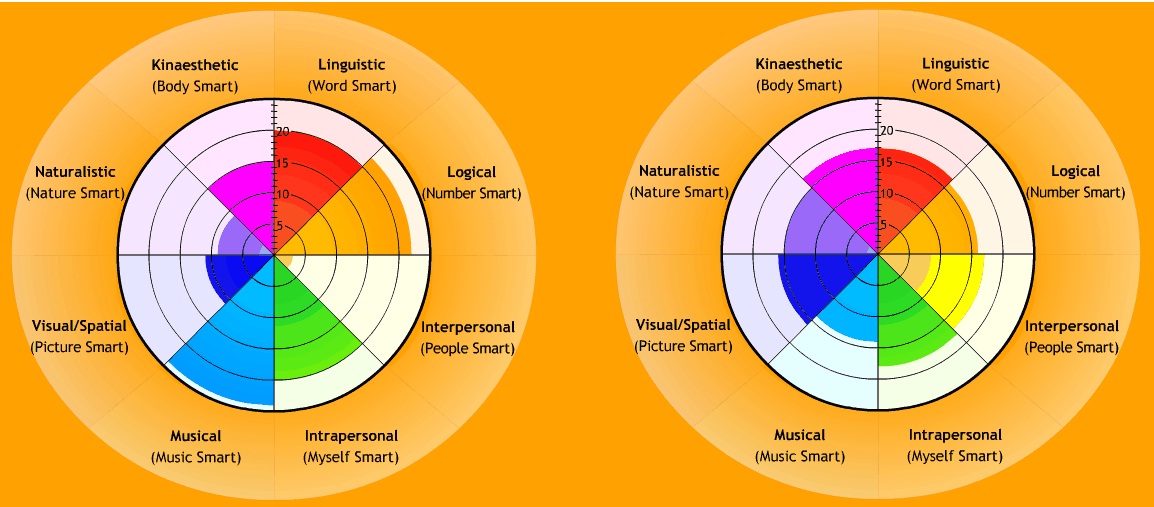
Oh, and this. It was fun and the results are super colorful. This shows my results (right) and the average for females from the United States who are 19+ years of age. Click for enlargement (teehee).
Vroom.
Stress relief via the internet!
Hahaha, holy crap, three finals right in a row, with Symbolic Logic smashed right in the middle.
Fun times. Though I do think I got the quantifier proofs right, and if I did, it would be the first three times that I got quantifier proofs right.
So.
Tonight I took an online test that was structured after Gardner’s multiple intelligences theory, which states that there are several different types of intelligence and that people have strengths and weaknesses in the various types. I took one early tonight, but I misplaced my results and didn’t want to go back and do it again, so I did a different one here.
My results (the higher the number, the stronger I am in that area):
Linguistic: 9
Logical-Mathematical: 10
Spatial: 10
Bodily-Kinesthetic: 6
Musical: 8
Interpersonal: 3
Intrapersonal: 9
A Short Definition of your Highest Scores
Logical-Mathematical – the ability to use numbers to compute and describe, to use mathematical concepts to make conjectures, to apply mathematics in personal daily life, to apply mathematics to data and construct arguments, to be sensitive to the patterns, symmetry, logic, and aesthetics of mathematics, and to solve problems in design and modeling. Possible vocations that use the logical-mathematics intelligence include accountant, bookkeeper, statistician, tradesperson, homemaker, computer programmer, scientist, composer, engineer, inventor, or designer.
Spatial – the ability to perceive and represent the visual-spatial world accurately, to arrange color, line, shape, form and space to meet the needs of others, to interpret and graphically represent visual or spatial ideas, to transform visual or spatial ideas into imaginative and expressive creations. Possible vocations that use spatial intelligence include illustrator, artist, guide, photographer, interior decorator, painter, clothing designer, weaver, builder, architect, art critic, inventor, or cinematographer.
Waiter! There’s an e in my pi (thus meaning he brought me pie! Sweet!)
Question 1: Do you pronounce the word “route” as “rowt” or “root”?
Question 2 (much more important): So the main reason I’m so interested in psychometrics (aside from the awesomeness of item-analysis and such) is to improve how we measure and test for intelligence. I personally think that what we measure to determine “intelligence” does not account for a lot of important things—especially if we redefine intelligence (which I think we should) to relate more to actions and mental states that aim to advance the species (not in that way, you sickos!).
So on to the actual question, something I’ve been mulling over for a while now: is motivation a component of intelligence? I’m not asking if motivation brings about intelligence, I’m asking whether or not two people with equal IQs (let’s just use the IQ number as the definition of what we call intelligence today, just for simplicity’s sake) are actually of different intelligence if one is more motivated than the other. In other words, if we had one person with an IQ of 130 and another person with an IQ of 130, and one of them had little motivation and the other had a lot of motivation, would the one with more motivation be more “intelligent”? What do you all think?
Of course, there are other concepts than just motivation that should be considered when trying to create a new measure for intelligence. So how about you guys tell me what you think should constitute intelligence, so I can see how other people see this topic. Also, do you think such a concept as intelligence can be quantified?
Wee!

 Eigenblogger