Oooooo, I like it!
As many of y’all know, I like logos/emblems/symbols/etc. In the past, I have offered my praise/critique of various Olympics emblems over the years, so let’s look at some of those logos now that the Paris Olympics are fast approaching, shall we?
In fact, let’s start with that one:

Not bad. Nice and simple. The woman depicted in the flame is Marianne, a symbol of the French Republic that represents “humanism, fraternity, generosity, and sharing.”
What about Winter 2026, set to be held in Milan and Cortina?

Eh. A little bland.
Summer 2028, held in Los Angeles?
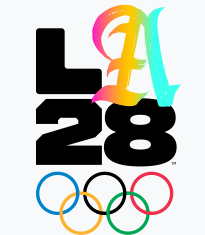
I like it! And the cool thing is that this isn’t the only emblem they’ve got. Apparently this is one of 32 37 different variations. Each variation features a different design of the “A” by various athletes, actors, artists, singers, etc.
That’s pretty freaking cool. I dig it.
That’s as far ahead as the emblems go so far. Hopefully future ones are cool as well!
Can’t Figure Out the Door? It Might Not Be Your Fault!
Haha.
So today I found out about the term Norman door, which refers to any door that is confusing to use. Or, in a broader context, it refers to any item/product that has a design element that does not make it clear how that item/product should be used.
It is named after Don Norman, who states in his book The Design of Everyday Things that:
“The design of the door should indicate how to work it without any need for signs, certainly without any need for trial and error.”
A vid:
The doors in the math building fall under the term “Norman doors.” Some of them have “push” or “pull” on them, but half of them don’t and it is definitely not clear what you should do with those. I still screw it up sometimes, haha.
I feel like I knew there was a name for this kind of thing, but didn’t know the name itself. Interesting!
Also:
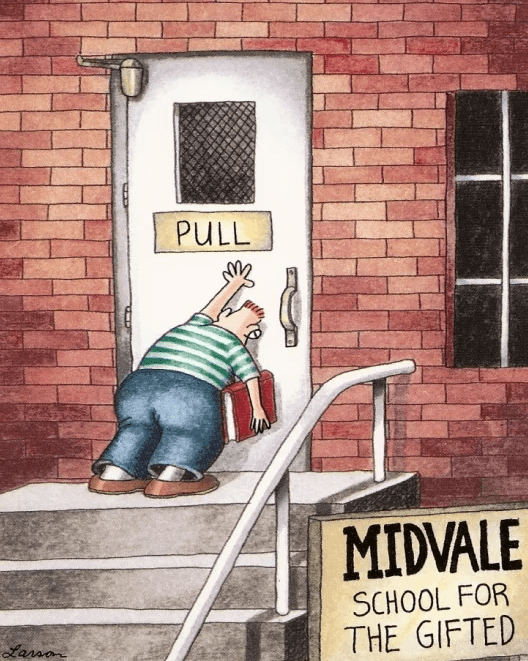
(Not really a Norman door with that handle, but this is what came to mind when I was reading about this, haha.)
All Quiet on the Western Font
Sigh.
You know what’s a big deal to me? Fonts.
Has anyone reading this ever seen the old Disney Silly Symphony cartoon called Music Land?
If you don’t have 9 minutes to watch: the story’s about two warring lands in the world of music: the Isle of Jazz, populated by anthropomorphic jazz instruments such as saxophones, trumpets, and guitars, and the Land of Symphony, populated by anthropomorphic—you guessed it—symphonic instruments such as violins, violas, cellos, etc. The princess of Symphony, a young violin, falls in love with the prince of Jazz, a little saxophone. They’re caught canoodling in Symphony, the prince is thrown into jail, and the two lands go to war over the whole thing. The prince escapes and the two lovers row out into the Sea of Discord (haha) separating the two lands and almost drown, causing the parents (Queen of Symphony and King of Jazz) to row out to rescue them. In the end, the queen and king fall in love and the two lands reconcile, creating a Bridge of Harmony across the Sea of Discord (d’awwwww). Seriously, watch the cartoon if you’ve got time, it’s pretty awesome.
Wow, tangent.
Anyway, to bring that back around, that’s kind of the relationship I see when I think of fonts. There’s like a Serif Land and a Sans Serif Land, with Times New Roman and Arial the two respective leaders. They absolutely hate each other and the serif fonts stay well out of the way of the sans serifs. And there’s like this half-breed group of wild semi-serifs that roam outside the boundaries of either land and eat the fonts that stray out of the protection of their respective areas.*
I’ll say it again: fonts are a big deal to me.
Anyway. The main reason I keep redoing my heading for this blog is because I have yet to identify a font as my particular signature font. Times New Roman is certainly my favorite font (serifs > sans serifs, I don’t care what anyone else says), but it’s not MY font. At least not for this blog. I keep jumping around with a few fonts (right now I’m using Metro, which is pretty great but isn’t just right), but every time I check for more to download I either download like 90 different ones and thus consequently have to delete yet another program from Vaio (hard drive = 99.9% full or something like that) while still not getting the right font or I get distracted reading about typography on Wiki.
So yeah, I know it doesn’t matter to anyone else and it’s probably just more annoying than anything else, but just to explain why that little header above keeps changing like every month/week/hour: I am searching for the right font. I know someday it will come.
The end.
Oh, also this, which I’ve posted before but am posting again because it’s hilarious and relevant.
*Do you see what goes on in my head? DO YOU? This is why I can’t take myself seriously.
Claudia the Angry Blogger Presents: Yet Another Rant against Pretty Much Everything
Alternate title: I’M ALL FIRED UP, WHAT’RE YOU GONNA DO ABOUT IT?!
I had a frustrating day today for various reasons. This little rant was inspired by a Google search (and Facebook). Haha, it’s a LOT longer than it was originally intended to be, so ignore it if you don’t want to read my incoherent ramblings about stuff that really doesn’t matter at all.
Perhaps the large businesses, website designers, and marketing department heads are familiar with the old adage, “if it ain’t broke, don’t fix it.” If they are, I truly doubt that they actually know what it means, as it is quite obvious by the state of change things are in nowadays that they currently have no intention of heeding its message.
I have a Bachelor’s degree in Psychology. It may not sound like much (and it’s not), but there’s one thing in particular that stuck with me throughout my undergraduate education that has, now that I think about it, been backed up by pretty every situation I’ve ever been in: people dislike change. I’m not talking about change that brings about better circumstances, either immediately or in the distant future (though usually we’re more apt to appreciate change that leads to things improving immediately, as we as a species pretty much suck at appreciating delayed rewards). I’m also not talking about change that occurs because something is broken or something isn’t working to the best of its capability. Of course they should change the design of, for example, a hammer, if the way it’s designed now causes people to take two hours to pound a nail into a board. I’m not talking about that kind of change.
I’m talking about change for the sake of change—changing stuff just because it’s felt that a new layout is needed, or “modernization” must occur. There’s no real payoff from it, so there’s really no reason to do it—and yet it’s done anyway. I know everyone knows what I mean because as of late, websites, companies, and everybody else who gets their hands on their own logo all seem to be really desperate to do this. I noticed it a few years ago with brand logos and designs suddenly changing to look more “modern”—in particular, I recall the old M&M’s packages being replaced with the newer, hipper, 90’s versions (more flashy text, a more ‘animated’ package background).
Why? No real reason whatsoever. I know that logos and packages are a somewhat different field than websites (and actual products themselves), but every time I see a newly re-designed package with a sticker that claims something to the effect of “new design, same great product!” I have to wonder, “then why change the packaging?”
As I said, though, packaging and brand logos are in a different league than websites. Web design is something that, when it’s done right, is not noticed at all. Herein lies the problem with sudden unnecessary change, and I will show you why:
Pick a website whose design you admire for its simplicity and ease of use. This whole thing started with Google’s desire to change things up for no reason, but let’s pick another website just for the sake of demonstrating my point with even more strength: Facebook. I was not on Facebook myself until it underwent its first (and possibly second, I can’t remember) layout overhaul2. I wasn’t really interested in what it had to offer, but I do remember that the tabs at the top weren’t yet present, the “mini-feed” still existed, and things ran pretty smoothly and information was easy enough to locate.
Not long after this, however, things began to change for no reason other than to…well, I still don’t know why they thought changing stuff around was a good idea. The tabs arrived, and if I recall correctly they were met with such opposition that I had, at one point, multiple friends inviting me to join multiple groups that either protested the new layout or that claimed they had a way to change your profile back to the “old Facebook.” Then the “news feed” thing came, along with its ability to seemingly randomly switch between the “most popular” and the “most recent” feeds. Same story, same opposition.
Deny it all you like, there’s no getting around the fact that there are a lot of people who dislike the changes Facebook has made (and, for reasons seemingly unknown, keeps making). It doesn’t take much to realize why. When I first started using Facebook, I really didn’t pay any attention to the layout, mainly for this reason alone: it worked. It did what it was supposed to do, and it was fairly efficient at doing so. I got all the information I wanted to see on one page with no unnecessary fluff or clicks.
When Facebook suddenly made the tab change, I (as well as everyone else) was forced to “retrain” our methods of navigating the website. Whether the new design was in actuality more efficient than the old one was not the point in question—when the mini-feed vanished on us, we had to expend extra effort to retrain our brains to recognize that it was now under the “wall” tab and not right in front of us when we went to our profile.
The point I’m trying to make now is the fact that unnecessary layout changes are not only, you know, unnecessary, but they draw the attention to any shortcomings that may have, by accident, been included with the new layout upgrade. All of a sudden our ability to rate videos has disappeared on YouTube. Though there are claims that the overall “clutter” of the site has been reduced3, how many people notice anything other than the fact that they can’t rate something as having five stars (or still notice that the layout is still not the greatest)? That’s the point I’m trying to make: when website layouts or designs change for no obvious reason than to just change, we don’t notice the good things. We notice the failures. So what do we do? We do what only comes natural: we bitch about it.
Note, however, that this bitching does absolutely nothing. And now we come to the reason why I went on this long rant in the first place: Google. There are several things that I have always expected to remain constant (or at least, said to remain constant) within my lifetime. Among such things are:
– the speed of light in a vacuum
– Planck’s constant
– the gravitational constant
– Google
So imagine my surprise when I Googled something this afternoon and, upon viewing the search results, found that I was privy to Google’s experimental (and possibly soon-to-be-permanent) sidebar. Immediately annoyed by its intrusion into my search results, I did a search on it itself and within the top few results were—guess what?—people bitching about the experimental sidebar. “I hate this format- I like Google because it was clean and simple and now it’s all cluttered like every other search engine out there4.” There appear to be pro-Google individuals in digital tears over the possibility that a sidebar will be a permanent addition to their search results pages.
And now we come very quickly to the second point I wish to make: bitching does absolutely nothing (most of the time). Again, this has to do with the fact that people are both creatures of habit and lazy, as well as the fact that there are about five websites, in my opinion, that most people use without thinking much about it. I have friends in another country; I log onto Facebook to see if there’s any recent news about them. No real thought, it just happens. It’s like this with all the big and popular sites, and no amount of changes will probably mess with that.
When a member of the Internet Axis of Power (Google, Yahoo!, Facebook, YouTube, those such sites)1 pulls a change on the public, of course there is going to be outrage. There certainly was when YouTube changed its format and not too long ago. Comments of “the new YouTube layout sucks!” were quickly thumbed up and became the most liked comments on quite a few of the videos I’ve watched.
Why does this happen? I reiterate: if something’s working fine, and there is a sudden change that doesn’t really do much to improve aesthetics, functionality, or ease of use, it generally messes with peoples’ minds in a way that makes them upset. They have to expend effort, either getting used to a whole new way of navigating a website in the most extreme cases (Facebook), or just getting their brains used to a new visual cue on their search results page in the milder ones (a la Google’s experimental sidebar). And people don’t like effort.
But these websites are still the strongest ones out there. YouTube could make us have to type a captcha to comment on a video or Facebook could make us do the same to post on our friend’s wall, and we’d probably still use them. Why? Because they’re there. Because they’re the websites we’ve grown to love and depend on and automatically scroll to in our list of bookmarked sites. It’s basically a battle between putting up with pointless, needless site changes, or changing ourselves to not go to those sites. And we all know what side wins every time.
I’m certainly not suggesting that these websites are the bourgeoisie oppression to our proletarian desires to breeze about the internet unheeded. I’m simply saying that we can bitch all we like—if we continue to use their sites, and those in charge see no significant drop in web traffic as a result of the changes they made, then really, what’s been accomplished but a lot of angry video comments, irate Facebook groups, and upset Google users posting “it’s the end of the universe!” on forums?
One or two user casualties will ultimately do nothing, and I’m nearly stating fact when I say this: is there really anything that Google, YouTube, or Facebook could (in their right minds) do to their sites to render a huge drop in web traffic? Will a sidebar on Google’s results pages actually cause us to go elsewhere if we want to search for something? And for those of us Facebook addicts (or Facebook addicts in training), will a more-difficult-to-navigate interface really deter us much from checking the news feed every five minutes?
I started this rant with the intention of complaining about the problems of superfluous changes in web design—specifically, I wanted to point out that websites that change their layout for no other apparent reason than to simply change things up a bit get negative feedback and may lose some of their credibility (though that’s not the word I’m looking for, but I can’t think of a better one at the moment). However, the point I seem to have made in the end is that we’re pretty much tied to the major websites—and to any website we use with consistency, really—to the point where these little changes, as frustrating as they may be, will do little to deter us from partaking in the
services said websites offer. So I guess the best we can do is hold our little bitch-fests and hope the web designers happen to read video comments.
Edit: I also just came across this tidbit of information while researching for this little rant.
“‘There is nothing wrong with the logo,’ said Google product manager Nundu Janakiram. ‘We wanted to brighten it up and make some tweaks to it.'”
“There is nothing wrong with the logo.”
“There is nothing wrong with the logo.”
“There is nothing wrong with the logo.”
Sigh.
1 By traffic: http://mostpopularwebsites.net/
2 http://en.wikipedia.org/wiki/Facebook
3http://techcrunch.com/2010/01/21/new-youtube/
4 http://www.google.com/support/forum/p/Web+Search/thread?tid=67f6459e09a827ee&hl=en
Today’s song: Pompeii by E.S. Posthumus

 Eigenblogger