Color Palette
Y’know what? I’m not mad at it.
I still have my standard favorites when it comes to colors (orange, lime green, yellow, red, mainly), but I think my enjoyment of non-standards has broadened over the past several years.
Like…I used to really dislike neon. I like bright colors and always have, but bright rich colors, not neon. But I really started to dig neon around the end of 2019 or so.
Same thing with pastels. I’m still not a huge fan, but I’ve grown very fond of mint and lavender (that’s why I wanted an iPhone 12 – I wanted that lavender color!).
So peach fuzz? Definitely not a color I would choose as a favorite or to wear, but I appreciate it.
The end.
High School Color Fun
Let’s time travel back to high school for a moment, shall we? I had this book (well, I guess, I technically still have it, haha) called “The Dewey Color System” by Dewey Sadka. It’s a personality test book that tells you about yourself based on the combination of your favorite primary color and favorite secondary color (with more info based on how you feel about other colors like black, white, gold, teal, etc.).
I was obsessed with this book and made everyone I know take the test (which is just, again, picking your favorite primary color and your favorite secondary color).
Here is said book:
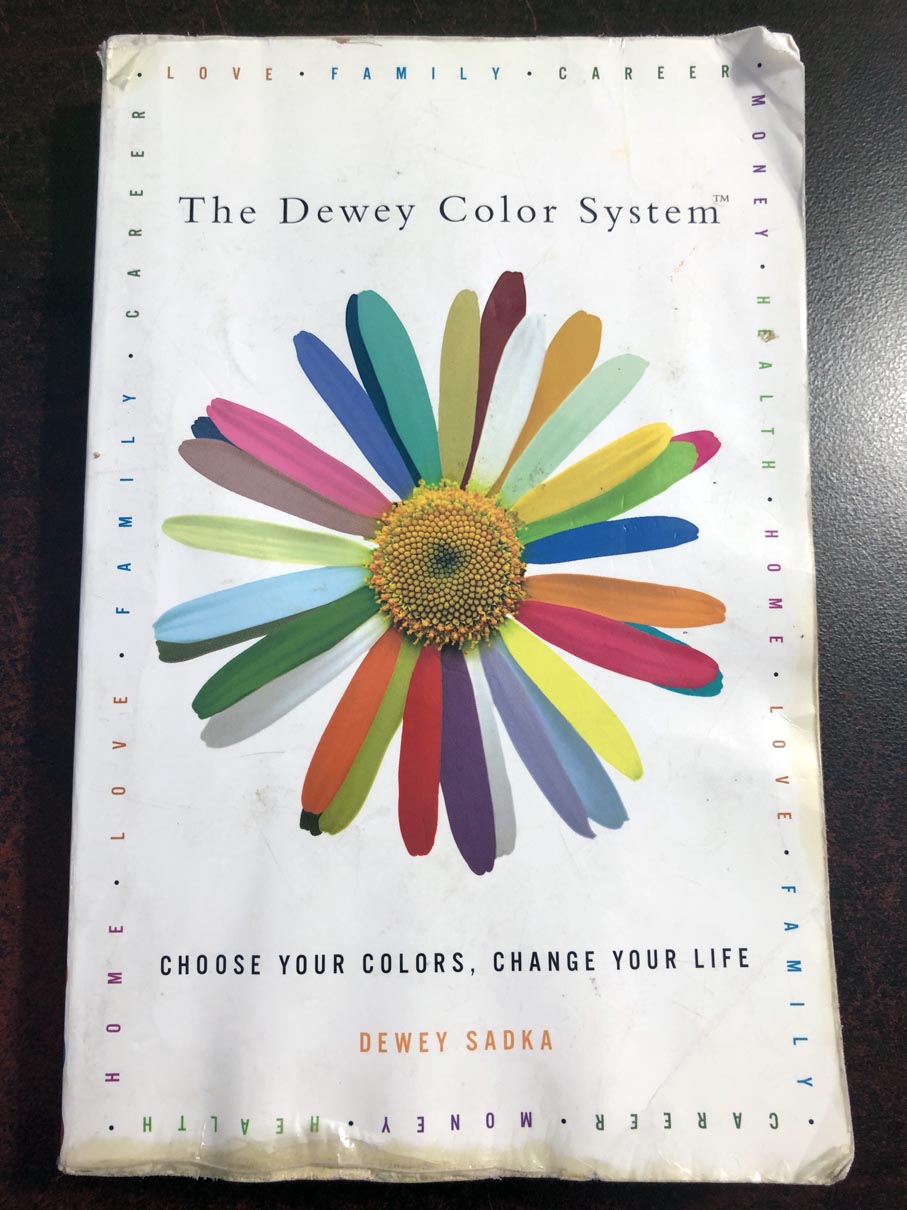
As you can see by how beat up it is, I used it a lot. I actually did a “stats” project in my 11th grade psych class where I looked at the frequencies of people’s personality types with the Dewey Color System and compared them to the frequencies of their Myers-Briggs personality types. Of course, I knew ZERO about stats at the time so I was just comparing the frequencies without any sort of test of statistical significance, but I did go back to the data a few years ago and tried to chi-square the hell out of it for funzies.
[Edit: I can’t find that blog for whatever reason, but it’s out there.]
Anyway. I think the test and results used to be online for free, but now it looks like you have to pay. SAD! That was the whole point of this blog, haha.
Edit again: alrighty, found the blog in question. Looks like I didn’t do anything that looked at Dewey vs. Myers-Briggs…just Myers-Briggs-related stuff. I wonder if I can find my data anywhere?
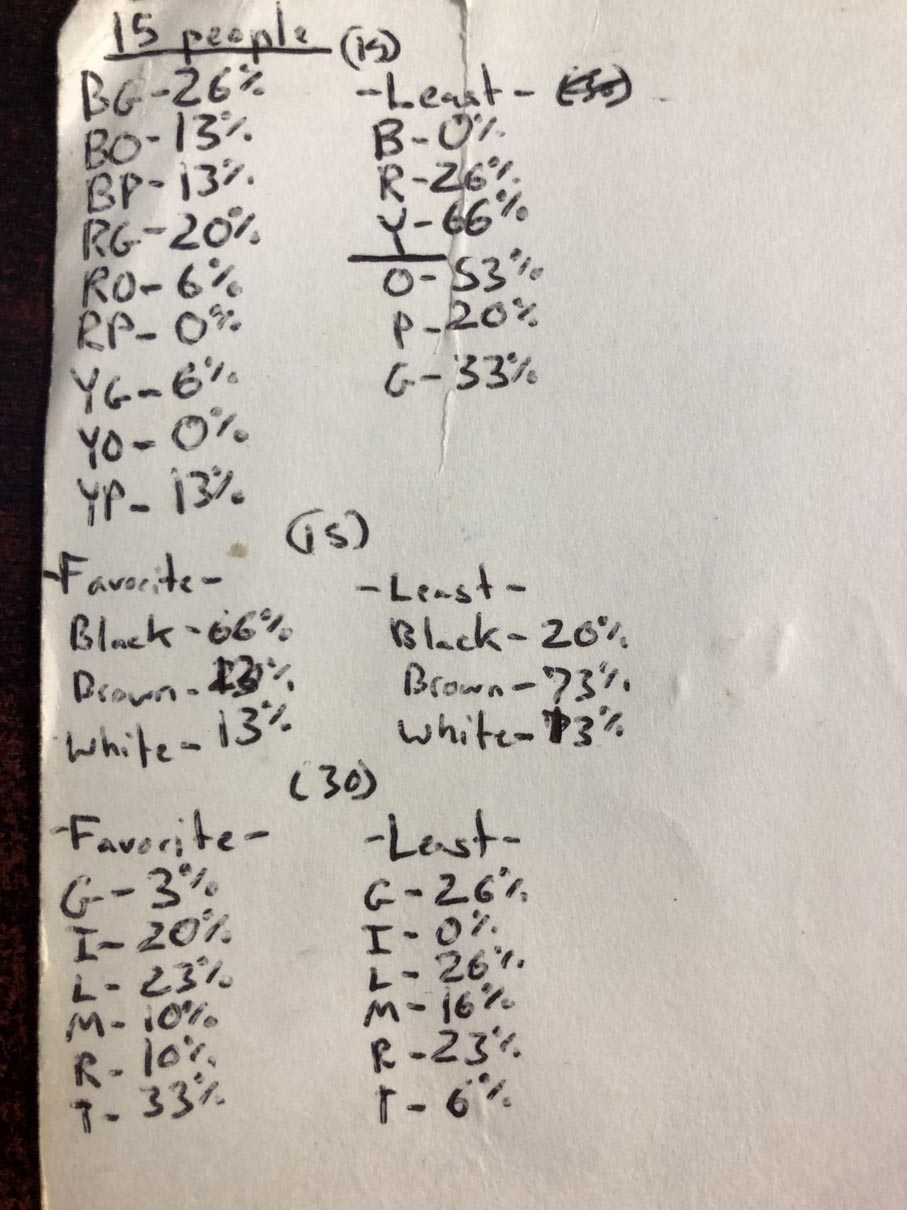
Edit again again: No data on both tests, but I did (of course) write down some of the results of the Dewey test in the front cover of the book. All those letter combinations at the top are the combos of favorite primary (Blue, Red, Yellow) and secondary (Green, Orange, Purple). The letters at the bottom are representing the six “intermediate” colors for which people were supposed to choose two as their favorites and two as their least favorites (Gold, Indigo, Lime, Magenta, Red-orange, Teal).
Also, my grades in high school were abysmal.

Algebra: my worst enemy in high school. Also, how the hell does one get a C in Wellness?
TWSB: The Colors of Google
So as is tradition, there’s some sort of major character death in my NaNoWriMo novel. At least this time it doesn’t happen until the end. Or near the end.
Or both.
Anyway.
I was going to put up my ending as an excerpt to torture you all today, but then I stumbled across a really cool science article. Considering I haven’t done my science blog yet this week, you get that instead!
Well, I guess it’s more math/pattern analysis, but hell, that’s science, ain’t it? I need to add a “math” category to my blog.*
Alrighty. So I stumbled upon this article by Ric Dragon of DragonSearch Marketing in which he makes a few educated conjectures about what the next color would be in the sequence if the Google logo had another letter.

The Google logo, as pictured above, has four colors: blue, red, yellow, and green. Mr. Dragon breaks up the letters into sequences of three to get this pattern:
- 1st sequence: blue, red, yellow (compliment to the combo of blue and red, purple)
- 2nd sequence: red, yellow, blue (compliment to the combo of red and yellow, orange)
- 3rd sequence: yellow, blue, green (combo of yellow and blue)
- 4th sequence: blue, green, red. Green = blue + yellow, but since blue is already in the sequence, he takes green-blue=yellow; thus the sequence is blue, yellow, red, with red being the compliment of blue and yellow, green.
From this, he makes the claim that the third color in any three-letter sequence must always be the result of mixing the first two colors or is the compliment of those first two colors.
So, again after removing the blue from the green in that last sequence, the next sequence of three would be yellow, red, ?
So if the rule here is combo, the next color would be orange (yellow + red)
But if the rule is compliment, the next color would be blue (compliment of yellow + red)
He talks a bit about iGoogle, too, which kind of messes up his patterns, but I actually just realized that I have a lot of stuff I should be doing other than blogging, so you’re just gonna have to read the article instead of my crappy summarizing. But it’s a cool thing to think about, eh? The mysteries of Google.
CLAUDIA OUT!
*Of course, that will require eliminating an old category to keep the total number of categories at 35. So some reassigning shall have to happen. Not that anyone else cares about that. Why the hell am I still talking?
Be still and know that I am DOG
Woah, dudes. Woah, woah, woah.
Awesome Breakbot song combined with ridiculously trippy music video? Life is good.
That is all.
I’ve been waiting years for this
Ladies and gentlemen, I present to you the statistically perfect pack of M&Ms!

How is it statistically perfect, you ask? Well, if you take a look at Mars’ website, you can find the percentage of all M&Ms that each color represents. 30% of all M&Ms are brown, red and yellow both make up 20%, and orange, green and blue each make up 10%. Therefore, in a bag of 23 M&Ms, we would have seven brown, five red, five yellow, two orange, two green, and two blue. For a perfect example of this, see above photo.
My day has just been made.
(And yes, I know this boosts my dork level to even higher levels; I don’t care!)

 Eigenblogger