Correlation and Independence for Multivariate Normal Distributions
OOOOH, thisiscoolthisiscoolthisiscool.
So today in my multivariate class we learned that two sets of variables are independent if and only if they are uncorrelated—but only if the variables come from a bivariate (or higher multivariate dimension) normal distribution. In general, correlation is not enough for independence.
ELABORATION!
Let X be defined as:
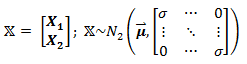
meaning that it is a matrix containing two sets of variables, X1 and X2, and has a bivariate normal distribution. In this case, X1 and X2 are independent, since they are uncorrelated (cov(X1, X2)=cor(X1,X2) = 0, as seen in the off-diagonals of the covariance matrix).
But what happens if X does not have a bivariate distribution? Now let Z ~ N(0,1) (that is, Z follows a standard normal distribution) and define X as:

So before we even do anything, it’s clear that X1 and X2 are dependent, since we can perfectly predict X2 by knowing X1 or vice versa. However, they are uncorrelated:

(The expected value of Z3 is zero, since Z is normal and the third moment, Z3, is skew.)
So why does zero correlation not imply independence, as in the first example? Because X2 is not normally distributed (a squared standard normal variable actually follows the chi-square distribution), and thus X is not bivariate normal!
Sorry, I thought that was cool.
MY FRIENDS KNOW ME SO WELL
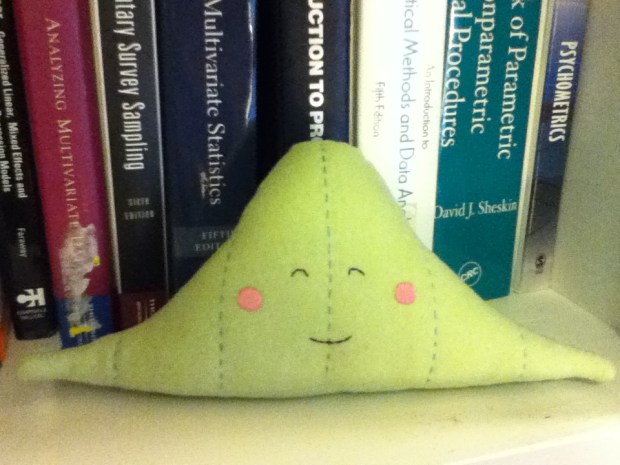
Look at this ridiculously adorable thing.

This was the “surprise” Nick sent me awhile back: a standard normal distribution plushie!! I told him about this Etsy shop like three years ago and then this dude shows up in the mail.
He is my new favorite little buddy.

LOOK AT HIM SMILING LIKE “YEAH I KNOW I’VE GOT A MEAN OF ZERO AND A STANDARD DEVIATION OF ONE AND I KNOW YOU WANT MY BOD”
He is so freaking adorable I can’t even stand it.
Right now he’s chilling with all my stats books, but I might bring him to my office to chill there.
Thankyouthankyouthankyou, Nick!

 Eigenblogger