Another space thing, sorry not sorry
As I’ve said before (including in yesterdays’ blog, haha), I really like things that give us an idea of scale, especially when it’s a scale that’s really hard for humans to comprehend.
So here’s a model of the Solar System, where the coolest thing is the very clever inclusion of the closest star (apart from, of course, the sun):
Have I Posted This Before?
I don’t think I have. I had the intention to at some point, but I don’t think I ever did.
So here it is.
A simulation, obviously, but it gives you a sense of scale and space and I love stuff that gives us a good sense of scale and space, don’t you? It’s terrifying and beautiful and amazing all at the same time.
Happy Discovery Day, Uranus!
It was on this day in 1781 that William Herschel observed Uranus (the planet, you immature nerds) and initially recorded it as a comet. However, he compared it to a planet and other astronomers at the time were suspicious of the comet classification due to its orbit around the sun appearing to be nearly circular. It eventually became accepted as the seventh planet.
Uranus was also instrumental in discovering Neptune due to perturbations in its (Uranus’) orbit that could only be explained by the existence of another planet out there somewhere.
So that’s pretty cool.
MOON FAMILY!
So Saturn already held the record in the Solar System for the most moons at 146, but a set of 128 new satellites discovered by a team of astronomers back in 2023 have officially been classified as moons! Saturn now has 274 recognized moons, which is pretty insane. Most of these new moons are extremely small, but still.
Also, I’m just going to leave this here.
(Yes, it’s a SolarBalls episode; yes, I’m still wildly obsessed; yes, it’s relevant because SolarBalls Saturn would probably lose his mind over an additional 128 new moon names to memorize.)
Edit: in searching for a relevant article to this story, I found this NASA article from 1995 talking about the discovery of two to four new Saturnian moon candidates. Back then, the total confirmed number of moons was only 18. Pretty wild!
Thanks, Mars!
Today, the Europa Clipper made its way past Mars on a gravity assist move to further support its eventual swing by Jupiter’s moon Europa!
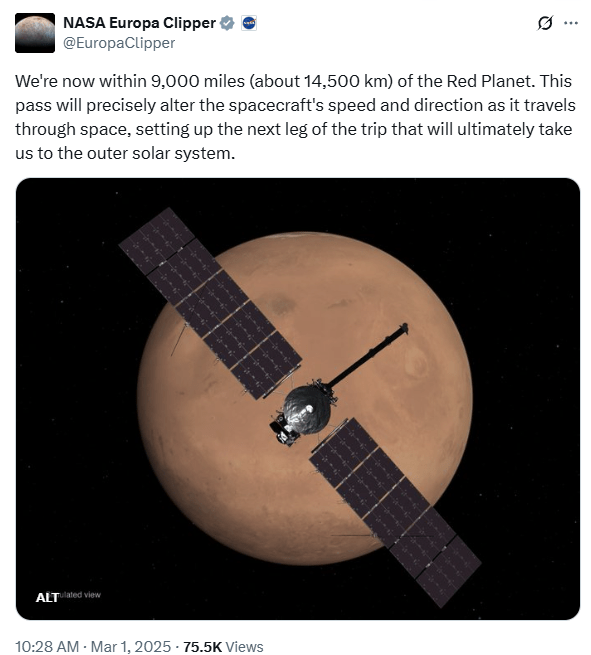
(Tweet)
As I mentioned in a previous post about this, the Martian gravity assist did not boost Europa Clipper’s speed but reduced it instead. This is so that less propellant is needed, as the craft still has a long way to go to reach Jupiter.
In fact, it’s swinging back to earth first for another gravity assist before being flung out past the asteroid belt. This gravity assist will happen in December 2026; the craft will get to Jupiter in April 2030.
Pretty cool, huh?
Europa Clipper News!
The Europa Clipper launched about 4.5 months ago with the goal of eventually examining Jupiter’s moon Europa. On March 1, it will perform a gravity assist by flying by Mars.
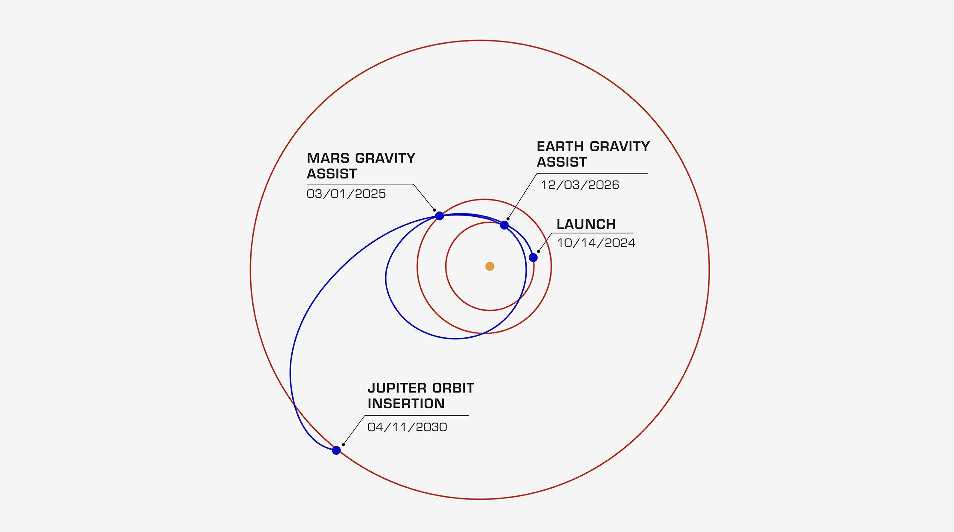
(Pic from here).
Unlike what you’d probably expect from something called a “gravity assist,” the Europa Clipper won’t be using Mars’ gravity to speed up but rather to slow down and reshape its orbit around the sun. This will set it up for a second gravity assist around the earth in late 2026 before it finally heads off to Jupiter.
Cool, huh?
I want to buy…
…a telescope!
We of course have a decent amount of light pollution in the city, but we can still see a good number of stars on a clear night. Makes me want to try out a nice telescope.
My mom used to have a telescope when I was a kid (was that on Borah? I can’t remember, haha), but I don’t think I ever got the hang of using it.
My biggest problem is that I’m actually exercising self-control over a purchase for once and I don’t feel like I know enough of the technical stuff to get the right telescope for what I want. It’s a big purchase and I’d want to make sure I’m getting what I need, so I’ll have to do more research on it.
Edit: Ooooh, nice site!
AAAAAA THIS IS COOL
So the sole flyby we’ve ever done of Uranus was by Voyager 2 in 1986. Of the many odd things about this planet, one extra strange thing observed by the spacecraft involved Uranus’ magnetic field. Namely, despite having radiation belts in its magnetosphere that were second only to Jupiter in intensity, there was no clear source of the energized particles or plasma that fed the belts.
However, new analyses of the 1986 data suggests that an unusual solar wind event may have been taking place during Voyager 2’s flyby of the planet, causing a change in its magnetosphere and temporarily stripping it of the plasma. According to scientists, these conditions occur about 4% of the time, and they just so happened to be taking place during the flyby. They suspect that Uranus’ magnetic field would have looked quite different had the flyby taken place even just a few days earlier.
Isn’t that wild?
Aww.
Saturn’s getting a nice bath from Aquarius.

(Yes, I know these celestial objects are incredibly far apart; SHUT UP, IT LOOKS CUTE.)
Puff Daddy: Planet Version
Thanks to my YouTube recommended list being like 90% astronomy-related now, I get to see stuff like this:
The idea of a planet having the density of Styrofoam is insane.
Good Luck, Europe Clipper!
And she’s off!
Not sure how things on earth will be going in 2030, but if we’re still somehow chugging along and not murdering each other for water, food, and other resources that we’ve destroyed due to climate change, the information this will send back will be so cool to see!
Did You Know…
That the area of the in which many water-related (and few land-related) constellations are located is called “The Sea” or “The Water?” And that it is suspected that this clustering of water-themed constellations exists because the sun passed through this part of the sky (at least where Ptolemy was naming constellations) during the rainy season?
Such constellations in “The Sea” include:
- Aquarius (the water-bearer)
- Capricorn (the sea-goat)
- Cetus (the whale)
- Delphinus (the dolphin)
- Eridanus (the river)
- Hydra (the water serpent)
- Pisces (the fishes)
Cool!
So I’m an idiot
(Obvious title is obvious)
Thanks to SolarBalls, I’ve been reading up on the planets, their moons, and all sorts of other space fun. I was reading about the shepherd moons of Saturn and Uranus and kept thinking “where have I heard that phrase before?” and it took me until today to realize it: Enya.
DUH.
We listened to this album a lot in Art Camp. Brings back immediate nostalgia and really makes me want to mess around with some clay.
Anyway.
Solar
This is a wonderfully produced little documentary on our Solar System.
Uranus is such a weird planet, yo. It’s my favorite.
That is all.
More Fun Ways for the Earth to End
My brain specializes in disturbing end-of-the-world scenarios that are just far enough on the plausible side to be extra terrifying.
As an example, I present last night’s dream:
In the dream, I’m out on our balcony looking at the stars on a clear night. I notice very quickly, however, that not only can I see the stars but I can also see the International Space Station. But it’s not a little dot like it usually is; rather, it’s SUPER CLOSE and I can see it in detail. Then I realize that I can see all sorts of space debris, like old discarded pieces of space crafts, random satellites, etc.
I think this is super cool and a product of Calgary’s skies being so clear, so I take a picture of it and send it to my mom. She responds by saying that something bad is happening and that I should turn on the news.
It turns out that the US government, in an effort to do…something (probably strengthen the military), has messed up one of the outer layers of the earth’s atmosphere (I’m not sure which, but I’m gonna say the ionosphere because that makes the most sense). Specifically, they accidentally made it way more magnetic than it should be. The result? All of the relatively close metal-based space debris is being drawn towards earth and is all starting to re-enter the earth’s atmosphere. As I’m listening to this news, I can actually see all of these pieces of debris get closer and closer in the sky, with one piece turning bright red as it falls into the upper atmosphere. The news anchor is telling people to be prepared for mass destruction* and to get underground if possible.
This is, of course, terrifying. In addition, the news says, the increased magnetic nature of the ionosphere is messing with all the electronics on earth. Sure enough, soon my phone no longer works and my conversation with my mom is cut off. My computer monitor, too, starts to dim and then eventually dies as well.
At this point I’m panicking, because I know I have to get Nate (who is nowhere to be found in the dream), Jazzy, and all our important stuff together and out of the condo as fast as possible. I’m also worried about my mom. She, however, shows up in the condo a few minutes later (hooray dream logic) and we both start to scramble to get things together to evacuate the building.
By this point, the power grid is starting to fail and the lights flicker and go out entirely. Now it’s dark (it’s still nighttime) and I can’t find a flashlight or Jazzy or her carrier or any of the other important stuff we need to keep with us (passports, etc.). Meanwhile, more and more pieces of debris are breaking through the atmosphere and crashing all around us, with some of the neighboring buildings going up in flames as burning pieces of metal collide with them.
It’s just this overall feeling of helpless panic.
Then I wake up.
Ugh.
I guess the takeaway from these nightly “here’s how you might die!” dreams is that this is the third one in the past week where in the dream, I’ve regretted the fact that I did not have things prepared for a quick evacuation (emergency bag + important stuff ready to be quickly gathered and taken with me). I’m assuming this is the universe telling me to get that stuff ready just in case.
Because you never know.
*In reality, most of these objects are probably small enough that they would just burn up before hitting the earth, but still…terrifying, right?
UH OH
BOOM!
I think it’s so cool that so many of the stars that we can see may not even be there anymore. As the article states, since Betelgeuse is 642 light years from us, it could have done its supernova show that long ago and we would still be seeing it as “normal” in the sky.
That’s super wild.
Also, “The Armpit of Orion” would be a fantastic metal band name.
THIS IS FASCINATING AND BEAUTIFUL AND IT IS NOW MY DESKTOP WALLPAPER

Holy fucking shit.
What you’re seeing here are cell-like regions of the sun’s plasma that result from the turbulent motions of hot plasma rising to the surface of the sun, cooling, and sinking again. This process of convection affects the sun’s magnetic fields, which can lead to solar storms if the fields get tangled enough.
For perspective, note that each of those “cells” is about the size of Texas.
Isn’t this beautiful, though, seriously? I love it so much.
Spaaaaaaace!
I love this guy’s video simulations of space stuff.
I also love the disclaimer “Saturns rotation is extra impossible, but I had to prevent the rings from colliding.”
Don’t we all, yeti dynamics? Don’t we all?
Total Eclipse of the Moon. Or Sun. Or Heart. Whatevs.
Nate and I were talking recently about solar eclipses vs. lunar eclipses. It seems like lunar eclipses are rarer than solar eclipses, just given the number of announcements we hear about each.
Both types of eclipse actually happen about the same number of times each year (usually two solars and two lunars). However, it IS more common to see a lunar eclipse, due to the different sizes of the earth, moon, and sun, as well as the different angles of the moon and sun in the sky.
A lunar eclipse occurs when the moon moves into the shadow of the earth. That is, it occurs when the earth is in between the sun and the moon. This type of eclipse can be seen anywhere on earth where the moon is over the horizon, which is approximately half the earth at any given time.
A solar eclipse occurs when the moon is in between the earth and the sun. The shadow cast by the moon onto the earth’s surface is quite small—about 300 miles in diameter. Thus, only the people/animals/sentient things within that small disk of moon shadow as it moves across the earth will be able to see the solar eclipse.
The difference in the number of reports on lunar vs. solar eclipses might just be due to the fact that when a solar eclipse is about to happen, a lot of sources might want to report on it so that they can tell people who might expect to see it. With a lunar eclipse, it’s more like, “well, about half the world can see this, so it’s not as newsworthy.”
Maybe. I dunno.
So there you go.
See the Light
I’d like to think that if I ever decided to start completely over with this schooling business*, I’d like to work to become a heliophysicist or a helioseismologist, because the sun is a freaking amazing thing. Want some evidence? Check it:
Our star is a badass.
*Something I wouldn’t ever rule out, knowing me.
Gwoba-Wubba?
So today was sufficiently awful.
But you know what made it better? The news that we LANDED ON A FREAKING COMET.
Isn’t that the most ridiculously cool thing? I, for one, didn’t even know we had plans to land on a comet, let alone that Rosetta was launched way back in 2004. I was in high school then!
It’s just so sci-fi, isn’t it? I guess now we have our backup plan ready for when global warming gets out of control even more so than it is. Comet ice mining will solve the problem ONCE AND FOR ALL!
TWSB: You Missed a (Big) Spot
Jupiter news!
So we all know the giant red spot on the giant, fast-rotating planet, right?
Of course we do! But do we know why it’s red?
For a long time, the main theory has been that the spot is red because the giant storm creating it is churning up reddish chemicals from beneath Jupiter’s clouds and bringing them to the surface for us to see.
But a new theory states that the redness of the massive swirling isn’t due to chemicals from beneath the clouds but rather due to chemical reactions with sunlight. Work by Kevin Bains, Bob Carlson, and Tom Momary, scientists based at NASA’s Jet Propulsion Laboratory, state that based on data collected from both laboratory experiments and Cassini’s flyby of the planet in 2000, they suspect that the red tint is due to the effects of ultraviolet light on ammonia and acetylene, the gases in the uppermost portion of the storm.
Baines states that if this is the case, then the spot is probably pretty dull in color beneath its uppermost clouds. According to the older theory, if the reddish chemicals are indeed coming from beneath the clouds, then the spot would be red all the way through. Baines and the others are currently doing more testing/simulations to try to gain evidence about what color lies beneath the red.
As for why the great red spot is, well, the only great red spot on the planet, Baines suggests it’s because it’s a very tall storm—much taller than any other—and thus is more likely to get “sunburnt.”
The flip is imminent!
What flip?
The solar magnetic field flip, of course!
I blogged about this awhile ago, back when NASA stated that the flip would complete within three to four months. Now they’re saying that they can predict it will occur within a few weeks.
Apparently the most noticeable affect of this on earth will be an increase in the aurora australis and aurora borealis, but there also might be some interference with satellites and some radio blackouts.
At least those giant solar storms they were predicting haven’t happened…yet.
TWSB: International Moon Station
Another demonstration of just how much “space” is in space.
Edit: Tumblr has led me to this wonderful (and slightly terrifying) video…
…as well as this info:
“What if the moon was the same distance away as the ISS? … While we think of the International Space Station as being, well, way out there in space, it’s not that far. Only around 400 km up, actually. If the Earth was a basketball, then the ISS would only be about a centimeter off its surface.
“On average, our moon resides 384,400 km away from Earth. … Even at that incredible distance, the moon can warp the liquid on the surface of Earth! Which brings me to a major problem with this video … in order to see this, we’d all be dead, and Earth would be very messed up indeed.”
I HAVE NO LIFE LA LA LA LA
I was reading about the Hubble Space Telescope last night.
Then Taylor Swift came on shuffle.
And then this happened this afternoon.
I Knew You Were Hubble (sung to Taylor Swift’s I Knew You Were Trouble)
Once upon a time in 1990
We sent you into space to show us what we couldn’t see
From here on earth, from here on earth, from here on earth
At first there was a snag: your mirror was misplaced
But with several quick repairs we saw the galaxies you faced
With clarity, with clarity, with clarity
And your first images had us all in awe
When we realized all the beauty that you saw
‘Cause I knew you were Hubble when you took pics
Of the vast cosmos, oh
Showed us new vistas with some shutter clicks
Space so diverse, oh
I knew you were Hubble when you took pics
Of the vast cosmos, oh
Showed us new vistas with some shutter clicks
Now we’re picturing our universe
Oh, oh, Hubble, Hubble, Hubble
Oh, oh, Hubble, Hubble, Hubble
Nebulae alive with purples, reds, and greens
Our wonder begs for more, and you give us the means
To satisfy these needs, to satisfy these needs, to satisfy these needs
And I guess you’re booked up with professionals’ requests
But some of those demands end up resulting in your best
Photography, photography, photography
Like the time you stared into one part of space
And your resulting Deep Field put us humans in our place, yeah!
I knew you were Hubble when you took pics
Of the vast cosmos, oh
Showed us new vistas with some shutter clicks
Space so diverse, oh
I knew you were Hubble when you took pics
Of the vast cosmos, oh
Showed us new vistas with some shutter clicks
Now we’re picturing our universe
Oh, oh, Hubble, Hubble, Hubble
Oh, oh, Hubble, Hubble, Hubble
And after 20 years in 2010
You’re still doing your job, and well, by bringing awe to all of man, yeah
I knew you were Hubble when you took pics
Of the vast cosmos, oh
Showed us new vistas with some shutter clicks
Space so diverse, oh
I knew you were Hubble when you took pics
Of the vast cosmos, oh
Showed us new vistas with some shutter clicks
Now we’re picturing our universe
Oh, oh, Hubble, Hubble, Hubble
Oh, oh, Hubble, Hubble, Hubble
I knew you were Hubble when you took pics
Hubble, Hubble, Hubble
I knew you were Hubble when you took pics
Hubble, Hubble, Hubble
Can you blame me, though? I mean seriously. How many things rhyme with “Hubble”?

 Eigenblogger