An Experiment (or, “What I Think About During a 26-Mile Run”)
So for anyone who is unaware, there is a bike/pedestrian path between Moscow and Pullman called the Bill Chipman Palouse Trail. Completed in 1998, it is an approximately seven mile long trail that starts near the intersection of Bishop Boulevard and Main Street in Pullman and ends at the intersection of the Pullman-Moscow Highway and Perimeter Drive in Moscow. A decade or so (?) ago, a little scale model of the solar system was set up on the Moscow side, where the sun was placed at the terminal end of the trail and each planet was placed an appropriate distance from this little model sun, ending with Pluto and the other dwarf planets near Warbonnet Drive.
This gives you a good idea of the distance between all the planets, but as I was running this morning, I wondered what this model would look like if it extended the entire length of the trail. That is, if the sun was placed where it currently is (at the Moscow end), but Pluto and the other dwarf planets were placed at the Pullman end, how would the spread of the planets look over these seven miles?
So I made a map! This is what that model would look like with the sun at the “mile 0” marker and Pluto/dwarfs at the “mile 7″ marker. Distances:
- Mercury: 0.069 miles from the sun
- Venus: 0.128 miles from the sun
- Earth: 0.177 miles from the sun
- Mars: 0.269 miles from the sun
- Jupiter: 0.922 miles from the sun
- Saturn: 1.698 miles from the sun
- Uranus: 3.403 miles from the sun
- Neptune: 5.334 miles from the sun
- Pluto/dwarfs: 7 miles* from the sun
And a picture, because that makes it so much easier to see.

I think that gives an even better representation of the vast distances between those outer planets. Also, it’s kind of cool that the Washington-Idaho border sits where the Asteroid Belt would be.
WOO!
*This is super approximate; there are obviously several inaccuracies when doing this in Google Maps in terms of getting the exact distances along that trail, AND I don’t remember if the “Pluto” marker is based on Pluto’s average distance from the sun, the average distance of the mentioned dwarf planets, or on something else.
Have I Posted This Before?
I don’t think I have. I had the intention to at some point, but I don’t think I ever did.
So here it is.
A simulation, obviously, but it gives you a sense of scale and space and I love stuff that gives us a good sense of scale and space, don’t you? It’s terrifying and beautiful and amazing all at the same time.
Happy Discovery Day, Uranus!
It was on this day in 1781 that William Herschel observed Uranus (the planet, you immature nerds) and initially recorded it as a comet. However, he compared it to a planet and other astronomers at the time were suspicious of the comet classification due to its orbit around the sun appearing to be nearly circular. It eventually became accepted as the seventh planet.
Uranus was also instrumental in discovering Neptune due to perturbations in its (Uranus’) orbit that could only be explained by the existence of another planet out there somewhere.
So that’s pretty cool.
Spherical
In honor of the planetary alignment taking place this month, The Sphere in Las Vegas is putting on a little show of the planets.
I love that Uranus is rotating on its side.
Also, The Sphere is like the most futuristic thing that has been constructed in the past like 20 years.
Puff Daddy: Planet Version
Thanks to my YouTube recommended list being like 90% astronomy-related now, I get to see stuff like this:
The idea of a planet having the density of Styrofoam is insane.
Solar
This is a wonderfully produced little documentary on our Solar System.
Uranus is such a weird planet, yo. It’s my favorite.
That is all.
TWSB: Planetary Perturbers: Space’s Version of Peer Pressure
So this is pretty awesome: apparently NASA’s found a Jupiter-sized planet that orbits its sun in the opposite direction of the sun’s rotation. No, this isn’t like Venus rotating in the opposite direction of the other planets…this is a planet revolving its sun in a direction that supposedly defies physics.
Wait, how in the hell…?
Let’s start with how solar systems are formed. First you need a huge cloud of particles. The collapse of this cloud and the result of the pull of gravity causes the cloud to begin to spin. As it spins, the densest part of the cloud condenses and forms a sun. Less dense parts condense into smaller balls of matter and become planets.
Now it makes sense, since all these stars and planets and such arose from a single spinning cloud of debris, that the balls of matter would all be either rotating (the sun) or orbiting (the planets) in the same direction, the direction of the original spinning cloud.
So how the heck could a planet single itself out and rotate in the opposite direction?
NASA scientists suspect that the change in rotational direction is actually due to the influence of a planet external to the solar system containing the rebel revolver. They suspect that the opposite-orbiting planet originally revolved around the sun in the correct direction. However, it was also close to another planet, most likely a giant, that was slightly further away from the sun. Thus, it was stuck in a sort of gravitational tug-of-war. Its gravitation interacted with the giant planet’s gravity, with each pass between the giant planet and the sun causing a decrease in the angular momentum in the planet in question.
As the planet began to lose its momentum, it began spiraling in towards its sun (since momentum is what keeps planets from just falling into their suns). But because its plunge to near certain doom gives the planet some additional angular momentum in the opposite direction of the sun’s rotation. This additional momentum causes the planet to stabilize and establish a new orbit—one in the opposite direction of the rest of the solar system.
And how freaking crazy is that?
Blog #[some really big number]
Haha, this is awesome.
It also led to about five hours on Wikipedia and miscellaneous other sites reading about Uranus. Uranus is my favorite planet.
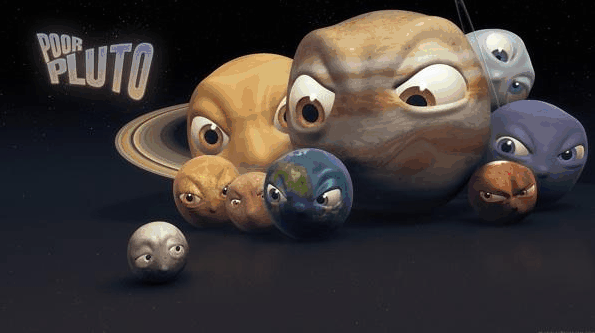
Also there’s this little illustration, which I love ever so much because Uranus is on his side:
ALSO, Apollo 13 has to have one of the best soundtracks ever.
Okay, that’s all. Slow day.
TWSB: Yay, Jupiter’s going to be able to hold its pants up again!
(Obligatory belt joke taken care of)
This photo shows a picture of Jupiter’s SEB (Southern Equatorial Belt) returning after its disappearance was noticed last May. This picture and others capture plumes of energy breaking through the cloud tops.
So pretty soon, say scientists, Jupiter will return to looking like we’re used to seeing it.
Haha, I know this This Week’s Science Blog is short, but I’ve been wondering when the band would return since I became aware of it being gone.
Today’s song: Nocturne by Nomo
Waiter! There’s some Plato in my Play-Dough!
The size of us here on earth in relation to the size of the overall universe: this kind of stuff boggles the mind. I love trying to comprehend it. I’ve searched around in various places to try to find stuff that would create a more comprehensive visual demonstration of size and perspective. So here come the YouTube videos.
First this: powers of ten, zooming from wide perspective to narrow perspective.
Then this little factoid, which I’ve mentioned on here before but I think it’s very relevant to get a good idea of the sheer size of the sun: The sun loses 7 million tons of material every second, but all the material lost so far amounts to less than 0.01% of its total mass since it started shining.
Here is a model of just the solar system to scale. Now look at the sun, how big it is.
Now this: another video I’ve linked to on here before (and on Facebook) but only because it’s ridiculous to think about things that size.
With this one you can compare them all more side by side.
Finally this one. It helps with the distance and the freaking huge expanse of the universe. Despite the implication near the end that a supreme being was responsible for all this, I think it’s a good demonstration. Keep in mind, this is traveling at the speed of light, taking us to the edge of the universe and then back in for perspective.
I love this stuff. Hope it was informative to you all.
Betelgeuse: making Uranus look small since 9,283,759,283,592 B.C.
Note: that is a random number in the title.
Puttin’ things in perspective for ya.
Just thought it was interesting.

 Eigenblogger