OH GOD A TEST
It’s a trap!

Take Free Advanced Global Personality Test
DNA
I could have sworn I’ve done this before, but I couldn’t find it anywhere. So here it is!
Generous Dreamer
You are a Dreamer
Your combination of abstract thinking, appreciation of beauty, and cautiousness makes you a DREAMER.
You often imagine how things could be better, and you have very specific visions of this different future.
Beauty and style are important to you, and you have a discerning eye when it comes to how things look.
Although you often think more broadly, you prefer comfort to adventure, choosing to stay within the boundaries of your current situation.
Your preferences for artistic works are very refined, although you vastly prefer some types and styles to others.
Though your dreams are quite vivid, you are cautious in following up on them.
You are aware of both your positive and negative qualities, so that your ego doesn’t get in your way.
A sense of vulnerability sometimes holds you back, stifling your creative tendencies.
Your independent streak allows you to make decisions efficiently and to trust your instincts
You are balanced in your approach to problem-solving, not letting your emotions hold you up.
You much prefer to have time to plan for things, feeling better with a schedule than with keeping plans up in the air until the last minute. Your decisions are well thought out, and you’re not the least bit impulsive.
You do your own thing when it comes to clothing, guided more by practical concerns than by other people’s notions of style.
You are Generous
Your awareness of those around you, along with your nuanced perceptions of the world at large, makes you the GENEROUS person that you are.
You value time to yourself and understand how rich your private world can be—you know that you don’t have to go wild to have a good time.
You are excited and energized by ideas and often enjoy things more through observation than through experience.
This tendency gives you an appreciation for different perspectives and opinions about the world.
Being as aware of others as you are doesn’t mean you find it easy to trust them immediately—this is something that happens more slowly for you.
Despite this, you are aware of the complexities of many situations and are reluctant to pass judgments on others.
Although you have fewer friendships than some people, those that you have are meaningful and are important to you.
You value spending time alone—it is while reflecting on the world around you that you often learn something new about yourself or begin to understand something that’s been bothering you.
I call your number but I can’t get through…
It’s that time of the year again! Hooray for retaking personality tests.

Take Free Advanced Global Personality Test
personality test by similarminds.com
There’s also my trait snapshot: neat freak, organized, worrying, phobic, fears the unknown, irritable, pessimistic, emotionally sensitive, fears chaos, risk averse, fragile, unadventurous, depressed, frequently second guesses self, perfectionist, hard working, practical, ordinary, cautious, takes precautions, good at saving money, suspicious, mind over heart, busy, altruistic.
The things we do when we’re given messenger and free time…
Hooray!
So Sean gave me two projective personality tests tonight. One I’d taken long ago (so I question my answers a bit because I had the old template still in my head), but the other was new. I’ll just give you my results, just in case you ever take the tests, ‘cause I don’t want to skew yours.
Onward (these are in Sean’s words, by the way):
~I don’t see a lot of value in the status quo
~Anything noteworthy must be done, not discovered
~I have an artistic, visionary personality; I feel unique but a little disjointed from my surroundings
~I have a fairly broad group of friends; my friends are there, but not “inside” my circle
~my idea of what I want in a romantic partner is un-developed. Right now I don’t have a template, so at the moment “lover” is just a special case of “friend”
~I don’t see difficulties as being added factors, just the normal surroundings “flaring up.” I feel like I can weather the difficulty
~My material possessions are decorative and aesthetic, and they’re important to me
~Knowledge is important to me (but it doesn’t open anything…long story)
~I feel like things will block my path that I have no way of defeating, but they can be circumnavigated
~My love life is “big and scary.” I go in prepared and try to keep myself as safe as possible from getting pulled under
~I hide from danger until it goes away, but I try to approach with a solution as custom-tailored as possible
Hooray for early morning conversations!
This site…
I am bored. Blogs will improve at some point. It’s hit or miss right now, I’m pretty busy.
Turn on the TV and turn to channel 2. The first five words you hear shall be this blog’s title
Boredom!
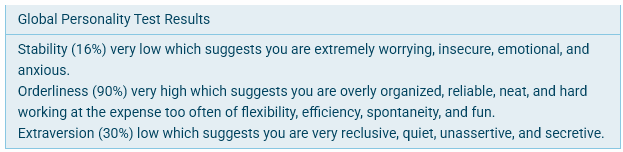
Take Free Global Personality Test
personality tests by similarminds.com

Take Free Big Five Personality Test
personality tests by similarminds.com

Take Free Enneagram Personality Test
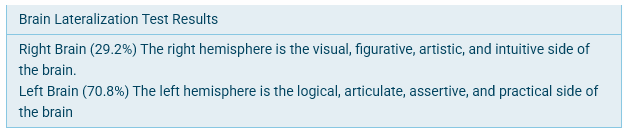
Are You Right or Left Brained?(word pair test)
personality tests by similarminds.com

Free Jung Personality Test (similar to Myers-Briggs/MBTI)

Take Free Freudian Inventory Test
personality tests by similarminds.com
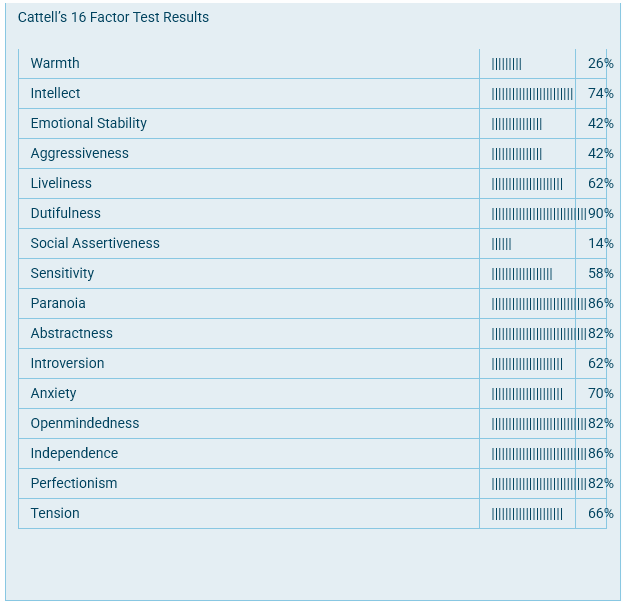
Take Cattell 16 Factor Test (similar to 16pf)
personality tests by similarminds.com
Progress? Regression? YOU BE THE JUDGE TODAY FOR THE LOW LOW PRICE OF $99.99!
Well, it’s that time of the year again. Anything more than twice a year is excessive. I’d do this tomorrow but I don’t want to blog about today.
September 27, 2006
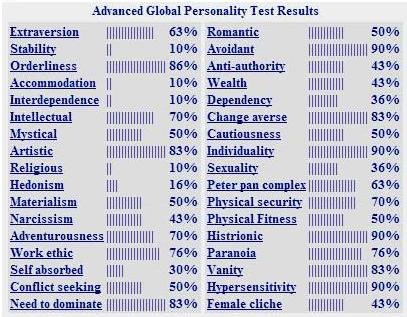
And now, September 26, 2007

Take Free Advanced Global Personality Test
personality tests by similarminds.com
Waiter! There’s an abominable snowman in my snow cone!
You know what I need? A new self-summery for this here MySpace. The problem is, I’m not quite sure how to go about it this time. My first one was really lame. The one I have now is pretty lame, too.
I know who I am. I know my little quirks, and I know how I see myself.
The question of the day is, how do others see me?
First hints: the ol’ Nohari and Johari windows I linked you all to months ago.
Top Johari: Intelligent, witty, and complex
Top Nohari: Vulgar (100%, baby!), chaotic, and overdramatic
Me? Overdramatic? NEVER! *faints for dramatic effect*
Okay, now that that’s done…I have a favor for my readers. Please tell me how you see me. What were your first impressions? What do I strike you as (both good and bad, please)? I know I’ll get at most, like, two replies for this, but hey, it’s worth a shot.
Enlighten me on myself.
The Outfielder in the Pumpernickel
I got home relatively early tonight (“relatively early” meaning 11:45) so I was bored. I was digging through all my old crap from school and found my book from Psychology of Personality. This got me thinking, so I kind of wrote my own primitive little model of what I think personality essentially is.
Please note: I do not expect any of you to read this, so if you want to, do so at your own risk! I wrote it at about 2 in the morning; therefore, it may not be very good. And the whole five continua idea is not mine; it was the way the book was laid out. And here we go! Oh, and if it reads kind of like a research paper—then yeah. That’s how I write.
The first and primary force of the personality is the pre-formed part of the self, or the primal force. The primal force is similar to Freud’s concept of the id—it deals with the necessities of life and essentially acts as a survival force. Without it, needs such as the need to eat or the need to sleep would be ignored. Even the need of familial love comes from the primal force. We need this love factor starting at an early age in order to trust our mothers enough to allow them to fulfill needs that we as young beings cannot fulfill on our own. All of us essentially have the same primal force.
Along with the fulfillment of these “primal” needs (food, water, shelter, reproduction, etc.), the primal force, when left on its own, is responsible for the ignoring of others’ wishes (as well as exploiting and harming others) in order to get its own wishes and needs fulfilled as soon as possible. However, if one takes a closer look at this force, they can see that it is not functioning on an irrational level. In fact, quite the opposite is occurring. It is very rational for the primal force to be driven to ensure the survival of a person, especially when others are in danger of consuming needed resources. The irrationality only becomes an issue when we introduce the second force in the personality: the socio-adaptive force.
The socio-adaptive force comes into play the minute the person is introduced to a form of social interaction outside the family. Called “socio” because it is formed entirely from a societal basis and “adaptive” because it adapts a person’s existing personality to fit the needs and wants of a society, the socio-adaptive force is similar to both Freud’s ego and super ego. It essentially “regulates” and covers up the impulses and drives of the primal force. While the primal force is never entirely covered up, the socio-adaptive force allows the primal force to function in a socially acceptable way. It suppresses its urges while shaping the personality, causing it to conform to the society the person enters. The socio-adaptive force varies, sometimes greatly, from person to person and even more so from society to society.
The primal force is almost genetic; it resides in the part of the brain responsible for carrying out the signals that drive us to fulfill our basic needs. The socio-adaptive force is entirely environmentally based; it would not come into existence without social relationships and a social influence outside the family unit.
Both forces have some conscious form. We are aware of, for instance, such drives as hunger and thirst, and it is the primal force responsible for our wanting and seeking out the fulfillment of these needs. We are aware of wanting friendship and relationships, and it is the socio-adaptive force that is responsible for this conformity. Both forces also, though, have an unconscious form. Often we are unaware exactly why we feel the need to have companionship or have the more hidden feelings of putting ourselves first. We are also mostly unaware why we conform to social norms such as wearing clothing or allowing ourselves to share. On an unconscious level, our primal force urges us to have relationships in order to mate and carry on the species while still putting ourselves first so we can survive, and our socio-adaptive force pushes us to suppress these wishes and to conform to our society in order to fit in and blend with others.
The dichotomy in the personality—this split between our primal needs and their fulfillment versus our societal conforming and need to blend and work well with others—sets the stage for the discussion of the five separate continua of basic human nature and where on each continuum my theory lies. These continua help to further explain how my theory explains personality.
<–x——————————->
Free will Determinism
The first continuum involves free will versus determinism. Free will can be defined as the ability or discretion to choose while remaining unconstrained by circumstances or things such as fate. Determinism can be defined as the idea that all choices have causes, and that all choices are not choices at all but the consequences of prior situations or experiences (such as destiny or preset laws or rules).
In a way, one could say that we are determined to have free will—we must, no matter what, make a choice. In no way are we ever truly bound into one option. In a sense, we argue for our free will by knowing that we are determined to have it. The importance, though, lies in whether or not these choices are predetermined—whether or not they are decided for us by some external influence. I do not believe this is so and because of this it can be said that my personality theory lays almost entirely on the free will side of the continuum.
It can be argued that my theory advocates a more deterministic view of human nature simply because it states that we are shaped entirely by our socio-adaptive force—society’s influence—acting on our primal force, or our most basic instinctual drive to fulfill our needs. However, nowhere does my theory state that we are not able to overcome society’s influences and be able to decide on our own how we take into account what we are exposed to. We have the ability to choose how we take what we experience and form whatever we want from it.
<——————————-x–>
Nature Nurture
The essential position on the next continuum, the nature versus nurture continuum, lies again in the idea of the primal and socio-adaptive forces. A strong position on the nature side of the continuum would argue that personality is shaped entirely by genetic factors—the way we think, feel, and act is entirely determined by our DNA. A strong proponent on the far nurture side of the continuum would argue the opposite—that we are entirely shaped by our environmental and social influences and that genetics plays no part in anything. My personality theory lies far over on the nurture side.
Without the socio-adaptive force—without the influence of society and other people on our personalities—we would all be reduced to consisting of only our primal force. That would lead us, basically, to be self-centered, greedy, needs-fulfilling beings that would have no regard for those around us. Without the nurturing factor—the environment and society—we would be left only with the nature factor—the “genetic” primal force, and with only this force functioning we would act in a completely different way than we do with the socio-adaptive force in place.
Humans are first formed by nature. Without any societal influences, we remain personality-wise with the simple primal force shaping how we think and act. But because the vast majority of us live in societies in groupings of other people, we can almost set aside the nature aspect of human personality and focus more on the nurture side, which allows for a much broader and a much more diverse array of personalities to develop.
<———-x———————–>
Past experiences Present experiences
Social experiences are important throughout the lifespan of the individual in order for the socio-adaptive force to continuously adapt to the social norms of the time. However, one cannot have these present experiences without taking into account the experiences of their past, and when we are young and have yet to have the experience of many social interactions we are much more impacted by our experiences than we would be at an older age. This is why my theory leans further toward the past experiences side of the next continuum (the argument that past experiences affect a person’s current thoughts, behaviors, and feelings) than the present experiences side (which argues that past experiences are not as important as present experiences in shaping a person’s reactions).
The primal force is not affected by past or present experiences; rather, it is the socio-adaptive force that is affected and in turn changes how the primal force is expressed in the personality. When we are young, we are flooded with new social experiences and our socio-adaptive force grows and changes the personality (which had previously consisted of simply the primal force) rapidly. As we begin to grow older, these social experiences lose their novelty and, though the socio-adaptive force is still shaped and changed by them, it still retains the main structure that had been developed in childhood and early adolescence, up to approximately age fifteen, after the major event of puberty has occurred.
Present experiences must not be ignored; they help us remain consistently adapted to our social settings and environment and allow for continuous small adjustments to the personality. However, past experiences should not be overlooked as the initial forces that set the stage for the shaping of our socio-adaptive forces. An example of this phenomenon could be found in how a person adapts to their social standing later in life. If this person was exposed as a child to a socially difficult or traumatic experience, they would most likely attribute their social standing to a different reason than if they had had socially easy experiences as a child.
The adult personality, specifically the adult socio-adaptive force, is shaped and formed into its general form in the first fifteen or so years of life. While it is able to change and help us conform to the changing social atmosphere we experience throughout our lives, its basis—the way we interpret our environment—remains approximately the same.
<———x————————>
Uniqueness Universality
In regards to the uniqueness (how individually different people are from one another) and universality (how we all share similar universal traits) continuum, my personality theory leans slightly to the uniqueness side. This again relates back to the primal and socio-adaptive forces and their individual relative uniqueness or universality.
We are all initially shaped by our primal forces, and this force is essentially of the same proportions and influence in every person. The differences in personality arise almost entirely from the influences of the socio-adaptive force, which is responsible not only for how much (or how little) of the primal force is allowed to be expressed in the outward personality but also for taking into account one’s entire social and environmental experience and shaping how one will react to and perform in it.
Basically, the primal force gives us the universal part of our personality—we all have a similar primal force. However, the socio-adaptive force, which takes into account both the concealing of the primal force and also the interpretation of social acts and behaviors, is unique in all of us. No two of us are able to perceive the same situation the same way due to all of our individual social training and experience. Also, no two of us have the same “coverage” of the primal force by the socio-adaptive force. Thus, uniqueness arises.
<——x—————————>
Equilibrium Growth
In order to delve into the continuum of equilibrium versus growth, we must first define what we mean by both, seeing as how both have rather broad definitions. For the purposes of my personality theory and in order to find a reasonable position on the continuum, the concept of “equilibrium” should be defined not as a state of rest but as a state of balance. The concept of “growth” therefore should imply not balance but a process of developing and a quest for an ultimate goal. In my personality theory, it is not the goal of either the primal force or the socio-adaptive force to develop and to reach an ultimate goal; rather, both strive to maintain equilibrium, or a balance. My theory lies closer to the equilibrium side of the continuum.
The primal force does not aim for a constant fulfilling of needs but instead strives for the elimination of the need to fill them. In other words, once the needs are filled, the primal force does not continue to press us to keep providing for those needs. It waits until the needs are no longer met to continue to assert its influence. It strives for balance, not for growth.
The same idea applies to the socio-adaptive force. It is not possible for it to strive for a complete and total conforming with the social environment due to the fact that the social environment is constantly changing. Instead, it strives for a continual equilibrium, or balance with the social situation. There is no ultimate goal to reach because the goal is continuously changing. Therefore, a social equilibrium or balance is much more reasonable to attain.
Something must be done about these damned hypnotists!
http://www.9types.com/newtest/homepage.actual.html
I’m a five. I kept the ones on here that sounded most like me.
How to Get Along with Me
Speak in a straightforward and brief manner.
I need time alone to process my feelings and thoughts.
Remember that If I seem aloof, distant, or arrogant, it may be that I am feeling uncomfortable.
What I Like About Being a Five
Standing back and viewing life objectively
Coming to a thorough understanding; perceiving causes and effects
My sense of integrity: doing what I think is right and not being influenced by social pressure
Not being caught up in material possessions and status
What’s Hard About Being a Five
Being slow to put my knowledge and insights out in the world
Feeling bad when I act defensive or like a know-it-all
Being pressured to be with people when I don’t want to be
Watching others with better social skills, but less intelligence or technical skill, do better professionally
Fives as Children Often
Spend a lot of time alone reading, making collections, and so on
Have a few special friends rather than many
Are very bright and curious and do well in school
Have independent minds and often question their parents and teachers
Watch events from a detached point of view, gathering information
Are sensitive; avoid interpersonal conflict
Fun with Fonts II
Haha, hello again! Since I got to campus early (like at 9:30) this morning, I was bored out of my MIND. So I went to the computer lab and came up with a few more font reviews. Then, when I came home, I realized that I had none of these fonts on my own computer; thus none of them showed up. So to keep things simple, these will all be in Times New Roman standard format. If you’re really that desperate to see what they look like, I suggest going to the Ag Sci computer lab, because it was on those computers that these were found. Annnnnnnnd, go!
DotumChe
This amuses me just because of the name: DotumChe. It sounds like the sound you make after a joke, you know? “Two tom-toms and a cymbal fell off a cliff. DotumChe!” Also, when you try to spell-check it, the first suggestion that comes up is “douche.”
Font
Ah, the font perfect for people who name their dog “Dog” and their cat “Cat” and their kid “Kid” and read “Magazine” and “Newspaper” daily. This is like the American dream of fonts, only it’s not called that. It’s called “Font.”
This font sponsored by “Sponsor.”
Informal Roman
Unfortunately for all of us, there is no archeological evidence supporting the Romans’ use of computers (let alone fonts), but several stubborn “historians” have continually voiced the idea and have constructed what they dub Informal Roman, a font similar to what had existed in Rome before the Romans began putting their computers next to their particle accelerators and having their hard drives erased by the powerful electromagnets (and thus abandoning the idea of computers all together). According to these historians, this font was of particular use in the typing of plans for arches and aqueducts in Microsoft Verbum documents. When creating final formal reports, Romans used Formal Roman, the equivalent of today’s Wingdings.
SuperFrench (yes, there’s a font called “SuperFrench”)
You have the right to become a SuperFrench. Anytime you choose to become a SuperFrench can and will be a time when you are allowed to utter the phrases “oui oui!” and “sacre bleu!” and “le croissant is too hard for my delicate teeth, you infernal pastry monkey!” both inside and outside French boarders. You have the right to speak French and to have a French person present during any SuperFrench adventures in any cafés you come across. If you cannot afford a French costume, cheese will be provided for you.
Blackladder ITC
This is the type of font used back in Elizabethan times by those jokesters that went around pasting “kick thee” signs on their friends’ backs and by tattoo artists who complied with the requests of drunken frat boys who wanted “I say, I do believe that Elizabeth I is quite a looker, pipeth-pipeth!” tattooed on their chests.
Niagra Solid
Because we need more fonts that rhyme with “Viagra.”
The masses never triumph! It is all an illusion, like those stupid “magic eye” things!
Life’s a funny thing, isn’t it? One day things are hell, the next everything seems to fall nicely into place. It’s frustrating, yet utterly delightful and intriguing.
Well anyway…
I decided today to take this one little personality test that I’d taken waaay back on September 27th of last year. I wanted to see how things have changed. What do you think?
Hmm…I’m more self-absorbed now, though I’m not really sure how that happened…if anything, I’d say the opposite occurred.
Sexuality and Peter Pan complex bit the dust…physical security is up, but I don’t know why…
Interesting. Overall, it’s proof that I don’t change much. If I would have done this back in second grade, I bet the similarity would still be there.
Looking for the best font for you? I got the answer right here for the low low price of $19.99!
Due to several (two) conversations with several (two) people, I have decided to take several (twelve) fonts and analyze the personalities of the people who might use them!
Be aware: some of the fonts are a little hard to read. If you can’t read them, I would advise you to copy and paste them into Word and transform them into a font you can more easily read.
Also be aware: I am a dork.
Here we go!
Bauhaus 93
After much deliberation, Maggie and I decided that this was the font of Millard Fillmore (but only if it were colored fuchsia). Why?
Because it reminded us of sex. The only problem with this font is the ‘s’, but that will not be a problem unless “Millard Fillmore had promiscuous sex in Mississippi (and now has syphilis).”
No one can use this except Millard Fillmore (and his spawn).
Chiller
Ah, the good o’l serial killer font. If you use this you may very well feel the need to dress up as a clown and kill people in their bathtubs.
Curlz MT
Like, OMG! This totally reminds me of, like, those girls who are always like talking and stuff? And, you know, they like aren’t very smart? And they’re like everywhere? I totally think they’d, like, use this font!!!!!!11
Eras Light ITC
Ah, the font God uses. So perfect in its lettering and so heavenly, no mortal can use it.
Possible side-effects of this font include incredible healing powers, the ability to walk on water, the ability to rise from the dead after a short period of time, and a strong affiliation with one’s Father.
And God said, “Let there be Eras Light!”
Juice ITC
This font is probably the most inappropriately named font there is. I would never call this font “Juice,” and I’m sure that any other non-blind person would have to agree. It’s more “Stick Up My Ass ITC” than anything.
This person will appear to be a fun-loving individual, but the moment something goes wrong or a task to be completed is assigned, he’ll crush you beneath his foot and never crack a smile again. The best example of personality change in this person would be if Bill Cosby suddenly, in a nanosecond, became Hitler.
“Juice.”
Please.
OCR A Extended
Gay marriage is wrong. Abortion is wrong. George W. Bush is a great president.
Sorry…
Republican font.
Avoid at all costs.
Perpetua Tilting MT Bold
This font compels one to use black and to speak in complete sentences. One feels they must use correct capitalization, though It does not matter when typing in this font. They may feel the urge to go to Wall Street.
Playbill
This person will enjoy calling you “pardner” even if you’re their mortal enemy. They are most likely very bow-legged and are a bit too close to their horse. They will see something—–say, a pie–—and claim it is not big enough for the both of you.
On the bright side, they are very good with ropes.
Rockwell Extra Bold
Hell yeah! This guy’s a man! He eats steak! He doesn’t wear a shirt! He likes to crush cans against his forehead! He likes using the phrases “dude!” and “touchdown!” and “get me a beer, woman!”. This guy has way too much testosterone for his own good. He enjoys nachos, barbeques, and barbequed nachos.
Oh, and sex.
Showcard Gothic
This is the type of person who is on the edge of using the “chiller” font. They probably press so hard when writing that they make impressions in the table/desk/steel plate beneath the paper. They’re the 34-year-olds who have worked at burger king their entire lives and are damn bitter about it.
When you are around this person, try not to use any phrase with the word “Whopper” in it.
Viner Hand ITC
This font shows the progress of the serial killer after they’ve been in prison for several decades and have been released back into society. Note the subtle hits of “Chiller” still breaking through the “nicer” lettering.
Watch the hell out for the person who uses this font.
Wide Latin
Does this font make my words look fat?
Only people who weigh upwards of 300 pounds should use this, unless one wants to convey a physical appearance of inescapable fat rolls. I honestly can’t see this font leading to a positive result on a dating site:
Sexybabe69: Hay there sexi ;) !!!
Joe100: Hello
Joe100: hold on]
Joe100: font chnge
Sexybabe69: hurry back k
Joe100: alright im back
Joe100: sexybabe
[sexybabe69 logged off]
Joe100: ello
Joe100: dam
See what I mean? Fonts can mess with people. I urge you to take this list to heart, no matter how crappily thrown together it is.
Special thanks to: Aneel (Thursday’s victim) and Maggie (Friday’s victim).
There are only ten people in this room: you, me, and my butt
Remember those tests that I took yesterday? Here are some (funny and accurate) jokes about my types:
A FIVE’s answer to the “is the glass half-empty or half-full?” question: “Well, after measuring it precisely with my Fleuromaton instrument, I have concluded that the volume of dihydrogen oxide in this silicon-based vessel is 50.8%, thus qualifying it as roughly Half-Full.
An INTJ’s answer to the “is the glass half-empty or half full?” question: “How can you say it’s half-full? It’s half-empty! I refuse to listen to your reasoning!”
An INTJ’s dark side: All facts which don’t fit their theories are just wrong. The more all-encompassing and less applicable to reality the theories, the better.
The INTJ acronym: It’s Not Thoroughly Justified!
And finally, the top 10 signs you’re a FIVE (#1 is freakishly accurate for me):
10. You call your plants by their Latin names.
9. The more excited people around you get, the more drained you feel.
8. You spend your time at a party reading the books in the host’s library.
7. You communicate almost exclusively by e-mail.
6. Most of your friends are on e-mail, and you haven’t met any of them face to face.
5. You consider it a good vacation if you can stay at home with your computer, books, videos, and garden for a week.
4. You would like to do #5 for a living.
3. You’ve actually read Darwin’s “Origin of the Species” and think it would make an interesting movie.
2. Someone asks you how you feel about someone or something, and you tell them you’ll get back to them next week after you’ve had time to think about it.
1. You bite into a Snickers bar, and you immediately see the correlation between the dissolving chocolate/peanut mixture with quantum electrodynamics and the potential existance of dark matter in the universe, the association of Mozart’s unfinished symphony and the cryptographic origins of ancient Sumerian linguistics, and how the right handed Cartesian orthoganal system of coordinates aligns with Mitochondrial cellular respiration, giving you a new understanding of the role of derivatives in modern financial portfolio analysis, and the enneagrammatic functions inherent in Microsoft’s Windows 98. AND when you try to explain this simple relationship, people have no clue what the HELL you’re talking about.
Huttah!
So today I took a couple online temperament/personality type test thingies. The first one I took was an online version of the Keirsey Temperament Sorter, which is a test I’ve already taken (and was classified as an INTJ). According to the online test, I am still an INTJ (introverted, intuitive, thinker, judger), or a Mastermind. I seem to very much match the description:
“They are rather rare, comprising no more than, say, one percent of the population. Being very judicious, decisions come naturally to them; indeed, they can hardly rest until they have things settled, decided, and set. They are the people who are able to formulate coherent and comprehensive contingency plans, hence contingency organizers or “entailers.” Masterminds will adopt ideas only if they are useful, which is to say if they work efficiently toward accomplishing the Mastermind’s well-defined goals. Natural leaders, Masterminds are not at all eager to take command of projects or groups, preferring to stay in the background until others demonstrate their inability to lead. Once in charge, however, Masterminds are the supreme pragmatists, seeing reality as a crucible for refining their strategies for goal-directed action. In a sense, Masterminds approach reality as they would a giant chess board, always seeking strategies that have a high payoff, and always devising contingency plans in case of error or adversity. To the Mastermind, organizational structure and operational procedures are never arbitrary, never set in concrete, but are quite malleable and can be changed, improved, streamlined. In their drive for efficient action, Masterminds are the most open-minded of all the types. No idea is too far-fetched to be entertained-if it is useful. Masterminds are natural brainstormers, always open to new concepts and, in fact, aggressively seeking them. They are also alert to the consequences of applying new ideas or positions. Theories which cannot be made to work are quickly discarded by the Masterminds. On the other hand, Masterminds can be quite ruthless in implementing effective ideas, seldom counting personal cost in terms of time and energy.”
Several Masterminds include Isaac Newton, Stephen Hawking, President Ulysses S. Grant, Friedrich Nietzsche, Thomas Jefferson, Augustus Caesar, and Ayn Rand.
Then I took another couple of tests to find out my Enneagram type. I’m a FIVE (the thinker/investigator):
“People of this personality type essentially fear that they don’t have enough inner strength to face life, so they tend to withdraw, to retreat into the safety and security of the mind where they can mentally prepare for their emergence into the world. Fives feel comfortable and at home in the realm of thought. They are generally intelligent, well read and thoughtful and they frequently become experts in the areas that capture their interest. While they are sometimes scientifically oriented, especially with the Six wing, just as many Fives are drawn to the humanities and it is not at all uncommon for Fives to have artistic inclinations. Fives are often a bit eccentric; they feel little need to alter their beliefs to accommodate majority opinion, and they refuse to compromise their freedom to think just as they please. The problem for Fives is that while they are comfortable in the realm of thought, they are frequently a good deal less comfortable when it comes to dealing with their emotions, the demands of a relationship, or the need to find a place for themselves in the world. Fives tend to be shy, nonintrusive, independent and reluctant to ask for the help that others might well be happy to extend to them.”
Several Fives include Albert Einstein, Stephen Hawking (again), Stanley Kubrick, Friedrich Nietzsche (again), and Vincent Van Gogh.
So yeah. I’m pretty much these.
Don’t mess with the MASTERMIND FIVE!!

 Eigenblogger