TWSB: Math: Ur Doin It Wrong
So today’s topic immediately brought to mind this little joke, which I’m sure you’ve all seen if you’ve traversed the Tubes for more than ten minutes:
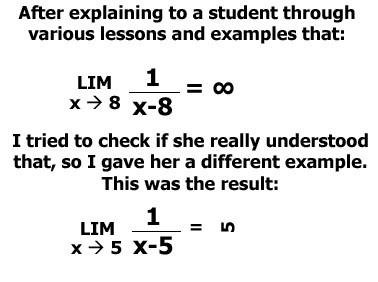
I know it’s not the same thing, but that’s what it reminded me of.
Anyway.
Today’s science blog has to do with the phenomenon called anomalous cancellation. Anomalous cancellations are arithmetic procedural errors with fractions that, despite being errors, will still result in a correct answer.
Examples from Wiki:
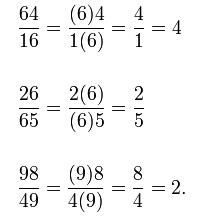
So it’s basically like looking at a problem and, as if you don’t know how to correctly solve it, trying to solve it intuitively based on the features of the numbers in the problem.
I might just be imagining it (because I’m me and I’m a spaz), but I feel like I come across this type of thing a lot. That is, I feel like I come across many situations in all my stats stuff where the correct answer can be achieved by seemingly “simple” methods that, in actuality, are incorrect method-wise but still lead to correct answers.
But again, I might be imagining it.
Anyway, I felt this an adequate topic for today’s blog, as I’m sure we’ve all come across problems like this but were not (at least, I was not) aware that such things had an actual name.
Numbers are crazy buggers, aren’t they?
Edit: Get your butts over to YouTube and listen to this awesome discussion of Leibniz’ Monadology. This pretty much made my week.
Edit 2: I don’t know why I didn’t just embed the freaking video in the first place. Claudia dumb!
Top 10 influential books
Hello ladies and gentlemen. There’s this note that’s been going around on Facebook where people list the top 10 books that have influenced them the most, or will stay with them the most. I decided that instead of posting this on Facebook (which I’m beginning to hate more and more), I’m putting it here.
The books I chose I chose because of their impact on me—be that from their emotional impact, their intellectual impact, the story itself, or the style of the writing. I explain in each case. It was hard to choose books that influenced me rather than choosing my favorite books, but I think I did this as unbiased as possible. Plus, the two overlap quite a bit.
Ranked from most influential to…well, 10th most influential, I guess. Haha.
1. Watchmen – Alan Moore and Dave Gibbons
This might be first because it’s the one I’ve read most recently, but it’s also first because it’s freaking awesome. The story’s intense, it’s very intellectual, and the art is superb. Read it!
2. The Monadology – Gottfried Leibniz
No, I’m not just putting this on here because Leibniz is a smoldering sex pot. Despite the “out-there” factor that is so high with the Monadology, the general idea of determinism that he expresses throughout it (and a lot of his other stuff) actually kind of lines up with how I see things.
3. Candide – Voltaire
I FREAKING ADORE Voltaire. This book is very funny if you know what it’s making fun of (hint: pretty much everything). And even though Voltaire makes fun of Leibniz, I still love this book.
4. The Caine Mutiny – Herman Wouk
YAY! This is my favorite book of all time, but it’s also on here because the story is AMAZING. Wouk is very good at building tension (just wait until you get to the actual mutiny; good luck putting the book down). It’s also freaking hilarious in parts.
5. The Chosen – Chaim Potok
I can’t remember when it was I read this, actually—I only remember the plot and the characters that have stuck with me since. This was one of two books that left me crying at the end. Very emotionally impactful. It’s about two Jewish boys, one of which does not want to follow in his father’s footsteps, if you want to know the very summarized plot.
6. The Great Gatsby – F. Scott Fitzgerald
Beautiful, beautiful writing style. I love Fitzgerald’s way of creating a story, and I love Gatsby.
7. On the Beach – Nevil Shute
The premise of this book is very intriguing: it examines a post nuclear war world from Australia’s point of view as the country sits and waits for all of the fallout from the northern hemisphere to drift through the atmosphere down to them. That’s really all you need to know.
8. Crime and Punishment – Feodor Dostoyevsky
Hooray for deeply psychological books!
9. An American Tragedy – Theodore Dreiser
This is a long book and seems kind of boring at the beginning, but once the “tragedy” happens, it really picks up. You get into Clyde’s head and feel his desperation.
10. Age of Reason – Jean Paul Sartre
I read this awhile ago and for some reason I still really like it. Probably because it’s existential.

 Eigenblogger