This Week’s Science Blog: Does It Smell Dark in Here?
So apparently neurobiologists have genetically altered mice to smell light (MICE CAN SMELL PHOTONS NOW BUT I’M STILL STUCK WITH NOTHING, WTF?) with the goal to better understand how olfaction really works.
The reasoning behind this is that, while odors are obviously the best means by which to study olfaction, the odors themselves are so complex that we’re usually left with more problems than answers. Light, on the other hand, makes things easier.
So these scientists “made the nose act as a retina” in order to better characterize the patterns of activation within the brains of the rodents.
What did they find out?
First off, they found out that the structural patterns of olfactory activation in the brain does not on its own describe exactly how olfaction works.
Second, apparently the timing of the “sniff” plays an important role in how odors are perceived. Weird.
Anyway. Because I’m biased I do a disproportionate number of TWSBs on smell. And solar flares.
Today’s song: Circus by Britney Spears
Oh my.

We are so fucked.
Today’s song: Enjoy the Ride (feat. Judy Tzuke) by Morcheeba
This Week’s Science Blog: Yo Dawg, I Herd U Like Dimensions
So we put dimensions on top of your dimensions so you could extrapolate about higher dimensions while in your dimension.
(Sorry.)
Not hard science so much as math, but what’s better than math*?
Sorry, these would be longer but I’m busy.
Today’s song: Blue Suede Shoes (Viva Elvis) originally by Elvis Presley
*Leibniz is, but he also invented calculus, so I guess my argument is null.
TWSB: My sunshakes bring all the spheres to the loop, and damn right, it’s hotter than yours
I apologize profusely for the title.
“Helioseismology is the study of the interior of the Sun from observations of the vibrations of its surface.”
DUDE.
Acoustic energy is used to “see into” the sun in a way similar to using ultrasound to see into the human body. The sun’s oscillations, first captured in the 1960s, have been used to try and understand the composition and dynamics of our star. According to here (which is an excellent cite full of info regarding this), “helioseismology is rather like trying to understand how a piano is built from the sounds that it makes when you drop it down a flight of stairs.”
Gotta love science.
And Berkeley’s Statistics program.
Today’s song: Prisencolinensinainciusol by Adriano Celentano
This Week’s Science Blog: The Robots are Getting Creepier
Oh my freaking god, nightmares.
This one’s pretty hilarious, though:
The fact that these things are made out of something called “septom” makes it even creepier, I think.
Today’s song: U + Me = by Dan Black
This Week’s Science Blog: Lost In Space…Sort Of
First off, that picture’s badass.
Second, this is proof that we’re all going to be massively screwed in the coming year or so.
Apparently the sun gave off a massive fart (read: solar storm) and blasted the Galaxy 15 satellite out of radio operation. It’s still working, but is now drifting in one of two “gravity wells” that house a lot of our space debris.
Those in charge of monitoring such things as the crap we dump into the vacuum that surrounds us say that it’s not likely the Galaxy 15 will collide with other active satellites, but there is concern over the fact that its still-working communications package might interfere with nearby orbiters.
The plan? Either shoot it with lasers (ooh, big surprise there) or just wait until its orbit decays and it hurtles through the earth’s atmosphere to rejoin us. Here’s my question: are they certain Galaxy 15 went offline due to the solar storm, or was that just a coincidental incident? If it wasn’t, then we’d better get the gravity wells ready for a whole bunch of incoming defunct debris, as these solar flares supposedly aren’t going to be backing off any time soon.
And yes, I checked—apparently “zombiesat” is an actual technical term. Snazzy.
Today’s song: Consequence by The Notwist
This Week’s Science Blog: And God Liked It, So He Put a Ring on It
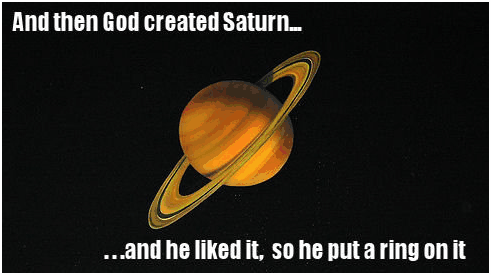
I’ve been waiting for an opportunity to post this picture with some related content for quite some time.
Anyway. Apparently there are tsunamis in Saturn’s rings.
Thirty years ago, NASA’s Voyager 1 probe detected rippling within a portion of the rings, as well as a gap that seemed to be a little larger than 9 miles wide. Today, observations taken from different angles show the gap to be much narrower than this, but have also revealed periods of “peaking,” as if there were obstructions in the gap.
Astronomer Phil Nicholson ascertains that these peaks are most likely slow moving giant ass tsunamis* rippling through the rings, reaching heights of nearly a mile. It turns out that the tsunami action matches the orbital rate of Titan (which circles Saturn once every 16 days), and thus scientists have assumed that the peaks are the result of the ring’s gravitational relationship with Titan.
As the article states, “As Titan orbits Saturn, its gravity likely yanks the section of ring particles that are in resonance with the moon—or moving at the same speed as Titan’s gravitational field.” However, aside from adding some really cool information about the interaction between Saturn’s rings and moons, scientists don’t think that these findings will have any major implications for the studying of Saturn’s rings.
*technical term
This Week’s Science BloAAAAH GOD MY REALITY
Today we enter the world of auxetics, materials that, when stretched, expand perpendicular to the applied force.
Wait, what? This:
It sounds counterintuitive at first (at least it did for me), but this type of hexagonal material seems familiar for whatever reason. These materials have a negative Poisson’s ratio—thus their expansion when stretched. Most materials have a positive Poisson’s ratio, since they thin as they stretch. According to one article I’ve read, Poisson’s ratio is defined as minus the transverse strain divided by the axial strain in the direction of stretching force…Poisson’s ratios, denoted by a Greek nu, n, for various materials are approximately 0.5 for rubbers and for soft biological tissues, 0.45 for lead, 0.33 for aluminum, 0.27 for common steels, 0.1 to 0.4 for cellular solids such as typical polymer foams, and nearly zero for cork.” This article was written back in 1987, back before auxetic materials had been thoroughly examined. Now there are models that have just been put out to help explain the behavior of this weird stuff that occurs naturally in some rock, bone, and, apparently, paper.
More info here, here, and here. Cool, huh?
Today’s song: Mashina by NikitA
TWSB: You are my sunshine, my only sunshine…you may determine how I decay…
More news pertaining to our star for this week’s science blog: apparently scientists from Perdue and Stanford have found that the decay of radioactive isotopes fluctuates with the rotation of the sun’s core.
The fluctuations are small (and most likely won’t radically alter any anthropological findings), but they may lend a hand in predicting future solar flares as well as have an impact on medical radiation treatments. The scientists have been collecting data for nearly four years and have determined (at least in the cases of silicon-32 and chlorine-36) that decay rates follow a 33-day pattern.
So how the hell can the sun affect decay rates? The scientists believe it’s due to solar neutrinos, near weightless particles produced by nuclear reactions in the sun’s core. However, these neutrinos have never been known to actually interact with anything before, so one of the scientists summed things up in the rather humorous sentence, “So, what we’re suggesting is that something that can’t interact with anything is changing something that can’t be changed.”
Woo!
Today’s song: Robot Rock by Daft Punk
This Week’s Science Blog: Microwaves – The Answer to Everything
I knew about the microwave background “noise,” but this video describes it and the paradox very well.
I also realize that I missed last week’s science blog, so here’s a link to the Internet Encyclopedia of Science. I know it’s no substitute for one of my obnoxious science reviews, but it’s certainly a lot more useful.
I LOVE YOU ALL!
RED BULL!!
Today’s song: Touch the Sky (Original) by Iambic
This Week’s Science Blog: Oh, the Humanity! Oh Wait, That was Hydrogen.
Firstly, I had no idea that there was a U.S. National Helium Reserve (and that it was in Arizona. At least that state’s good for something). Secondly, this reserve may not be around that much longer, as we’ve been squandering helium for so long that scientists (and helium reservoir researchers, assuming such people exist) fear that we may run out soon.
Yup. Like cheap crack, helium’s been being sold for way too cheap, causing it to be wasted. Which is kind of funny, considering the primary consumption of helium comes in the form of MRI scanners, rockets, and spacecraft, things that members of the general public usually don’t try to build in their backyard (unless I’m missing something). This means that the squandering must be occurring on a much higher level of business (damn you, NASA and party clowns!).
Anyway, helium on earth is formed from the decay of terrestrial rock and as a byproduct of nuclear fusion, though the latter is in such small quantities that it’s pointless to think of it as a helium source. So unless we plan on bringing the sun over for a visit any time soon, the stockpiles of this noble gas are going to be depleted. And I guess the U.S. still has the monopoly on helium (I say “still” because the same monopoly is why the Germans used hydrogen in the Hindenburg), so we’ll probably have to say goodbye to element #2 in the near future, seeing how the U.S. usually deals with these kinds of things.
Solution: stockpile those helium tanks used to fill party balloons. Or kill clowns. Or both.
Today’s song: Disgusting by Miranda Cosgrove
This Week’s Science Blog: Extraverts are Nosy
Social science counts for these, but only sometimes.
I found this study today in which they concluded that extraverts have higher activity in their brains when smelling pleasant odors than those who do not self-report being extraverts.
Positron emission tomography (PET) was used to get images of participants’ brains (particularly the regional cerebral blood flow, or rCBF) as they were exposed to pleasant and unpleasant olfactory stimuli. Following this, participants completed the NEO Five-Factor Inventory, the results of which the researchers examined to see which participants were self-reported extraverts and which were not. The goal of the study was to see if there was an association between extraversion and rCBF, mainly because many psychologists feel that extraversion as it is currently defined is not the best way to describe exactly what it entails, as previous studies have shown that it more fundamentally represents a trait related to a bio-behavioral approach system that controls motivation.
So the study showed what they were looking for—higher extraversion scores were associated with greater activation in the amygdale and occipital cortex when exposed to pleasant odors. The authors also stated that the difference between how extraverts and introverts respond to such stimuli may also suggest that depression may be associated with decreased activation in certain parts of the brain (like the amygdale) when exposed to certain stimuli, since extraversion is negatively correlated with depression and other depressive disorders (I find this connection a bit fuzzy, but okay, sure).
And, you know, self-reported scores are always a little bit iffy, but whatev. I thought it was an interesting study.
Today’s song: Heather (Radio Edit) by Samin
This Week’s Science Blog: Haha, We’re Screwed Now
So I don’t know if anyone else has heard of this yet, but apparently there are new strains of bacteria that are resistant to every type of antibiotic we throw at them, and health officials are starting to freak out.
A new enzyme, NDM-1, has been found to enable bacteria to become resistant to all the stuff we’ve developed so far, and thus has the potential to screw over the human race, experts say. The strain is said to have originated in India and has been found in Pakistan, the U.K., and apparently Canada (back in Vancouver in February—it’s surprising not more people were infected with all the Olympic insanity going down then).
So who knows if this is going to be another Antrhax/SARS/Bird Flu/Swine Flu thing or if it’s going to turn into something out of a Camus novel. Either way, interesting stuff.
Today’s song: Naturally by Selena Gomez & The Scene
This Week’s Science Blog: The Kaye Mutiny
Here is a video of shampoo acting weird.
This is the Kaye effect: the piling and streamering of liquids that sheer under stress (like shampoo, hand soap, stuff like that). We normally don’t see it because, apparently, the little piles and streamers happen in fewer than 300 milliseconds.
Kaye originally described the phenomenon as, “pfft I don’t know what the hell is going on*” in 1963, but since then I guess scientists have decided to spend a bit more time checking out shampoo with a high speed camera.
So yeah. Pretty cool.
*exact quote, totally
Today’s song: Air War (PicturePlane Remix) by Crystal Castles
This Week’s Science Blog: Spin Cycle
As with most science blog material, I found this via StumbleUpon. This guy wrote an article on what the earth would be like if it slowly came to a rotational stop. I’m going to ramble about it, but read the article anyway, ‘cause it’s got cool pictures to go along with everything.
So if the earth were to slow to a stop over the course of a few decades, the length of the year would remain the same (rotation about earth’s axis is ceasing, not its revolution around the sun), but the length of the day would grow to almost the same amount of time.
Okay, cool.
Much more severely, though, a lack of rotation = lack of centrifugal force—which means that all of a sudden it’s gravity’s turn to take over the main control of the oceans. Since the earth has been spinning for quite some time now, it has taken on the shape of an ellipsoid. What does this mean? It means that the gravity of the “still earth” would be greatest at the poles. And since gravity would suddenly get promoted to Ocean Headmaster in this world of axial stillness, the world’s oceans would slowly begin to “drain” to the poles. ‘Cause gravity’s lazy like that. I like how the article, at this point, basically says “the math for this is probably freaking insane, so we don’t really know how the interplay between rotational slowdown and separating oceans would truly play out.”
So with the oceans taking a trip to the higher latitudes (and after the point where the rotational inertia decreases to the point where the oceans fully separate), the previously underwater land around the equator will start to emerge, until the earth suddenly had one big continent around it’s equatorial belt (Pangaea II: This Time It’s Circumnavigational) and two mega polar-central oceans. Again, check out the article maps for helpful visuals on how weird our planet would then look.
Snazzy? I CERTAINLY THINK SO.
Oh, here’s the article.
Today’s song: 21 by Death Metal Disco Scene
This Week’s Science Blog: Atmospheric Emotional Breakdown
So apparently the thermosphere just made a record collapse and is now on the rebound.
Wait, what?
The thermosphere, as you probably all know, is one of earth’s most outer atmospheric layers and lies between the mesosphere and the exosphere (for a bit more concrete perspective: the International Space Station orbits within the thermosphere). The layer helps protect the earth’s surface from ultraviolet radiation from the sun.
Contractions and expansions of the thermosphere are not unheard of; in fact, the layer goes through an expansion/contraction pattern that generally follows the 11-year solar cycle—maximum solar activity = warming and expansion, lower solar activity = cooling and contraction. However, scientists have recorded the recent contraction as being the biggest one in 43 years.
Why? Many say it’s because the sun right now isn’t doing much (gearing up for those mega solar flares that we’re due to experience in 2011 and 2012, no doubt), but some suggest that the size of the collapse is too big to be caused by solar inactivity alone and can be at least partially explained by an elevated level of carbon dioxide in the atmosphere. However, even mega levels of CO2 are unable to explain the thermosphere’s dramatic shrinking, according to models.
So who knows what’s going on. It’s probably the next step in “we’ve screwed up our planet past any reasonable point of saving it.”
Today’s song: Paris (Ooh La La) by Grace Potter & The Nocturnals
This Week’s Science Blog: It’s a Bird! It’s a Plane! It’s those guys at NASA being dorks!
So what does NASA do with an old airplane? For once, this week’s science blog doesn’t involve lasers, but it DOES involve a big ass telescope.
That’s right, an old jumbo 747 jet is being used to house a telescope called the Stratospheric Observatory for Infrared Astronomy (SOFIA) which is used to make observations at altitudes lower than space-based telescopes (obviously) but above the range of many of the atmospheric effects that impact ground-based telescopes.
Ground level telescopes are affected by the absorption of infrared wavelengths by water in the atmosphere. The SOFIA jet gets around this by finding the middle ground between dealing with this IR wavelength issue and the problems of getting a giant telescope into space (and then adjusting it).
Apparently they’ve been working on this project for over 14 years. They installed the telescope by cutting an 8-foot hole into the side of the jet and essentially fastening some sort of garage door covering over the lens that, when opened, doesn’t appear to affect the performance of the jet.
The scope also weighs 17 tons. Pretty snazzy.
Today’s song: Don’t Ask Me by OK Go
This Week’s Science Blog: The Itty Bitty Proton Committee
So it turns out the world of itty bitty things holds further surprises. The proton is now known to be about 4% smaller than previously thought (radius-wise), which is apparently a big enough deal to warrant concerns about having to recalculate basic physical formulae. Unsurprisingly (as it appears to be something that’s done a lot), scientists discovered this by shooting lasers at stuff—specifically, an exotic hydrogen atom. So why is this a big deal? According to the article, “…either the theory governing how light and matter interact (called quantum electrodynamics, or QED) must be revised, or a constant used in many fundamental calculations is wrong.”
FREAKING PROTONS, MAN, GUMMING UP THE SYSTEM.
Quine would have something major to say about this. Things like this really make me want to go into philosophy of science.
Today’s song: The World I Know by Collective Soul
This Week’s Science Blog: Rigidity is Fun
This is not technically a science blog, but I figured I should include sexy technology stuff every once and awhile, too. So here’s a cool video:
I love the little shapes they use. This is astounding technology.
That is all.
Today’s song: Where Is My Mind? by Maxence Cyrin
This Week’s Science Blog: Geothermal Massacre 2: This Time it’s OUR Fault
HA! Get it??
Over the past few days I’ve come across two different articles (randomly) with somewhat conflicting views.
Article 1 says: “geothermal drilling does not cause earthquakes”
Article 2 says: “oh crap, geothermal drilling’s going to cause California to become Earthquake City!”
According to article 1, geothermal drilling sometimes involves the deliberate fracturing of deep rock to provide a steady supply of heat to the earth. This is obviously different than an earthquake, which is the shaking caused by a shift in rock along a fault. However, seismic-similar incidents can be caused “whenever rocks are fractured.”
Article 2 notes the concerns of many Californians who are situated near a new geothermal drilling operation by AltaRock that will be starting up soon. This article also cites a geothermal operation in Switzerland that apparently triggered a 3.4 magnitude earthquake.
Article 1 responds to this alleged drilling-earthquake correlation by stating that yes, so-called “microearthquakes” can occur and are usually around or less than magnitude 3 and aren’t usually felt or considered dangerous.
So I guess the conclusion is that yes, geothermal drilling can cause earthquakes, but they’re small enough to not cause harm? It’s an interesting “conclusion,” but if I were a Californian near one of these sites, I’d probably still be a bit worried, considering how earthquake-prone the whole West Coast is.
Hmm.
Today’s song: Hey There Mr. by Leisure Alaska
This Week’s Science Blog: Water Stalagmites
My mom bought me this snazzy little silicon ice cube tray (ice flower tray, actually) from IKEA when she was up here, and I finally got around to filling it with water a few days ago. Today I opened the freezer to get something else, and got a strange little surprise from my ice cube tray:


Ice spikes! I don’t know about you guys, but I pretty much never make/use ice cubes, so this was a new phenomenon to me. So I thought, “hey, water’s weirder than hell, this probably has something to do with its special freezing properties.”*
So I Googled “Ice spikes” and what do you know—that’s actually what they’re called. Usually they’re a lot bigger and more impressive, but conditions in which they form are usually more favorable than “Claudia’s freezer.”
They form when conditions are just below freezing and arise due to a fact we all know: water expands when it freezes. When conditions are appropriate, a thin layer of ice can forms over the surface of the water. However, if the integrity of the ice layer is compromised in a certain place, the water beneath it, still in the process of freezing, can be forced up through the opening in the upper ice layer as it continues to expand. This can also happen if there’s a bubble trapped in the water.
Me being me, I’d like to see a comparison of the average size of ice spikes formed in ice cube trays made of non-expandable material (hard plastics) versus those formed in ice cube trays made of more flexible (and possibly expandable?) material like silicon.
Yeah.
*This thought was shortly followed by, “SCIENCE BLOG!”
Today’s song: UPular by Pogo
This Week’s Science Blog: Google Sun (or, “Oh Crap, the Google Boys Have a Big Lens”)
I remember the “lenses” part of my high school physics class being one of the things I was really interested in in that class (the Rube Goldberg project was a sore spot for me, and the cardboard chair project was designed so that only about 1/3 of the class was able to get enough cardboard from the recycling center).
The “Will It Lens?” blog obviously shows the dark side of the Google guys. They have our internet, and now they’re harnessing our sun. Scary, huh? One guy’s blog elaborates on their burning projects, which is pretty interesting.
Fresnel lenses are probably something with which everyone who reads my blogs is familiar, but I still think they’re cool. Common uses include headlights, lighthouses, and tools for sun-loving pyromaniacs.
More. Another guy makes a huge focus dish out of an old satellite dish. Ah, the wonders of Craigslist…
Fun trivia fact: Baruch Spinoza (one of the three main Continental Rationalists along with Descartes and Leibniz) died as a direct result from being a lens grinder in his early life.
Today’s song: Take it Home by The White Tie Affair
Gives new meaning to “dropping a few kilos”
I’m thinking of having a weekly science-related blog, how does that sound for everyone? Such a plan will probably only last a month or so at most, but I like plans, so deal with it.
In the spirit of this new installation. (Edit: apparently the LA Times hates direct links to their articles; sometimes this link works and sometimes it just goes to a list of articles. If it does this, just ctrl + F “kilo,” that should bring you there. It’s a worthwhile article to read).
When I get a new cat (because it’s inevitable at some point in my life, though I don’t dare let another living feline in the same house with Annabelle), I’m naming him Kilogram 20.
“…at least six copies of the kilogram have been lost or damaged over the years from war, clumsiness or other reasons.” That’s insanely funny. Haha, I guess on the bright side we can say the SI is “losing weight.”
Today’s song: So Rich, So Pretty by Mickey Avalon
H2OH MY GOD ICE IS BADASS
Oh, water. You are an odd duck.
I remember (probably from physics?) that there were several different “phases” of ice, but I don’t remember going into nearly as much detail as this cool (GET IT?) little article does.
Why has no rapper picked up the name “Ice Ic” yet?
And Ice X would be a great action movie name.
More “ice”citement from Wiki. You just have to love sentences like “There is still debate about why ice is slippery.”
Yay.
Today’s song: Great White Bear by Dear Reade
Yoctonewtons: the weakest bullies on the playground since April 2010
In this blog: Claudia fights the urge to make as many physics-related puns as possible.
So check this micro-insanity out:
Take a bunch of beryllium ions, trap them in a chamber using strong magnetic forces and weak electrostatic forces, get them really cold, and then point lasers at them to see if anything causes the ions to move.
AND OH YES, THE IONS MOVE!
Apparently, freezing cold, stuck-in-place ions = good way to capture very very minimal forces. Measuring the ions for movement allowed for scientists to detect forces in the yoctonewton range, which is 10-24 Newtons.
For perspective (that doesn’t really matter, ‘cause everything else involves so much more force than this):
– The maximum force of a freaking mosquito is about 10-3 Newtons (somewhere in the range of millinewtons).
– 1022 Newtons is the approximate gravitational attraction between the earth and the sun (above the force magnitude of a giganewton).
– 1044 Newtons is the Planck force (somewhere in the range of a “take-THAT-you-ineffectual-agitated-beryllium-ions” newton).
Science: it’s way cooler than you’ll ever be.
Hertz, don’t it?
Sorry, I couldn’t resist.
Today’s song: Sleepyhead (Cillo Remix) originally by Passion Pit (http://www.youtube.com/watch?v=adEcSRvLNfM – listen and be chill)

 Eigenblogger