Things a normal person does to relax:
– sleeps
– hangs out with friends
– copious amounts of alcohol
– screws around
Things Claudia does to relax:
– ignores sleep
– locks herself in her apartment
– copious amounts of Red Bull
– fits a structural equation model to her music data
Yeah.
I’ve spent a cumulative 60+ hours solely on my thesis writing this week, and considering all the other crap I had to finish, what with the semester ending and all, that’s a pretty large amount of time.
Despite that, it’s pretty sad that I spent my first few hours of free time this week fitting an SEM to my music.
BUT IT HAPPENED, so here it is.
With “number of stars” the variable I was most interested in, I wanted to fit what I considered to be a reasonable model that showed the relationships between the number of stars a song eventually received from me (I rarely if ever change the number after I’ve assigned the stars) and other variables, such as play count and date acquired. Note: structural equation modeling is like doing a bunch of regressions at once, allowing you to fit more complicated models and to see where misfit most likely occurs.
Cool? Cool.
Onward.
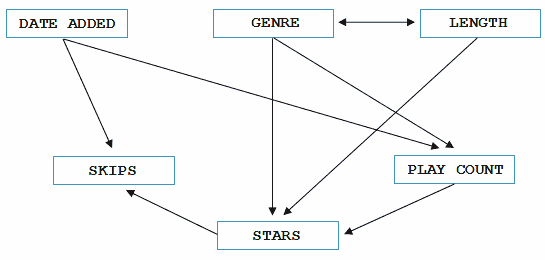
This is the initial model I proposed. The one-way arrows indicate causal relationships (e.g., there is a causal relationship in my proposed model between the genre of a song and the number of stars it has), the double-headed arrow indicates a general correlation without direction. Oh, and “genre” was coded with numbers 1 through 11, with lower numbers indicating my least favorite genres and higher numbers indicating my favorite genres. Important for later.
Using robust maximum likelihood estimation (because of severe nonnormality), I tested this model in terms of its ability to describe the covariance structure evident in the sample (which, in this case, is the 365 songs I downloaded last year).
So here’s what we got!
Satorra-Bentler scaled χ2(7) = 9.68, p = 0.207
Robust CFI: .992
Robust RMSEA: .032
Average absolute standardized residual: 0.0190
All these stats indicate a pretty awesome fit of the model to the data. This is shocking, considering ridiculous non-normality in the data itself and the fact that this is the first model I tried.
Here are the standardized pathway values (analogous to regression coefficients, so if you know what those mean, you can interpret these), with the significant values marked with asterisks:
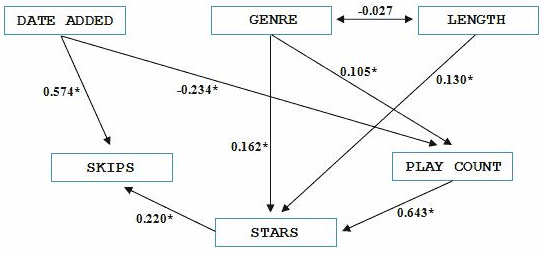
So what’s this all mean? Well, in general, the relationships I’ve suggested with this model are, according to the stats, a good representation of the actual relationships existing among the variables in real life. Specifically:
– There is a significant positive relationship between genre and play count, which makes sense. Songs from my more preferred genres are played more often.
– There is a strong positive relationship between play count and stars, which also obviously makes a lot of sense.
– The significant negative relationship between date added and play count makes sense as well; the more recently downloaded songs (those with high “date added” numbers) have been played less frequently than older songs.
– There is no significant correlation between genre and song length, which surprises me.
– Genre, length, and play count all have significant, direct effects on how many stars I give a song.
– Another interesting finding is the positive relationship between stars and skips, which suggests that the higher number of stars a song has, the more often it is skipped. Perhaps this is just due to the sheer number of times I play the higher-starred songs. Who knows?
Yay! Fun times indeed.

 Eigenblogger
Most people I know will ignore sleep, lock themselves in their apartment/house and drink a lot of caffeine while obsessing over Something that others may see as odd to relax. It’s good to have something that is fun.
Also, cool model. Even though I don’t understand a lot of the higher lever stats stuff, it is fun to see the results.
LikeLike