Top Books of 2023 (LIES IT’S ALL LIES)
Yo.
So I had every intention of doing a “Top Five Books I Read in [insert previous year here]” thing like I’ve done the past several years. But…
a) I only read 12 (?!) books this year, and
b) Nothing even remotely compares to War and Peace.
I’m not kidding. I can’t make a “top five” list because all the other books are all at the same-ish level and War and Peace stands mountains above them all. I guess maybe Andersonville is a bit higher than the others, but still. A “top two” list? Nah.
War and Peace is my “top books” from last year.
Fight me.
Book Review: War and Peace (Tolstoy)
Have I read this before: Technically, yes. I read it in either 7th or 8th grade because the kid I liked was reading it and I wanted to be like him. Or with him. Or better than him. It was complicated. Anyway, I finished it and he didn’t but I’ll be damned if I remembered anything other than one of the characters being named Pierre. Note that I discuss my history with this book in this blog post, so you may want to read that first. You know, if you actually care.
Anyway.
Review: Where do I even start with this? Do I start with how there are about 80 characters but they’re all written so distinctly and thoroughly that you truly get a sense of their different personalities and backgrounds? Do I start with the fact that I knew approximately NOTHING about the Napoleonic Wars going into this thing but now all I want to do is read about that period in history in even more detail than it’s described in War and Peace? Do I start with the way Tolstoy portrays how the war effects everyone – especially the young people – is simultaneously so subtle and so blatant that you get both the “during” and “after” perspectives of this chunk of history? Can I talk about how great this particular translation is, because it certainly doesn’t even sound like a translation and sounds like you would suspect Tolstoy wrote it to sound?
WHERE DO I START
I loved this book, friends. Absolutely loved it. It’s been quite a while since a book was that engaging for me (probably not since Lonesome Dove, and before that it had been even longer). I know it’s a massive tome, but if you haven’t read it yet, READ IT.
READ.
IT.
It will capture your soul.
Hell, I don’t even know if I want to read another book for a while. What could compare to this, honestly?
Favorite Part: Again, where do I start? I just checked my Kindle and I have a ton of pages bookmarked for quotes, incidents, and descriptions that I especially liked.
Some are funny, like Bilibin’s discussion of the generals:
“Except for your man Kutuzov, every single column is commanded by a non-Russian. Look at the commanders: Herr General Wimpfen, le comte de Langeron, le prince de Liechtenstein, le prince de Hohenlohe, and then there’s Prshprshprsh-all-consonants-and-no-vowels – like all Polish names.”
Or Pierre thinking he’s destined to destroy Napoleon single-handedly because he did some stuff with numbers and found out their names were the same numerically.
“If you use this system to write out the words l’empereur Napoleon numerically, the sum of the letter-numbers comes to 666 (allowing 5 for the e omitted from le), which makes Napoleon the beast prophesied in the Apocalypse.”
…
Once he applied the system to his own name in its French version, ‘Comte Pierre Besouhof”, but the total was miles out. He changed the spelling, substituting z for s, added de and the article le, but he still couldn’t get what he wanted. Then it occurred to him that if the answer he was looking for was to be found in his name, surely his nationality ought to be mentioned as well. He tried Le russe Besuhof and this came to 671, only five too much and 5 was the value of e, the letter dropped from the definite article in l’empereur Napoleon. Dropping the e again (quite unjustifiably) Pierre got the answer he was after in the phrase l’russe Besuhof – exactly 666! This discovery shook him.”
That’s hilarious.
Many of them are the beginnings of long stretches of philosophical discussion about war (way too long to type here). Especially near the end, Tolstoy interjects every several chapters or so with a chapter dedicated to some sort of philosophical examination of some aspect of war, the character of man, history’s interpretation of events, etc.
There are also parts that I wouldn’t have gotten as much out of if I wasn’t learning French:
“He kissed her hand and called her vous and Sonya. But their eyes when they met were on tu terms and they shared a tender kiss.”
Also, a completely unintentional hilarity was included since the translator (or Tolstoy himself, I’m actually not quite sure) included a “Summary of Chapters” section in which every single chapter gets a one- or two-sentence summary. Some of the summaries are hilarious just because they make no sense unless you know how the chapter is structured (is it part of the plot or is it a “Tolstoy Philosophy Power Hour” section? Or both?). Best example: “Alexander renounces power. Why do bees exist? For no single reason.”
Rating: 9/10. This is in my Top Five.
Let’s get PHYSICAL
And by “physical” I mean “a physical copy of War and Peace.”
It’s here and it’s enormous.
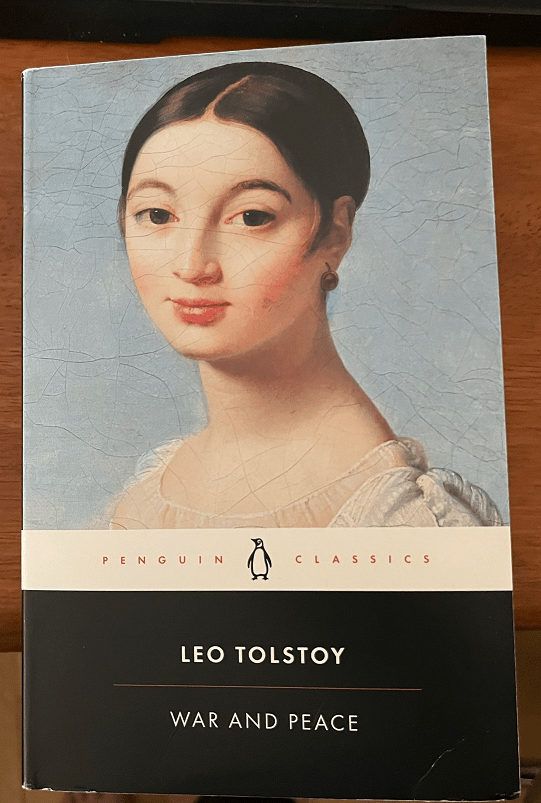
I can’t wait to finish it, but at the same time, I don’t want to finish it, because what the hell can follow this book?
So I’m reading War and Peace and MAN
I got NOTHING out of this when I read it the first time.
I suppose story time is in order, here.
Back in 7th grade I made a list of about 150 “classics” that I wanted to read. My current “250 Books” list is an extension of that original list. I don’t know why I made this list – I probably just wanted to look smart – but I started working through it immediately, selecting books that our junior high library had.
One of these books was War and Peace.
Now, I don’t remember if I decided to read it first and then the kid I liked (Lead) decided to read it as well or if he decided to read it and I chose to read it because of that, but somehow we both ended up reading it at the same time. I don’t know where he got his copy, but I had the junior high library’s copy, which was this massive tome of a thing where the text was in two columns on each page (like a dictionary). I took this thing everywhere and read it at every opportunity with the sole goal of just getting through it and showing Lead how smart I was (he actually never did finish it and I did, so that’s kinda cool I guess).
But I remembered NOTHING from it apart from the fact that one of the main characters was named Pierre.
Now in my defense, there ARE a lot of characters in War and Peace and they all have very Russian names. And if you’ve ever read any Russian lit, you’ll know that one dude can be referred to by like seven different names. So that was rough.
Also, I don’t know what translation I had, but I have a feeling it was one of the worse ones. I can’t blame my lack of comprehension entirely on the translation, but it’s worth noting that I was reading other books around this time that were objectively “as hard” or “harder” vocab- and grade-level-wise compared to War and Peace (e.g., Of Human Bondage, As I Lay Dying, The Bridge of San Luis Rey) and had no problems understanding those. So.
Anyway, let this be a gentle prompting to revisit books you read in your youth (especially any of those “classics” that you HAD to read for a certain class) and give them another chance. Perhaps you’ll find something you really enjoy.

 Eigenblogger