NEEEEEEEEEEEERDS! (Actually, Skittles)
Today I found this blog post, which is a follow-up to another blog post talking about how many bags of Skittles would need to be observed before two identical packs (same number of candies, same color distribution) were discovered.
In this follow-up post, the author also looks at the overall distribution of the colors across the packs and finds the following:
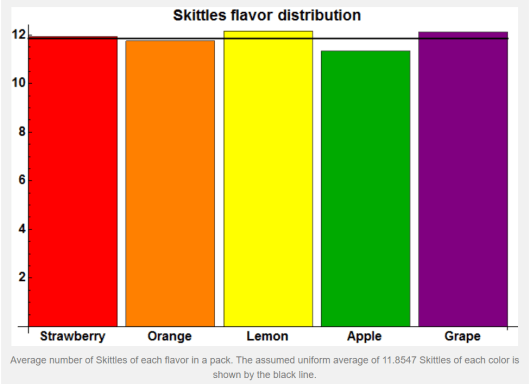
(Image from here)
They remark: “The most common and controversial question asked about Skittles seems to be whether all five flavors are indeed uniformly distributed…I leave it to an interested reader to consider and analyze whether this departure from uniformity is significant.”
Well, I am an interested reader, so here we go.
We’re going to test the claim that the flavors* are uniformly distributed (by stating that the proportions of each of these five flavors are equal) against the claim that the flavors are not uniformly distributed (by stating that at least one proportion differs from the others).

Let’s use p-value = 0.05.
The author has graciously made their data available to the public, so I snagged it up and got the following information:

Applying a chi-square goodness-of-fit test, we get the following results:
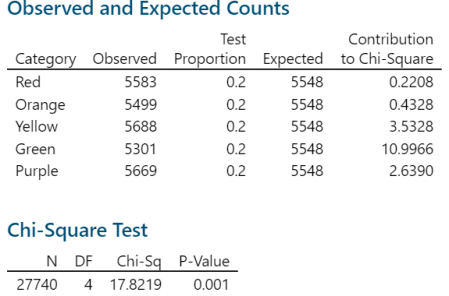
Since our p-value of 0.001 < 0.05, we reject H0 and conclude that at least one of the above proportions differs from the expected 0.20 under the null hypothesis. This means that statistically, the proportions are significantly different.
…I should be getting stuff ready for the end of the semester. Or working on my NaNo. Why did I do this?
*I’m using color rather than flavor, since a) “red” is easier to type than “strawberry” and b) candy flavors such as these are MEANINGLESS TO MY BROKEN NOSE
This Week’s Science Blog is Sweet!
Well this is about the coolest study ever.
Windisch, Windisch, and Popescu (a trio of badass Austrian scientists) wrote a paper detailing the best way to enjoy spherical candies like M&Ms and Skittles.
The researchers placed whole and fractured candies into bowls of tap water (tap water has approximately the same pH as saliva) and mechanically agitated the water slightly to mimic movement in the mouth. They videotaped the candies from above to observe their dissolve rates.
As might be expected, they concluded that to maximize the life of the candy, consumers should try to maintain the candy’s spherical shape for as long as possible. Fracturing the shape increases the surface area, causing the pieces to dissolve faster.
But the best part is their conclusion: “Even though we now know how candies dissolve in time we stress that the best thing to do when eating a candy is to forget about these considerations, since they draw your attention away from what candies are made for: enjoyment.”
Read their paper and stats here.

 Eigenblogger