MOON FAMILY!
So Saturn already held the record in the Solar System for the most moons at 146, but a set of 128 new satellites discovered by a team of astronomers back in 2023 have officially been classified as moons! Saturn now has 274 recognized moons, which is pretty insane. Most of these new moons are extremely small, but still.
Also, I’m just going to leave this here.
(Yes, it’s a SolarBalls episode; yes, I’m still wildly obsessed; yes, it’s relevant because SolarBalls Saturn would probably lose his mind over an additional 128 new moon names to memorize.)
Edit: in searching for a relevant article to this story, I found this NASA article from 1995 talking about the discovery of two to four new Saturnian moon candidates. Back then, the total confirmed number of moons was only 18. Pretty wild!
Aww.
Saturn’s getting a nice bath from Aquarius.

(Yes, I know these celestial objects are incredibly far apart; SHUT UP, IT LOOKS CUTE.)
This Week’s Science Blog: And God Liked It, So He Put a Ring on It
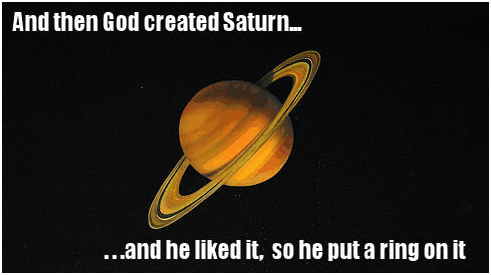
I’ve been waiting for an opportunity to post this picture with some related content for quite some time.
Anyway. Apparently there are tsunamis in Saturn’s rings.
Thirty years ago, NASA’s Voyager 1 probe detected rippling within a portion of the rings, as well as a gap that seemed to be a little larger than 9 miles wide. Today, observations taken from different angles show the gap to be much narrower than this, but have also revealed periods of “peaking,” as if there were obstructions in the gap.
Astronomer Phil Nicholson ascertains that these peaks are most likely slow moving giant ass tsunamis* rippling through the rings, reaching heights of nearly a mile. It turns out that the tsunami action matches the orbital rate of Titan (which circles Saturn once every 16 days), and thus scientists have assumed that the peaks are the result of the ring’s gravitational relationship with Titan.
As the article states, “As Titan orbits Saturn, its gravity likely yanks the section of ring particles that are in resonance with the moon—or moving at the same speed as Titan’s gravitational field.” However, aside from adding some really cool information about the interaction between Saturn’s rings and moons, scientists don’t think that these findings will have any major implications for the studying of Saturn’s rings.
*technical term

 Eigenblogger