brb, sleeping furiously
HELLO PEOPLE!
So today is the closing ceremony of the 2014 Winter Olympics. SADNESS!
This year’s Olympics prompted me to do a little stats project: specifically, I wanted to see if there was any sort of correlation between latitude and the quantity of medals earned in both the summer and winter games.
Now before I show you the results/plots, yes, I know that there are a lot of other factors aside from latitude that affect countries medaling in the games (wealth, government, national/international politics, geography, etc.). In fact, I’m sure that several such factors correlate somewhat with latitude on their own—for example, industrialized nations send waaaay more athletes than less-industrialized/developing nations, and many nations that are considered industrialized just happen to be at higher latitudes…that’s just one example. So take all of this nonsense with a grain of salt, m’kay?
Anyway.
Procedure:
I denoted a country’s latitude by the latitude of their capital city. For example, the US is at latitude 38º53’ N, ‘cause that’s where Washington, D.C. is. I realize that this method of measuring latitude is not so accurate for some countries whose capitals are either at the extreme south or extreme north of the country, but I didn’t want to go by, say, the “average” latitude of a country ‘cause then I would have never finished this freaking thing. So capital latitude it was.
I then consulted the almighty Wikipedia for a table of the number of medals won by country in both the summer and winter games (and within both, the total number of gold, solver, and bronze). So medal counts + latitude = my dataset!
Analyses:
First things first: correlations!
- Correlation between latitude and the number of medals won overall: 0.374
- Correlation between latitude and the number of medals won in the summer games: 0.353
- Correlation between latitude and the number of medals won in the winter games: 0.393
The above correlations do not take into account the fact that some countries have participated in almost every Olympic games (like the US) and some have participated in like four or five of them. So I made a new set of variables that took that into account. I took the ratio of the number of medals won to the number of games participated in (so they’re kind of a “how many medals per Olympics” set of variables). I did this for the summer and winter games separately as well as “overall.” The “adjusted” correlations were:
- Correlation between latitude and the number of medals won overall: 0.397
- Correlation between latitude and the number of medals won in the summer games: 0.390
- Correlation between latitude and the number of medals won in the winter games: 0.411
So not too much of a change, especially for the winter games.
(One other correlation to note when looking at the above results: the correlation between latitude and the total number of games participated in is 0.609)
Now let’s look at some graphs!
This first one shows medal count by latitude, split by type (gold, silver, bronze) for the summer games:

(Note that countries who haven’t won a medal are not plotted; those values that look like “zero” are actually indicating that one medal of that respective color has been won.)
(Another note: these are “absolute” latitudes, meaning that I’m not distinguishing between degrees north vs. degrees south; I’m really just interested in how far away from the equator countries are.)
This second one shows medal count by latitude, split by type (gold, silver, bronze) for the winter games:
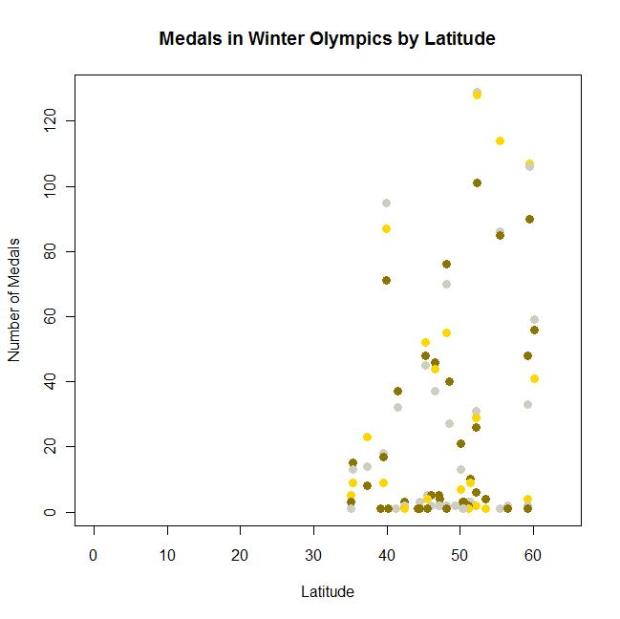
Also, I didn’t catch this until after I made the graphs (and am too lazy to go back and fix it), but notice the difference in the scales of the y-axes for summer vs. winter.
Anyway.
Cool, huh?

 Eigenblogger