Common Curta-sy
“WTF is a Curta?” you may be asking.
I’ll tell you!
The Curta is a little handheld mechanical calculator introduced in 1948 by Austrian engineer Curt Herzstark (so I guess “Curta” was an easier name than “Herzstarka”). Real-life ones look like THIS (source for pic)…

…and were considered the best portable calculators until the digital ones started coming out in the 1970s.
Its design is based in part off of…(wait for it)…Leibniz’ Step Reckoner. It is able to do addition, subtraction, multiplication, division, and also square roots. What made it different from contemporary calculators was, though it employed a stepped drum mechanism like most others, Herzstark was able to create and patent a single drum that did the work of 10+ drums, thus making the Curta super compact.
I wanted to get a real one, but they’re like $400 now, so this simulator was a cool find. If you want to get all up in the Curta’s business but are intimidated by all the arrows/dials (it’s like a slide rule on steroids!), check out this manual.
Claudia’s Alternate History Party
GUYSGUYSGUYSGUYSGUYS I’m hyper.
You know what I would love to do (even though it would screw history and the rest of existence up because that’s how these things work)? I would love to take a graphing calculator and a calculus textbook, go back in time, and show them to Leibniz.
“Look!” I’d say. “See this little itty bitty machine? Look at all this nonsense it can do! Not only can I add, subtract, multiply, and divide in a fraction of a second, I can also find square roots, sines, cosines, and tangents, and GRAPH FUNCTIONS! This is your Step Reckoner on steroids. YOU helped pioneer this! EVERYBODY uses these now.
“And look at this textbook. This is what we use to teach calculus to people today. Let me show you some of these symbols. See what we’re using? dy/dx! And the elongated S! We’re still using YOUR symbols because they remain the clearest, easiest, most adaptable ones for this branch of math. AND THIS COMING FROM THE FAR-OFF YEAR OF 2013!!”
Ignoring the whole “somebody just time-traveled!” aspect, I think the calculator would really be the thing that would blow his mind. I mean, the Step Reckoner was massive and it just did the four basic operations. Plus, you know, the fact that the calculator now has this crazy-ass digital display thing. I’d totally help him take it apart and do the best I could explaining what the components were.
Of course I’d probably end up having to lean in reeeeeeeally close to him to do that.
Y’know.
TWSB: Water, Water (Used) Everywhere
We all know the whole “carbon footprint” thing, right? The amount of greenhouse gas emissions caused by an individual via things like transport, food production, fuel, housing, etc.? Yeah, that.
Well today I stumbled upon a website that allows you to calculate your water footprint. Again this is exactly as it sounds and, in my opinion, is even scarier in terms of the freakish amount a single human requires.
Here is the calculator I used, and here are my results:
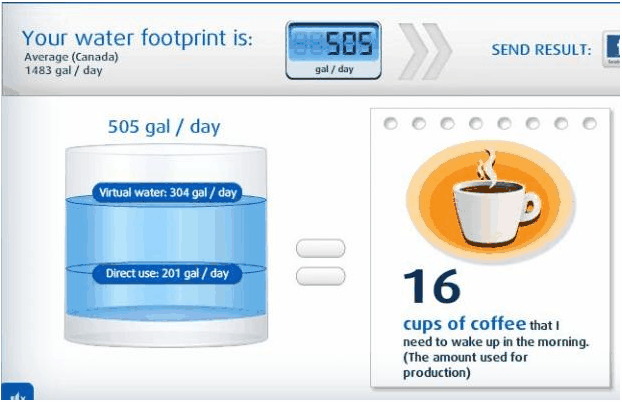
According to Wikipedia, the global average footprint is 1,240 cubic meters of water per person per year. That’s 1,240 metric tons, or 2,733,704 pounds of water.
That is ridiculous.
The United States, of course has the largest average water footprint in the world (2480 cubic meters), while China has the smallest at 700 cubic meters.
What’s your water footprint, ladies and gents?

 Eigenblogger