Blog 660: Leibniz, Leibniz, Leibniz! (Get out of my pool!)
OH.
MY.
GOD.
You all know my love of Voltaire and his absolutely brilliant novella Candide, correct? Of course you do. If you didn’t by this point I’d be seriously disturbed.
Well anyway.
You all know (maybe) that the main target of Voltaire’s satire was Gottfried Leibniz’ philosophy, particularly his now infamous claim that we live in the best of all possible worlds (Pangloss in Candide preached this philosophy throughout the whole book, you may recall).
Let me tell you something: you have not LIVED until you actually sit down and READ Leibniz, particularly his Discourse on Metaphysics. The thing is so absolutely ridiculous and nonsensical that it is quite possibly the best piece of philosophical work in existence.
Let me elaborate:
God is an absolutely perfect being who has metaphysical and moral perfection, according to Leibniz. That is, he has perfect power and knowledge and does everything for the best. He criticizes Descartes and Spinoza respectively for putting subordinate to god’s will his intellect and putting subordinate god’s intellect to his will. Leibniz says that god’s will and intellect are both substantial and perfect; thus, it is not possible for god’s will to be indifferent, and because he has moral perfection, it is incompatible for god not to have chosen the best things in the world in which we live (and we are driven to assume that this is the best of all possible worlds because of this).
This is all well and good, in my opinion. Leibniz still sounds rather rational in comparison to Spinoza (freaking Spinoza…).
Just wait.
To leave us simply with this definition of god is rather inadequate. Therefore, Leibniz further develops his ideas as the Discourse goes on. He next goes on to establish what he believes to be the way that god interacts with the substances—namely, us humans. Leibniz labels us all as individual “substances”—things created by and subsequently put into harmony with one another by god. He kind of relates this to Aristotle’s ideas of the primary substance, which I won’t really get into save to say that Leibniz elaborates on it a little further—he states that we—each of us, individually—are individual substances and “complete beings.” Ourselves, our substances, include our entire history and our future of everything that has occurred or will occur to the substance (us). Basically, we’re everything that we’ve ever done, everything we’ve ever experienced, everything we’ll ever do, and everything we’ll ever experience. We cannot know about our substances a priori, but god can. Thus, god sees from every individual substance’s viewpoint (every individual human) all at once, and all their lifespan can be seen at once by him.
That’s still okay, pretty much, right?
Okay.
Now imagine this scenario: I walk up to you tomorrow and give you a good slap on the cheek. Common sense would tell us that the substance that is “I” just hit the substance that is “you,” right? In other words, two substances just interacted, correct?
Not to good ol’ Leibniz!
There are no interactions between substances, he says. Substances are entirely independent of each other. Each is simply a perspective on the entire universe that is free of any influence of any other substance. But then how on earth, you may be asking yourself, does it appear that we substances interact with each other on a daily basis?
Simple!
Remember when I said Leibniz felt that god could know every individual’s substance in its entirety, from way back at the beginning of its history to the moment it dies? And remember how he said god could see every single substance’s perspective?
This is where Leibniz makes the claim of the century: because of god’s ability to see everybody’s history and future, he can essentially “align” everybody’s what I’m going to call “linear time and action paths” (pretty cool-sounding, eh?) so that it appears that subjects are interacting.
So remember when I said imagine me giving you a good slap to the cheek a few paragraphs ago? Yep, god planned for that. He “saw it coming,” I guess you could say, and “aligned” our two linear time and action paths so at the very moment when my substance (“me”) was making a move as if to slap, your substance (“you”) feels as if they were just slapped. All without no interactions between substances whatsoever!
This freaking blows my mind for several reasons:
1) I’m actually shocked more satires weren’t produced off of this guy. I mean, Candide didn’t even touch this “god pulls on the matrix of life so that everything’s lined up perfectly and we’re all kept in this illusion that we’re actually interacting” thing.
2) Why in the world is this guy even in our repertoire of “famous philosophers we should study”? Why is this horribly fantastical philosophy still even considered? Is it because it’s such an epic failure? Seriously, the thing has a “WTF” factor to rival scientology. In fact, it may surpass scientology. Observe:
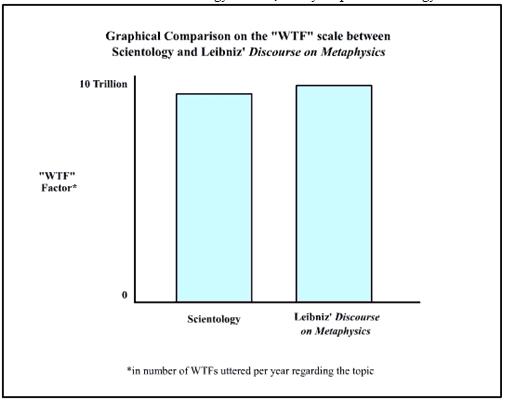
3) This was the one and only cartoon-worthy thing I could think of. I’m disappointed in myself. It’s so dumb.

Leibniz, I freaking love you, man. I’m totally adopting your philosophy as my religion. Leibnizm.
He is now the frontrunner in “the philosopher Claudia is going to dress up as” for my little party. And he edges out Voltaire only because he’s primarily considered a philosopher and Voltaire’s primarily a writer/satirist/sexy man.

 Eigenblogger