Book Review: For Whom the Bell Tolls (Hemingway)
Have I read this before: Yes! I read this during the summer of 2008. I remember reading it in the Wallace basement during our breaks on that U of I cleaning job.
Review: I vaguely remember that this book’s ending making me cry the first time I read it. It didn’t provoke that reaction at all this time, but it was still an impactful ending. And my opinion of any given book is heavily swayed by its ending. A Handmaid’s Tale? Not a fan, strictly because I hated the ending. A Prayer for Owen Meany? It was good throughout, but the ending nailed it for me and made it one of my favorite books. The ending didn’t “make” this one for me, but it was a good ending and it was a memorable book. I like Hemingway in general.
Favorite Part: Probably the ending, hahaha.
Rating: 6/10
Clubby-Sitters Babe
So a few weeks ago I mentioned that I wanted to intersperse my classics reading with some books from my childhood. And a HUGE series for me as a kid was the Baby-Sitters Club series. My favorite character was always Claudia because a) same name! and b) she was artistic and wore funky, artsy clothing. But I remember liking all of the characters.
So I decided that some (or a good portion of) my “childhood books” list will be all the Baby-Sitters Club books I can get in Kindle version.
Which turns out to be…all of them?
Nice.
I’m not reading them in order, but that’s okay. I’ll probably start with some of the Claudia-centric ones and branch out from there.
Woo!
BOOK ‘EM, DANNO
Yo.
So thanks to my Kindle, I’ve been burning through my original “200 Books” list quite rapidly, to the point where not too long ago I turned it into a “250 Books” list.
I’ve updated it again!
It now contains 300 books. Because.
Take a look here.
I’ve also decided to color my top five books on that page just so that random passers-by know that The Caine Mutiny is the best goddamn book ever my literary preferences.
Bye.
A Confession:
If you were to take a look at the books on Kondle (my Kindle, in case anyone forgot. Yes, he has a name. Eat it.), you would no longer find just classics.
Instead, you would also find several children’s books that were popular in the early- to mid-1990s.
Why?
Because I’ve been in major “book nostalgia” mode and have been wanting to re-read books that I remember from my childhood.
So I’ve decided to intersperse my classics with said childhood books. First up is A Wrinkle in Time, which I think was read to us by our teacher (Mrs. Lohrmann) in sixth grade.
Do you have any stand-out books from your childhood? Let me know, ‘cause maybe I read them too and am just forgetting them, haha.
Book Review: Don Quixote (de Cervantes)
Have I read this before: Nope.
Review: Okay, so I knew nothing about this book other than there was something in there involving windmills and that the word “quixotic” came from it. So I didn’t know what to expect going into it, which made it so much better.
Parts (swaths) of this are absolutely hysterical. It’s easy to feel badly for Don Quixote ‘cause the dude’s delusional, but it’s hard to feel bad for Sancho Panza because he’s in full possession of his faculties but keeps following Don Quixote around EVEN THOUGH THEY ALL GET BEATEN UP LIKE EVERY FIVE PAGES. Y’all should read it if you haven’t. It’s a classic for a reason.
Favorite Part: Like I said, parts of this are absolutely hilarious.
1. Sancho Panza being like “are you absolutely nuts?” when Don Quixote starts charging “knights” – and they’re actually sheep:
Sancho called to him, saying:
“Your grace, come back, Senor Don Quixote, I swear to god you’re charging sheep! Come back, by the wretched father who sired me! What madness is this?”
2. That whole scene when Sancho and Don Quixote puke all over each other.
3. Andres wanting absolutely nothing to do with Don Quixote because misfortune follows him everywhere:
It is certainly true that when he left, he said to Don Quixote:
“For the love of God, Senior Knight Errant, if you ever run into me again, even if you see them chopping me to pieces, don’t help me and don’t come to my aid, but leave me alone with my misfortune; no matter how bad it is, it won’t be worse than what will happen to me when I’m helped by your grace.”
4. When Don Quixote stabs the hell out of a bunch of wine skins while asleep, destroying them all, thinking that they’re parts of a giant.
5. When he absolutely demolished Master Pedro’s puppets because he thought they were real.
Rating: 7/10
Top Books of 2023 (LIES IT’S ALL LIES)
Yo.
So I had every intention of doing a “Top Five Books I Read in [insert previous year here]” thing like I’ve done the past several years. But…
a) I only read 12 (?!) books this year, and
b) Nothing even remotely compares to War and Peace.
I’m not kidding. I can’t make a “top five” list because all the other books are all at the same-ish level and War and Peace stands mountains above them all. I guess maybe Andersonville is a bit higher than the others, but still. A “top two” list? Nah.
War and Peace is my “top books” from last year.
Fight me.
Book Review: A Christmas Carol (Dickens)
Have I read this before: Nope! I’ve seen all the standard movie adaptations, though.
Review: So the adaptation that I had in my mind going into this book was the Muppet version, so as was the case when I read Treasure Island, all the characters had their respective Muppet/human voices as they spoke in the book. I was actually surprised at how much of the narration (especially at the start of the book) and dialogue was honored in the adaptations I’ve seen, but I guess that’s part of the classic tale.
Favorite Part: Stave Three, where we follow Scrooge and the Ghost of Christmas Present. I always liked the idea of the Ghost of Christmas Present having such a short life because he only exists in the present and another “present” is always on the horizon.
Rating: 7/10
Book Review: Andersonville (Kantor)
Have I read this before: No. I know we had the book in our junior high library, though, and I considered it during those very first few months of using my Book List. Never did read it, though.
Review: Oof. This book. This was a hard read because basically every chapter was “here’s this soldier’s life from birth until he gets to Andersonville. Get invested in him, he’s interesting. Oops, now he’s died the most horrible death imaginable!”
Of course there was a main storyline threading through the whole thing, but that’s what a majority of this book felt like.
It was very well-written. Very impactful. You don’t really think about those types of prison conditions in the US, even back then, but the real Andersonville Prison was probably even worse than in these fictionalized tales.
Favorite Part: the interaction between Coral and Naz near the end. That whole segment of the book was the most emotional part, in my opinion, because of everything building up to it and how so much of their relationship was built wordlessly and was based on their circumstance and histories instead. Easily the most memorable part of a very memorable book.
Also, these few lines (which was pretty much the only humor in the whole book) between Coral and Naz.
“What’s them?”
“From tropic lands. From many an ancient river, from any a palmy plain.”
“Hain’t you smart with your rhymes and truck!”
“It’s a hymn.”
“Don’t care if it’s a her.”
Rating: 6/10
Take a Look / Don’t Date a Book
I just realized that unless the weather gets SUPER CRAPPY over the next month or so, the number of books I will have read this year will be really low.
Because yes, I only ever read (fiction) when I’m on the treadmill.
So maybe we won’t get a “Top 5” list for this year, but I’ll at least give a Top 3.
Book Review: War and Peace (Tolstoy)
Have I read this before: Technically, yes. I read it in either 7th or 8th grade because the kid I liked was reading it and I wanted to be like him. Or with him. Or better than him. It was complicated. Anyway, I finished it and he didn’t but I’ll be damned if I remembered anything other than one of the characters being named Pierre. Note that I discuss my history with this book in this blog post, so you may want to read that first. You know, if you actually care.
Anyway.
Review: Where do I even start with this? Do I start with how there are about 80 characters but they’re all written so distinctly and thoroughly that you truly get a sense of their different personalities and backgrounds? Do I start with the fact that I knew approximately NOTHING about the Napoleonic Wars going into this thing but now all I want to do is read about that period in history in even more detail than it’s described in War and Peace? Do I start with the way Tolstoy portrays how the war effects everyone – especially the young people – is simultaneously so subtle and so blatant that you get both the “during” and “after” perspectives of this chunk of history? Can I talk about how great this particular translation is, because it certainly doesn’t even sound like a translation and sounds like you would suspect Tolstoy wrote it to sound?
WHERE DO I START
I loved this book, friends. Absolutely loved it. It’s been quite a while since a book was that engaging for me (probably not since Lonesome Dove, and before that it had been even longer). I know it’s a massive tome, but if you haven’t read it yet, READ IT.
READ.
IT.
It will capture your soul.
Hell, I don’t even know if I want to read another book for a while. What could compare to this, honestly?
Favorite Part: Again, where do I start? I just checked my Kindle and I have a ton of pages bookmarked for quotes, incidents, and descriptions that I especially liked.
Some are funny, like Bilibin’s discussion of the generals:
“Except for your man Kutuzov, every single column is commanded by a non-Russian. Look at the commanders: Herr General Wimpfen, le comte de Langeron, le prince de Liechtenstein, le prince de Hohenlohe, and then there’s Prshprshprsh-all-consonants-and-no-vowels – like all Polish names.”
Or Pierre thinking he’s destined to destroy Napoleon single-handedly because he did some stuff with numbers and found out their names were the same numerically.
“If you use this system to write out the words l’empereur Napoleon numerically, the sum of the letter-numbers comes to 666 (allowing 5 for the e omitted from le), which makes Napoleon the beast prophesied in the Apocalypse.”
…
Once he applied the system to his own name in its French version, ‘Comte Pierre Besouhof”, but the total was miles out. He changed the spelling, substituting z for s, added de and the article le, but he still couldn’t get what he wanted. Then it occurred to him that if the answer he was looking for was to be found in his name, surely his nationality ought to be mentioned as well. He tried Le russe Besuhof and this came to 671, only five too much and 5 was the value of e, the letter dropped from the definite article in l’empereur Napoleon. Dropping the e again (quite unjustifiably) Pierre got the answer he was after in the phrase l’russe Besuhof – exactly 666! This discovery shook him.”
That’s hilarious.
Many of them are the beginnings of long stretches of philosophical discussion about war (way too long to type here). Especially near the end, Tolstoy interjects every several chapters or so with a chapter dedicated to some sort of philosophical examination of some aspect of war, the character of man, history’s interpretation of events, etc.
There are also parts that I wouldn’t have gotten as much out of if I wasn’t learning French:
“He kissed her hand and called her vous and Sonya. But their eyes when they met were on tu terms and they shared a tender kiss.”
Also, a completely unintentional hilarity was included since the translator (or Tolstoy himself, I’m actually not quite sure) included a “Summary of Chapters” section in which every single chapter gets a one- or two-sentence summary. Some of the summaries are hilarious just because they make no sense unless you know how the chapter is structured (is it part of the plot or is it a “Tolstoy Philosophy Power Hour” section? Or both?). Best example: “Alexander renounces power. Why do bees exist? For no single reason.”
Rating: 9/10. This is in my Top Five.
Mes livres de français sont arrivés !
Yay!

One is (obviously) a French-English dictionary; the other is a book on conjugating French verbs.
Apprendre le français est agréable !
Let’s get PHYSICAL
And by “physical” I mean “a physical copy of War and Peace.”
It’s here and it’s enormous.
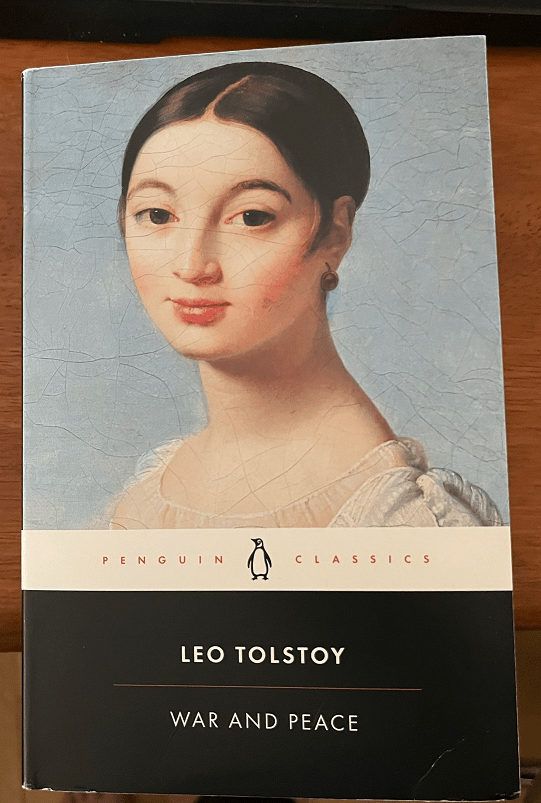
I can’t wait to finish it, but at the same time, I don’t want to finish it, because what the hell can follow this book?
So I’m reading War and Peace and MAN
I got NOTHING out of this when I read it the first time.
I suppose story time is in order, here.
Back in 7th grade I made a list of about 150 “classics” that I wanted to read. My current “250 Books” list is an extension of that original list. I don’t know why I made this list – I probably just wanted to look smart – but I started working through it immediately, selecting books that our junior high library had.
One of these books was War and Peace.
Now, I don’t remember if I decided to read it first and then the kid I liked (Lead) decided to read it as well or if he decided to read it and I chose to read it because of that, but somehow we both ended up reading it at the same time. I don’t know where he got his copy, but I had the junior high library’s copy, which was this massive tome of a thing where the text was in two columns on each page (like a dictionary). I took this thing everywhere and read it at every opportunity with the sole goal of just getting through it and showing Lead how smart I was (he actually never did finish it and I did, so that’s kinda cool I guess).
But I remembered NOTHING from it apart from the fact that one of the main characters was named Pierre.
Now in my defense, there ARE a lot of characters in War and Peace and they all have very Russian names. And if you’ve ever read any Russian lit, you’ll know that one dude can be referred to by like seven different names. So that was rough.
Also, I don’t know what translation I had, but I have a feeling it was one of the worse ones. I can’t blame my lack of comprehension entirely on the translation, but it’s worth noting that I was reading other books around this time that were objectively “as hard” or “harder” vocab- and grade-level-wise compared to War and Peace (e.g., Of Human Bondage, As I Lay Dying, The Bridge of San Luis Rey) and had no problems understanding those. So.
Anyway, let this be a gentle prompting to revisit books you read in your youth (especially any of those “classics” that you HAD to read for a certain class) and give them another chance. Perhaps you’ll find something you really enjoy.
Book Review: Treasure Island (Stevenson)
Have I read this before: No.
Review: It was impossible to read this without hearing each character in the voice of the Muppet (or human) who voiced them in Muppet Treasure Island. Captain Smollett? Kermit. Mr. Arrow? Sam Eagle. Long John Silver? Tim Curry. Squire Trelawny? Fozzie. I was actually surprised at how closely Muppet Treasure Island followed the actual book. I realize this is more of a review of Muppet voices than anything, haha, but I did enjoy the book! Needs this scene, though.
Favorite Part: Ben Gunn. He was an enjoyable character.
Rating: 6/10
Book Review: The Mill on the Floss (Eliot)
Have I read this before: No.
Review: Of the George Eliot works I’ve read, this is probably my least favorite. I didn’t hate it, but the characters weren’t as engaging as those in Silas Marner or Adam Bede. In some parts Maggie is insufferable (but isn’t that the case for all of us?), but her secret relationship with Philip was genuine and sweet. I also like how she almost seems to “lose her way” given her circumstances, but comes back to her senses despite the consequences she must face. I felt a lot of sympathy for Tom, too.
Favorite Part: I loved Maggie’s and Philip’s walks in the woods. Like I said, that felt like the most genuine and interesting part of the story to me.
Rating: 6/10
Book Review: Lorna Doone (Blackmore)
Have I read this before: Okay, I SWEAR TO GOD I’ve read this before. I distinctly remember propping the U of I Library’s copy up on the elliptical machine at the rec center back in, like, 2007. I swear. But I did NOT remember this book at all, apparently. So.
Review: This is a long-ass book for a relatively simple plot, in my opinion. It meanders all over the damn place at the start with little John Ridd, but I guess it kind of has to in order to set up his back story and socio-economic status. And there’s surprisingly little Lorna Doone for the first portion of the book given that the story is named after her. I guess we get a bunch of her later in the book, though. Am I bad for picturing the Doones like Cletus and his family from The Simpsons?
Favorite Part: This freaking duck part. It sticks out so much from the rest of the book, hahahaha:
“Thereupon Annie and I ran out to see what might be the sense of it. There were thirteen ducks, and ten lily-white (as the fashion then of ducks was), not I mean twenty-three in all, but ten white and three brown-striped ones; and without being nice about their color, they all quacked very movingly.
…
Annie began to cry ‘Dilly, dilly, einy, einy, ducksey,’ according to the burden of a tune they seem to have accepted as the national duck’s anthem; but instead of being soothed by it, they only quacked three times as hard, and ran around till we were giddy.
…
Therefore I knew at once, by the way they were carrying on, that there must be something or other gone wholly amiss in the duck-world.”
(It’s just so freaking random)
Rating: 5/10
Book Review: The Good Soldier (Ford)
Have I read this before: No? This is one of those books that feels super familiar, but I’m not sure if I’ve actually read it, haha. If I have, though, it would have been back at the very start of using my list given how vague my memory is of it (so like 7th grade).
Review: I love the opening line of this book: “This is the saddest story I have ever heard.” Instant hook. There’s so much going on with each of these characters under the surface and so much deception amongst them that it’s almost hard to keep track of it all. I like how even the Wiki article describes the narrator as follows: “he is either a gullible and passionless man who cannot read the emotions of the people around him or a master manipulator who plays the victim.”
Favorite Part: This beautiful line:
“And it was a most remarkable, most moving glance, as if for a moment a lighthouse had looked at me.”
That’s just…that’s so simple and beautiful.
Rating: 5/10
Book Review: Waiting for Godot (Beckett)
Have I read this before: Yes. Couldn’t tell you when, but I’ve read it before.
Review: I…I didn’t enjoy this as much as I remember enjoying it the first time. I remember being much more amused and intrigued when I read it before; this time I was not as invested. I don’t know why. Maybe I had built the story up in my mind to be more than it actually is. Who knows.
Favorite Part: One thing I did still like was the pacing. This moves along at a good clip but, at the same time, seems to not move at all due to where the play is set and how little actual motion occurs during it. It’s an interesting contrast and makes things more interesting.
Rating: 5/10
Book Review: Travels with Charley (Steinbeck)
Have I read this before: No.
Review: This is Steinbeck + dog Charley traveling across the US in a camper. It’s basically the great American road trip with a lot of reflection about the state of America and the American people. He makes sure to note the differences in the people and cultures from state to state, especially as he hits the Midwest and then the West. It’s a summary of the flaws of a country and its people from someone who’s really good at describing the flaws of a country and its people.
Favorite Part: A few good quotes:
“I have always heard that Maine people are rather taciturn, but for this candidate for Mount Rushmore to point twice in an afternoon was to be unbearably talkative.”
After getting a flat tire: “It was obvious that the other tire might go at any moment, and it was Sunday and it was raining and it was Oregon. If the other tire blew, there we were, on a wet and lonesome road, having no recourse except to burst into tears and wait for death.”
“Americans are much more American than they are Northerners, Southerners, Westerners, or Easterners. And descendants of English, Irish, Italian, Jewish, German, Polish are essentially American. This is not patriotic whoop-de-do; it is carefully observed fact. … It is astonishing that this has happened in less than two hundred years and most of it in the last fifty. The American identity is an exact and provable thing.”
Rating: 6/10
Book Review: Sons and Lovers (Lawrence)
Have I read this before: No.
Review: Can a novel include a normal, healthy relationship or is that too boring? Of course, this is the guy who wrote Lady Chatterley’s Lover, so. Paul’s relationship with his mother is the most co-dependent relationship I’ve read about in a long time. I should shut up because I’m super close to my mom too, but not in the oddly terrifying way he is. It’s a pretty sad book if you think about it.
Favorite Part: Pauls’ thoughts on his lover Clara:
“’What is she, after all?’ he said to himself. ‘Here’s the seacoast morning, big and permanent and beautiful; there is she, fretting, always unsatisfied, and temporary as a bubble of foam. What does she mean to me, after all? She represents something, like a bubble of foam represents the sea. But what is she? It’s not her I care for.’”
Rating: 5/10
Best Books: 2022 Edition
I read 29 books last year! Now it’s time to pick the top five. From fifth best to best.
#5: The Grapes of Wrath (Steinbeck)
I still stand by my claim that if one wishes to read Steinbeck, one should not start with The Grapes of Wrath (especially if you’re young and/or have a short attention span). It is sloooooooooow at the start. But once things start to pick up and everyone gets on the move, the pacing gets a lot better and it’s much easier to get invested in the characters. Also, the ending is heartbreaking.
#4: The World According to Garp (Irving)
This is not as good as A Prayer for Owen Meany (because that book’s climax is the most perfect climax I’ve ever read), but it displays Irving’s wonderful ability of creating characters that are simultaneously boring and quirky and his ability of making you care about said characters even before you realize you do.
#3: A Confederacy of Dunces (Toole)
This was probably the weirdest book I’ve read on my list. I feel like Ignatius is what Boomers think all Millennials are like (even though this was written in 1980, before the first Millennials were even born). Ignatius is obnoxious but oddly charming in a weird way, and reading about his thoughts, adventures, and how he interacts with others was entertaining.
#2: Breakfast of Champions (Vonnegut)
Vonnegut has such a specific style and sense of humor, and of all the works of his that I’ve read so far, I think both the style and humor come out best in this book. It’s also full of little illustrations drawn by Vonnegut and the whole thing has a wonderful rhythm to it as you watch Hoover go more and more insane.
#1: Lonesome Dove (McMurtry)
I mean, was there any doubt? I loved this book, yo. I think Captain Call might be one of my favorite literary characters now, haha. This is another one that starts out slowly, but I honestly didn’t notice it that much because I was immediately engaged with the characters. Check it out if you’ve never read it; you won’t be disappointed.
Book Review: The Razor’s Edge (Maugham)
Have I read this before: Nope.
Review: I enjoyed this one! I like how Larry is introduced via interactions with several different friends, including Maugham himself. I think this paints a very realistic picture of how a person can be affected by war once said war is over. The other characters were enjoyable as well; you feel sympathy for Gray after the stock market crash, you feel frustrated at Isabel’s treatment of Sophie, and you feel sorry for Elliott both due to his own wants and just in general.
Favorite Part: The opening of Part Six:
“I feel it right to warn the reader that he can very well skip this chapter without losing the thread of such story as I have to tell, since for the most part it is nothing more than the account of a conversation that I had with Larry. I should add, however, that except for this conversation I should perhaps not have thought it worthwhile to write this book.”
Rating: 6/10
Book Review: The Quiet American (Greene)
Have I read this before: No.
Review: Greene has an interesting writing style. I definitely liked this one better than The Power and the Glory. It held my attention better, even though I’m not a huge war novel fan. Perhaps it’s the characters and how Fowler expresses a very real range of opinions of Pyle depending on what’s going on around them and between them.
Favorite Part: Fowler’s and Pyle’s conversations when they were stuck in the guard tower and their eventual escape.
Rating: 5/10

 Eigenblogger